Lessons · Lesson 3 of 3
Twist, ply, and the T-shirt that turned
Work out a twist multiplier from a count, read what twist does to strength, feel and output, and diagnose the stored twist that makes a single jersey garment spiral.
Lesson 3 of 3 · 34 min
The situation
A thread is only a thread because it has been twisted. Take the twist away and the fibres slide apart in your fingers. How hard the yarn was twisted is a setting somebody chose on a machine. That setting governs strength, feel, dye depth, spinning speed — and therefore price. This lesson follows that stored twist all the way into a customer's washing machine, where it slowly pulls a T-shirt's side seam around the body.
2 June, 14:40, Nordvik's distribution centre outside Jonkoping. The 24,000 TS-440 tees from PO NV-3318 arrived two weeks ago, and a routine wash test has just closed.
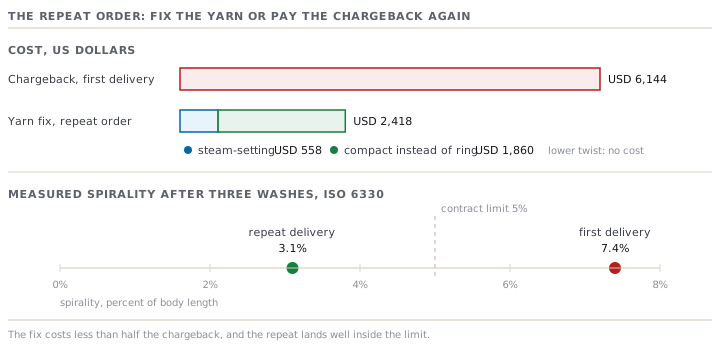
The report is one line long. Spirality after three home laundering cycles to ISO 6330: 7.4 percent, against a contract limit of 5 percent. Spirality means the fabric twists after washing, so the side seams travel around the body. On a body length of 71 cm, 7.4 percent is a side seam that has moved 5.3 cm around the wearer. Anybody can see that with the garment on a hanger. The vendor agreement prices this failure at 8 percent of invoice value: USD 6,144 on an order worth USD 76,800, plus a corrective action report and a repeat inspection on the next delivery.
The garments are perfectly sewn. The fault was decided six months earlier, at a ring frame, in a number that appears on no document anybody on this order ever read.
Twist, and why turns per inch means nothing on its own
Twist is what turns a bundle of loose fibres into a thread. Twisting makes the fibres spiral, presses them against each other, and creates the friction that stops one fibre sliding out from between its neighbours. No twist, no yarn.
Twist is counted as turns per inch, TPI, or turns per metre, TPM. One is 39.37 times the other.
But a bare TPI figure tells you nothing on its own, because a thick yarn needs far fewer turns than a thin one to reach the same tightness. Eighteen turns per inch on a coarse Ne 10 gives a soft, airy yarn. The same eighteen turns on a fine Ne 40 gives a cord. What really describes the yarn is the twist multiplier, sometimes called the twist factor:
TM  = TPI / square root of Ne          TPI = TM x square root of Ne
TPM = TPI x 39.37
The square root is not a trick. How tight a yarn feels depends on the angle the surface fibres make with the yarn's centre line. That angle depends on turns per unit length multiplied by the yarn's diameter — and diameter grows with the square root of mass per unit length. So two yarns at the same TM have the same surface angle, whatever their counts. That is why a spinner can quote one number for a whole quality.
For our Ne 30, the square root of 30 is 5.477. So a TM of 3.4 is 3.4 x 5.477 = 18.6 TPI, or 733 TPM.
| End use | Twist multiplier | TPI at Ne 30 |
|---|---|---|
| Single jersey, hosiery | 3.0 – 3.4 | 16.4 – 18.6 |
| Interlock, rib, fine gauge knits | 3.4 – 3.7 | 18.6 – 20.3 |
| Weft, woven | 3.4 – 3.8 | 18.6 – 20.8 |
| Warp, woven | 4.0 – 4.6 | 21.9 – 25.2 |
| Voile, crepe, high-twist effects | 5.0 – 6.0 | 27.4 – 32.9 |
Read the first and the last row together. A warp yarn is twisted hard because it has to survive the loom: the sizing, thousands of passes through the heald wires, and the beat of the reed on every pick. A knitting yarn is twisted softly, because nothing on a knitting machine rubs it hard — and because the garment has to feel like a T-shirt. The same cotton at the same count is a different product at either end of that table.
What more twist buys, and what it costs
Strength rises with twist — and then falls. Up to about TM 4.5 in cotton, more turns mean more grip between the fibres, so a stronger yarn. Past that point, the fibres lie at such a steep angle to the yarn's centre line that less of each fibre's own strength points along the thread, and the yarn gets weaker again. Every spinning textbook draws this as a curve with a peak. You should know that your fabric sits on the low side of it.
Three other things move with twist. All three move in the same direction, and none of them in your favour:
- The feel gets harder. A high-twist yarn is a stiffer yarn. It makes a leaner, crisper, cooler fabric. That is exactly what you want in a voile, and exactly what you do not want in a tee.
- Dye uptake falls. A tighter yarn lets less dye liquid in. So a high-twist yarn dyes a touch lighter on an unchanged recipe, and takes longer to reach an even shade.
- Output falls, so the price rises. This one is plain arithmetic, and it is the reason spinners resist your requests.
A ring spindle puts in one turn per revolution. So the yarn delivered per minute is spindle speed divided by TPI. At 18,000 rpm and TM 3.4:
- TM 3.4 gives 18.6 TPI, so
18,000 / 18.6= 968 inches a minute, which is 24.6 m/min. - TM 3.9 gives 21.4 TPI, so
18,000 / 21.4= 841 inches a minute, which is 21.4 m/min.
A 15 percent increase in twist costs 13 percent of the frame's output, on machinery that costs the same to own whether it spins fast or slowly. The spinner prices that at roughly USD 0.18 a kilo, or USD 1,116 on our 6,200 kg. This is why "just add a bit more twist" is a commercial conversation, not a technical one.
S and Z, and why they matter
Hold a length of yarn upright. If the surface fibres run in the same direction as the middle stroke of the letter Z, the yarn is Z-twisted. If they follow the middle of the letter S, it is S-twisted. That is the whole definition, and it is one of the few things in this trade with no exceptions.
Ring-spun singles are almost always Z. Two-fold yarns are almost always Z singles folded together with S twist — the opposite direction. Folding in the opposite direction partly unwinds each single, and cancels out its leftover twisting force. That is not a detail. It is the reason a plied yarn behaves itself.
Direction also shows in woven cloth. A Z-twist weft in a Z-direction twill makes the twill line stand out sharply, because the fibre spiral and the weave line run the same way. The same yarn in an S twill softens the line. Crepe fabrics alternate S and Z picks on purpose, and the shrinkage fight between them is what makes the crinkle.
Spirality: stored twist meeting a knitted loop
Now back to Jonkoping.
A single jersey fabric is one yarn forming one row of loops after another, and a plain jersey loop has nothing holding it square. The yarn in the loop still wants to untwist. A spun yarn is a loaded spring, and steaming, dyeing and drying only partly release it. Give it a wash, a tumble and the freedom to move, and every loop rotates a little in the same direction. The loop columns lean, and the side seam travels around the body. That is spirality. It is measured as the seam's displacement divided by the garment length, after a set number of wash cycles, under ISO 16322 or AATCC 179.
It is a yarn fault that shows up in a garment. That is why it is so often argued over between departments that each did their own job correctly.
Five levers move it, in order of effect:
- Lower the twist multiplier. Coming down from TM 3.6 to TM 3.2 removes a large part of the stored force. It costs you strength, and it will raise end-breaks on the knitting machine, so it has a limit.
- Use a two-fold yarn, or plate the fabric. A balanced two-fold yarn has almost no leftover twisting force, and spirality all but disappears. It is the reliable fix and the expensive one: doubling and two-for-one twisting add about USD 0.55 a kilo and a week of lead time.
- Use compact yarn. Compact spinning binds the surface fibres in. That lets you keep the same strength at a twist multiplier about 0.3 lower — you buy back the strength that lever 1 gave away.
- Steam-set the cones. Treating the cones with saturated steam in a vacuum chamber relaxes the stored force before the yarn is ever knitted. It is the cheapest step on this list, at about USD 0.09 a kilo. It is also the one most often skipped, because it adds a day.
- Knit and finish it right. Feeder tension, the machine's turning direction relative to the yarn's twist direction, and the skew setting on the compactor together move spirality by two or three percentage points. These compensate. They do not remove the stored force.
What happened on TS-440 was ordinary, and it added up. The yarn was bought at TM 3.6 instead of the 3.2 a jersey wants, because the knitter had complained about end-breaks on the previous style, and the spinner solved that complaint. Nobody steam-set the cones, because the delivery was tight. And the fabric was knitted on a machine turning in the direction that adds to a Z-twist yarn's lean instead of working against it. Each of those three is worth a couple of points of spirality. They add.
Here is the fix for the repeat order, priced against the chargeback it prevents.
| Line | Amount |
|---|---|
| Steam-setting, 6,200 kg at USD 0.09 per kg | USD 558 |
| Compact instead of standard ring, USD 0.30 per kg | USD 1,860 |
| Twist multiplier reduced from 3.6 to 3.25 — no cost, small output gain | nil |
| Total added yarn cost | USD 2,418 |
| Chargeback avoided | USD 6,144 |
| Measured spirality on the repeat delivery | 3.1 percent |
Prompt · Diagnose a spirality failure and cost the fix
The day a wash test comes back over the spirality limit and somebody has to decide what changes on the repeat order.
Act as a knitting and yarn technologist investigating a spirality failure. Test result: [PERCENT] percent spirality after [NUMBER] wash cycles to [ISO 6330 OR AATCC 135], against a contract limit of [PERCENT] percent. Garment [STYLE] for [BUYER], [QTY] pcs, FOB USD [PRICE], invoice value USD [VALUE], body length [CM] cm. Chargeback clause: [PASTE THE WORDING]. Yarn as bought: count [COUNT], route [CARDED OR COMBED, RING OR ROTOR OR COMPACT OR VORTEX], twist multiplier [TM] and direction [S OR Z], cones steam-set [YES OR NO]. Fabric: [CONSTRUCTION], gauge [GG], stitch length [MM], machine rotation relative to yarn twist [DETAIL]. Finishing: [OPEN WIDTH OR TUBULAR, COMPACTOR SETTINGS]. Do the following. First, convert the twist multiplier to turns per inch and turns per metre at this count and say whether it is inside the normal band for this fabric. Second, rank the likely contributors to the measured spirality and give each a rough share of the total, saying which are yarn, which are knitting and which are finishing. Third, list the corrective actions available on the repeat, each priced per kilo and in total across [KG] kg, with the lead time each one adds. Fourth, give me the spec line for the repeat order in one sentence. Fifth, tell me honestly which of these actions will not survive a tight delivery, and what I should therefore do first. Do not propose a cutting or marker compensation as a fix.
AI can make mistakes — check anything you act on.
Check yourselfA weaver asks for Ne 40 warp at TM 4.2. How many turns per inch is that, and why so many?Show the answer
The square root of 40 is 6.325. So TPI is 4.2 times 6.325, which is 26.6 turns per inch, or 1,047 TPM. The twist is high because a warp end is rubbed thousands of times before it becomes cloth — through the drop wires, the healds, the reed, and the beat-up on every pick — and a soft yarn simply breaks. The cost of that decision is a stiffer, cooler, leaner fabric and a slower spinning frame. Both are accepted on purpose in a woven warp, and both would be wrong in a jersey.
Check yourselfYour single jersey is failing spirality at 7 percent. The knitter proposes cutting the garment panels on a compensating angle so the seam lines up. Is that a fix?Show the answer
No. It hides the symptom on the hanger at delivery, and it does nothing to the stored twist. So the garment still turns in the consumer's wash — and now it turns from a starting point that was deliberately skewed, which can end up worse than doing nothing. It also wastes fabric, because a compensated cutting marker nests badly. Spirality is stored twist in the yarn. Fix it at the yarn — a lower twist multiplier, steam-set cones, compact or two-fold yarn — and only then trim the last two or three points with the compactor's skew setting.