Lessons · Lesson 2 of 3
Ne, Nm, Tex, denier — and the conversion that cost a season
Convert a yarn count between every system in use, read a ply notation without guessing, and predict what a count change does to fabric weight before the loom runs.
Lesson 2 of 3 · 35 min
The situation
Thread thickness is written down in at least five different ways. Half of the systems count upwards as the thread gets finer. The other half count upwards as it gets thicker. That is not a small detail. Thickness decides what a metre of cloth weighs. So a figure read in the wrong system gives you see-through cloth, or heavy cloth. This lesson gives you the conversions, and the one way of writing a folded yarn that cannot be read wrong.
2 April, 11:15. The TS-440 programme has grown, and a second knitter, Ravi Textile Mills in Faisalabad, has been asked to quote the repeat colours. Their fabric development manager sends one line back:
Your spec says Ne 30/1. Our library holds this quality at Nm 51/1. Please confirm which you want.
They are the same yarn. 1.693 x 30 is 50.79, which a mill rounds to 51. Ravi are not being difficult. They are being careful, because the two numbers look nothing like each other, and the person who has to press the button on a 6,200 kg purchase would rather ask than assume.
Most people in this trade cannot do that conversion in their heads. Spend an hour and become one of the people who can. Here is why it matters: the count is the one number that decides how much a metre of fabric weighs. A fabric spec that names the wrong count is discovered on the loom, or at the distribution centre. Never in between.
Two families of number, running in opposite directions
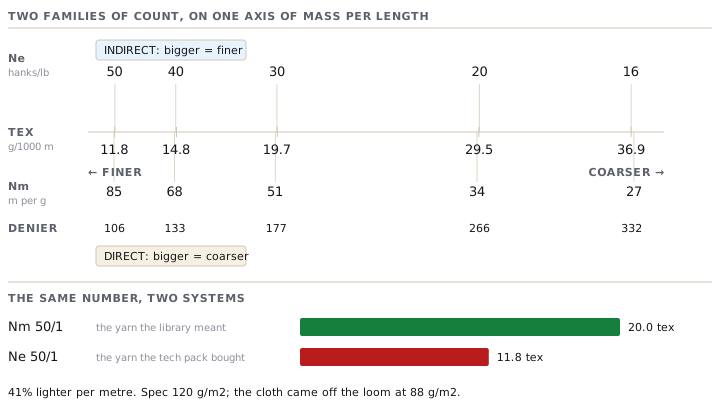
There are only two ideas here. Once you have them, the rest is division.
An indirect system counts length per unit of mass. How much length do I get from a fixed weight? A finer yarn gives more length per kilo. So a bigger number means a thinner yarn.
- Ne, the English cotton count: the number of 840-yard hanks in one pound. Ne 30 means thirty hanks weigh one pound.
- Nm, the metric count: metres per gram. Nm 51 means fifty-one metres weigh one gram.
A direct system counts mass per unit of length. How heavy is a fixed length? So a bigger number means a fatter yarn.
- Tex: grams per 1,000 metres.
- Decitex, dtex: grams per 10,000 metres. The system the man-made fibre industry actually works in.
- Denier: grams per 9,000 metres. Older, but still standard for filament yarn and hosiery.
Carry one sentence out of this section. In Ne and Nm a bigger number is a finer yarn; in tex, dtex and denier a bigger number is a coarser one. Every mistake in this lesson comes from somebody who had that backwards for ten seconds.
The conversions you actually use
Tex  = 590.5 / Ne          Ne   = 590.5 / Tex
Tex  = 1000 / Nm           Nm   = 1000 / Tex
Nm   = 1.693 x Ne          Ne   = Nm / 1.693
Den  = 9 x Tex             dtex = 10 x Tex
Two constants do all the work. Neither of them is arbitrary.
590.5 is where the pound and the metre meet. One pound is 453.59 grams. One hank of 840 yards is 768.10 metres. At Ne 1, that length weighs that mass. So 1,000 metres weighs 453.59 x 1000 / 768.10 = 590.5 grams. Ne 1 is therefore 590.5 tex, and every other count divides into it.
1.693 is simply 1000 / 590.5. It converts an English cotton count to a metric one, and back. If you memorise one number, memorise this one. Ne and Nm are the two systems that sit on the same spec sheet and look interchangeable.
| Ne | Tex | Nm | Denier | Where you meet it |
|---|---|---|---|---|
| 16 | 36.9 | 27.1 | 332.2 | Heavy fleece, denim weft, terry |
| 20 | 29.5 | 33.9 | 265.7 | 200 g single jersey, canvas |
| 30 | 19.7 | 50.8 | 177.1 | 180 g single jersey, poplin |
| 40 | 14.8 | 67.7 | 132.9 | Fine jersey, shirting |
| 50 | 11.8 | 84.7 | 106.3 | Fine poplin, voile |
Work one row yourself before you go on. Ne 30: 590.5 / 30 is 19.68, so 19.7 tex. 1000 / 19.68 is 50.8, so Nm 50.8. 9 x 19.68 is 177.1 denier. Then the cross-check: 1.693 x 30 is 50.79. The two roads to Nm agree. That is how you know you have not turned anything upside down.
Filament yarn is quoted differently again, and the notation carries a second number. A polyester lining yarn written 150 denier / 48 filaments is 150 grams per 9,000 metres. So 150 / 9 is 16.7 tex, or dtex 167, or Ne 35.4 if you insist on putting it beside a cotton count. The 48 is the number of individual filaments in the bundle. Each one is 150 / 48 = 3.125 denier. That per-filament figure is what decides the feel. The same 150 denier split into 144 filaments is a microfibre and feels like silk. Split into 24, it feels like a raincoat.
Ply and folding: the notation read wrong every week
Ne 30/1 is a single yarn of Ne 30. The /1 is not decoration. It states that this yarn is one strand.
Ne 40/2 is two singles of Ne 40 twisted together. Two strands of Ne 40 side by side weigh twice as much per unit of length. So the resultant count is Ne 20. In tex, where the arithmetic runs the natural way: 590.5 / 40 is 14.8 tex per strand, and two of them is 29.5 tex, written R 29.5 tex/2 — R for resultant.
So:
- In an indirect system, plying divides:
Ne 40/2resolves to Ne 20;Nm 68/2resolves to Nm 34. - In a direct system, plying multiplies: two ends of 14.8 tex is 29.5 tex.
The error, and what it cost
Brayford Shirting, a British menswear brand, holds a cotton poplin in its fabric library from Filatura Bergamo, specified Nm 50/1 in warp and weft, finished at 120 g/m².
For the autumn programme the fabric was moved to a mill in Bangladesh to hit a price. A merchandiser building the tech pack copied the count out of the Italian document and wrote Ne 50/1.
Do the conversion the merchandiser did not do. Nm 50 is 50 / 1.693 = Ne 29.5, or 20.0 tex. Ne 50 is 11.8 tex. The specified yarn was 41 percent lighter per unit of length than the yarn that was meant. And nothing on the tech pack said so, because both numbers were 50.
The mill quoted it, bought it and wove it. At a fixed thread density, fabric weight moves with tex. So a straight substitution predicts 120 x 11.8 / 20.0 = 70.8 g/m². The weaver saw the problem coming and packed in as many warp threads as the reed would take. The fabric still came off the loom at 88 g/m², against a 120 g/m² specification. See-through under a shop light, limp in the hand, and outside every tolerance in the file.
| Line | Cost |
|---|---|
| 18,000 m woven and rejected, at USD 2.35 per metre | USD 42,300 |
| Air freight to recover five weeks of reweave | USD 11,400 |
| Total, from one letter on a tech pack | USD 53,700 |
Nobody was careless. The merchandiser copied a number accurately out of one document into another. The system the number belonged to was carried in the reader's head. And the reader changed.
Which system, where
| Material | System | Typical |
|---|---|---|
| Cotton and cotton-rich spun yarn | Ne | Ne 30/1 |
| Wool, worsted, linen, many blends in Europe | Nm | Nm 48/2 |
| Polyester and nylon filament | Denier or dtex | 150 denier / 48 filaments |
| Elastane | dtex | 20 dtex, 40 dtex |
| Sewing thread | Tex, and a ticket number | Ticket 120 |
| Technical and test reports, everywhere | Tex | 19.7 tex |
Two of those rows need a sentence each. A spun polyester or a poly-cotton blend yarn is normally quoted in Ne, even though it contains no cotton, because it is spun on cotton-system machinery. So "Ne 30/1 65/35 PC" is a perfectly ordinary thing to read. And sewing thread carries a ticket number, which is a commercial size, not a count. The metric ticket is the resultant metric count multiplied by three. So Ticket 120 is Nm 40 resultant, about R 25 tex. A ticket number cannot be compared across brands or across thread types, and it is never a count.
Prompt · Convert a count and check it against the fabric weight
Whenever a count crosses a border between systems — an Nm quote against an Ne spec, a denier filament beside a spun yarn, or a folded count with no resultant given.
Act as a fabric technologist. I have a yarn count to convert and sanity-check before it goes into a specification. The count as I received it: [PASTE EXACTLY, INCLUDING ANY PLY NOTATION]. Its source: [MILL, COUNTRY, DOCUMENT]. The count already in my own specification, if any: [PASTE]. The fabric: [CONSTRUCTION], target weight [GSM] g/m2, thread density or gauge [DETAIL]. Do the following. First, state which system the received count is in and how you know, and say explicitly if the notation is ambiguous rather than guessing. Second, express it in all four systems — Ne, Nm, tex and denier — showing the arithmetic line by line, and for a folded count give the resultant separately from the singles. Third, compare it against the count in my specification and tell me whether they are the same yarn, and if not, by what ratio they differ. Fourth, predict the effect on fabric weight if the received count were used at my specified thread density, using the rule that weight moves with tex, and give the predicted g/m2. Fifth, write the count back to me in the one form that cannot be misread. If you cannot tell which system the source used, say so and tell me exactly what to ask the mill.
AI can make mistakes — check anything you act on.
Prompt · Price two spinning routes against each other
At costing, when a cheaper yarn is on the table and somebody has to say in dollars what the difference buys and what it takes away.
Act as a senior merchandiser costing a knitted garment programme. Order facts: buyer [BUYER], PO [NUMBER], style [STYLE], [QTY] pcs, FOB USD [PRICE] per piece, order value USD [VALUE], my target margin [PERCENT]. Fabric [CONSTRUCTION] at [GSM] g/m2, yarn requirement [KG] kg including knitting and dyeing losses. Here are the yarn offers on the table, each with its route and price per kilo: [PASTE THE QUOTES]. Lint or raw material price today: USD [PRICE] per kg. Do the following. First, put every offer into one table with price per kilo, total yarn cost on this order, cost per garment, and the difference from the cheapest expressed both in dollars and as a percentage of FOB. Second, for the carded-versus-combed gap, show the fibre arithmetic — the realisation of each route, the lint I must buy to ship the yarn I need, and how much of the price gap that explains — then say what the remainder is paying for. Third, for each offer, name the property the customer will actually notice and when they will notice it: at approval, at the first wash, or after twenty. Fourth, tell me which offer you would take and the one assumption that decision rests on. Do not recommend the cheapest yarn without stating what the buyer approved the sample in.
AI can make mistakes — check anything you act on.
Check yourselfA European mill offers you Nm 34/2 for a jacket lining warp. Your costing sheet is built in Ne and tex. What are you being offered?Show the answer
Nm 34/2 is two singles of Nm 34, so the resultant is Nm 17. Convert it: tex is 1000 divided by 17, which is 58.8 tex resultant. Ne is 17 divided by 1.693, which is Ne 10.0. So you are being offered a coarse two-fold yarn, about as thick as a heavy denim warp. Write it into your sheet as R 58.8 tex/2 and the ambiguity is gone. And note what would have happened if you had read the 34 as a resultant: you would have costed a yarn half the weight, and quoted the fabric about 40 percent light.
Check yourselfYour tech pack says 180 g/m² single jersey in Ne 30. Knitting proposes Ne 24 because it is in stock. What happens to the fabric?Show the answer
Ne 24 is 24.6 tex against 19.7 tex — a quarter more mass per unit of length. At the same stitch length and gauge, the fabric comes out around 225 g/m², a quarter over spec. And it will not fit the machine gauge properly either, because the loops need more room. The consequences reach past weight: more yarn per garment, so the costing moves; a stiffer, warmer fabric; and a garment that is no longer the one the buyer approved. If the count must change, the stitch length and the gauge change with it, and the fabric is approved again.