Lessons · Lesson 1 of 6
Seven customers, one shirt
Sort the people who buy clothes into the types that really behave differently, and read each one on the five questions that reach the factory floor.
Lesson 1 of 6 · 19 min
One week, seven enquiries, one garment
Ghannam Apparel is a knitwear factory in Qutur, in the Egyptian delta. Eight sewing lines. Thirty operators to a line. About four million pieces a year. Its everyday garment is QP-4165, a men's short-sleeve cotton piqué polo: three-button placket, ribbed collar and cuff, side vents. Nothing about it is special. That is the point of this course.
In the second week of February, Rania Ghoneim, who runs Ghannam's merchandising, had seven live enquiries on her desk. All of them were for that same shirt. The quoted prices ran from USD 4.62 to USD 13.73.
A merchandiser who thinks a quotation is only a costing exercise will look at that spread and decide something simple: some buyers pay well, others do not, so chase the good ones. That is wrong, and it costs a factory a whole year. It treats seven different kinds of business as seven versions of one business, differing only in generosity.
They are not versions of one business. Each of the seven makes money in a different way. And the way a buyer makes money decides how it must buy. How far ahead it can commit. Whether it can own cloth. What makes it repeat. Who is left holding the stock that does not sell. What it does when a season goes wrong. Each of those lands on Ghannam's floor.
The five questions
Vocabulary is not the problem. Every merchandiser can already say "fast fashion" and "department store". The problem is that those labels tell you nothing you can act on. These five questions do, because each one has a consequence on the floor.
1. Who decides which cloth, and who pays for it? A buyer that names the mill and negotiates the yarn price itself has taken the cloth decision away from you and left you the invoice. A buyer that never mentions cloth has left you both.
2. How far ahead is the commitment, and how much of the quantity is firm on the day you must order cloth? This is the most useful number in the taxonomy, and almost nobody works it out. It is not the lead time. It is the overlap — or the gap — between the day money is promised and the day money is spent.
3. What triggers a repeat: a number, a person, or a stock-out? A sell-through threshold (a set percentage of the stock sold by a set date) is a number, and you can plan against it. A buyer's judgement is a person, and you can only ask. A marketplace stock-out is neither, and it arrives on a Tuesday.
4. Who carries the stock that does not sell? Somebody does. If it is not the buyer, look harder. It is probably you.
5. When demand disappoints, what shape does the disappointment take? Cancellation. Delay. A request for money after the fact. A cut to next year. Or silence. Five shapes, needing five different protections. Lesson 5 prices them.
The seven, answered
Here are Ghannam's seven enquiries from that week, in the order Ghoneim eventually ranked them.
| Buyer | What kind of business | Quoted FOB |
|---|---|---|
| Hallgate | Clothing arm of a grocery group, 1,100 stores | USD 4.62 |
| Ludenholt | Department-store group, own-label menswear | USD 5.40 |
| Marnholt Sourcing | Buying agent placing for a US brand | USD 5.40 |
| Panmoor Wholesale | Wholesaler supplying 340 independent shops | USD 5.85 |
| Volante | Vertically integrated fast-fashion chain, 640 stores | USD 5.95 |
| Trelloway Apparel | Licensee making polos under the Aurick sports brand | USD 6.15 |
| Onbrook Trading | Marketplace seller, no shops at all | USD 6.80 |
FOB means the price with the goods loaded at the port of shipment. The buyer pays the freight from there.
Read that price column on its own and Onbrook looks like the best customer in the room. Hold that thought until lesson 4. There Onbrook also asks for eight hundred pieces in a fourth colour, and the honest answer is USD 13.73.
Now the five questions.
| Buyer | Cloth decided and paid by | Firm on the day cloth is ordered | Repeat triggered by | Carries unsold stock | Disappointment arrives as |
|---|---|---|---|---|---|
| Hallgate | Buyer nominates mill, factory pays | 100% | Annual review | Buyer | A smaller programme next year |
| Ludenholt | Factory, from an approved list | 100% | Buyer's judgement | Buyer | A retrospective request |
| Marnholt | Factory | 100% | The brand behind the agent | The brand | Whoever signed the order |
| Panmoor | Factory | 100% | Its own shops reordering | Buyer | A request to delay shipment |
| Volante | Factory, at its own risk | 20.8% | Sell-through threshold | Buyer | A repeat that never comes |
| Trelloway | Factory, licensor approves | 100% | Licensor's range plan | Licensee | An approval that arrives late |
| Onbrook | Factory | 100% | A stock-out | Buyer | Silence |
Four things in that table are worth more than the table.
Only one buyer of the seven is under 100% in the third column, and that changes everything about it. Volante's 20.8% is not a weakness in Volante. It is the model working exactly as designed. Lesson 2 puts a price on it.
A column of "buyer carries the stock" tells you almost nothing on its own. Six of the seven carry it. What differs is what they do to you when they are carrying too much of it. That is the last column, and nobody asks about it at the quoting stage.
Two buyers do not decide their own cloth. Hallgate names the mill, because its price is built on a yarn contract it placed once for the whole year. Trelloway cannot approve a substitution at all, because the Aurick licence keeps that right with the brand. Neither fact shows up in a price. Both decide what happens in a crisis.
The last column holds five different shapes across seven rows. This is the finding that justifies the whole course. Ghannam's standard protections — a deposit, a confirmed order, a signed size set — are shaped against exactly one of those five. Against the other four they do nothing at all.
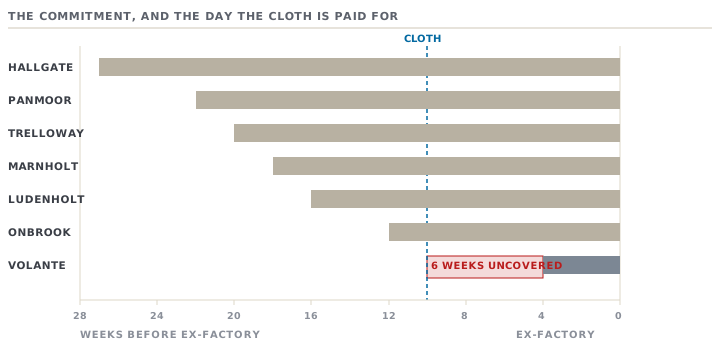
The window that decides everything
Look at the drawing rather than the table. Every row is one buyer type on the same time axis. The bar is the commitment. It starts the day the buyer's promise arrives and ends at delivery. The tick is the day Ghannam must order cloth, which for this polo is ten weeks before the goods leave the factory.
For six of the seven, the tick sits inside the bar. The buyer promised first, and the factory spent afterwards. That is what a normal order looks like. It is also why factories that serve only those six have never had to think about any of this.
For Volante the tick sits outside the bar, six weeks to the left of it. Ghannam must buy cloth for a quantity nobody has ordered, so that it can serve an order that may never come. Nothing has gone wrong. Nobody has behaved badly. The gap is the product. Volante's whole commercial advantage is that it decides late. A supplier who insists it decide early is asking it to stop being Volante.
Why "difficult" is usually the wrong word
Ghoneim's predecessor kept a note at the front of the buyer file. Of one of these seven it said: "will not commit — chase every season". He had been chasing for four years.
He was asking a fast-fashion retailer to behave like a supermarket. The supermarket buys a year ahead because volume committed early is what makes its price possible. The fast-fashion chain does not commit until it has seen two weeks of trading, because deciding late is what makes its margin possible. Neither one is being difficult. Each is doing the only thing its own business allows.
That is the core of this course. It is worth stating as a rule you can use in a meeting:
Before you decide what to ask a buyer for, work out what their own business model lets them give. An ask their model forbids will be refused however good the relationship is, and the refusal will teach you nothing.
Lesson 3 turns that into a list. For each buyer type: one ask that costs them nothing, and one that is impossible by design. It also shows that the free ones are routinely left unasked.
Check yourselfPanmoor's order is 100% firm on the day Ghannam orders cloth. Is Ghannam therefore safe?Show the answer
Safe against the wrong thing. Panmoor's promise to Ghannam is firm, and Panmoor is good for the money. What is not firm is the promise made to Panmoor by 340 independent shops, none of which has paid a deposit. When those shops go quiet, Panmoor's warehouse fills up. Its request is then not a cancellation. It is a request to delay shipment, which leaves the goods finished, the line-days spent and the invoice unissued. A firm order protects you against cancellation. It does not protect you against a buyer whose own order book is not firm.
Prompt · Sort this buyer on the five factory questions
When an enquiry arrives from a company you do not know, and you are about to answer it with a price and a lead time.
Act as an export merchandising manager in a garment factory. I am about to quote a buyer I do not know well. I want them sorted before I price anything. Here is what I have: name and country [BUYER]; what I think they are (retailer, supermarket clothing arm, department store, fast-fashion vertical, wholesaler, brand licensee, marketplace seller, buying agent, or unknown) [TYPE]; the enquiry, which is style [STYLE], quantity [QTY], colours and sizes [BREAKDOWN], required ex-factory or delivery date [DATE], and today's date [DATE]; and anything they have sent me, such as a purchase order, a terms document, a forecast or an indication, pasted here [PASTE]. First, answer these five questions. Where I have not given you enough to answer one, say UNKNOWN and name the single question I should ask them. Do not guess. (1) Who decides which cloth, and who pays for it? (2) How many weeks separate their commitment from delivery, and how much of the quantity is firm on the day I must order cloth? (3) What triggers a repeat: a published sell-through figure, one person's judgement, or an empty shelf? (4) Who owns the stock that does not sell? (5) If the season goes badly, what shape will their disappointment take? Second, tell me which buyer type above best fits those answers, what would have to be true for it to be a different one, and the single piece of evidence that would settle it. Third, name the two or three things this type of buyer simply cannot give up, and the two or three that cost them nothing and are usually never asked for. Do not invent facts about the named company. Work only from what I gave you, and label every inference as an inference.
AI can make mistakes — check anything you act on.
What to take away
- "The buyer" is not one kind of organisation. These seven behave differently enough that a factory treating them alike is wrong about most of them.
- Ask the five questions before you quote: who decides and pays for cloth, how much is firm when cloth is ordered, what triggers a repeat, who carries unsold stock, and what shape disappointment takes.
- The most useful number is the gap between the day the promise arrives and the day the money is spent. Work it out for every account you have.
- A buyer's model decides what it can concede. A refusal that comes from the model is not negotiation, and it cannot be won.
- Your standard protections are shaped against one failure. There are five.