Lessons · Lesson 4 of 6
Who is actually your customer
Find out who really owes you the money for an order, and who really has the power to approve a change to it. Often neither one is the name on the label.
Lesson 4 of 6 · 18 min
The name on the shirt is not the customer
Three of Ghannam's seven buyers sit between the factory and the shop that finally sells the garment. A buying agent places the order for somebody else. A licensee makes somebody else's brand. A wholesaler sells to shops it does not own. All three raise the same two questions. Answer them when you quote, and you never have to answer them in a lawyer's office.
Who owes you the money? If the order goes wrong, which company is your debtor, and can it pay? You are relying on that company's balance sheet — the list of what it owns and what it owes.
Who can approve a change? If a mill misses a delivery in October, who says yes to a different cloth, and how long do they take?
These are two separate questions with two separate answers. Each one has ruined a factory's year.
Marnholt Sourcing: every check was right, and every check missed
Marnholt Sourcing is a buying office with fourteen staff. For three seasons it has placed orders with Ghannam on behalf of a US menswear brand. The brand's labels go in the shirts. The brand's distribution centre receives them. The brand's name is on the price tickets. In August, Marnholt placed 22,000 pieces of QP-4165 at USD 5.40 each — USD 118,800.
Ghannam did four sensible things before accepting.
- It ran a credit report on the brand. Thirty years old, profitable, rated fine.
- It read the purchase order. The consignee is the brand's distribution centre.
- It checked the payment history. Three seasons, every invoice paid on time.
- It looked at the artwork. Care labels, hangtags and cartons all carry the brand.
Every one of those is a good check. Every one of them looked at the brand.
In November the brand cut its programme. The shirts were already made, and they were refused. But the brand was not Ghannam's debtor. The buyer field on the purchase order read Marnholt Sourcing. Marnholt's own conditions, attached to that order, said Marnholt buys for resale — it buys on its own account and sells the goods on. Ghannam had no contract with the brand at all.
Marnholt could realise USD 88,000 of assets against creditor claims of USD 215,200 — Ghannam and two other suppliers. That paid out 40.9 cents in the dollar. Ghannam recovered USD 48,580 and lost USD 70,220.
Nobody was careless. The four checks were correct and done in the right order. They answered a question nobody had asked: is the brand good for the money? The brand was excellent for the money. It was simply not the buyer.
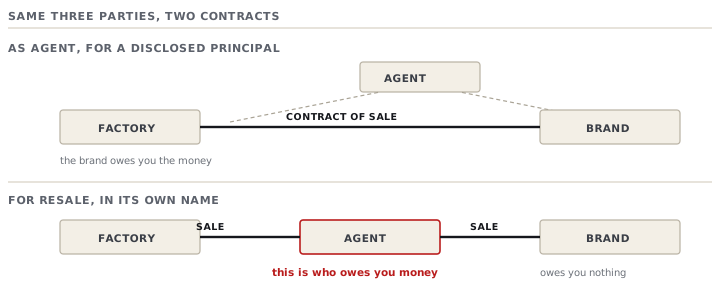
The four-line test
It takes half a minute, and it is the whole of the protection.
- Whose name is in the buyer field of the order? That company is your customer until something else says otherwise.
- Who pays? Look at the name on the letter of credit application — the bank document a buyer opens to guarantee payment — or at the account the transfer comes from. An agent that pays from its own account is behaving as a principal, the party that owns the deal, whatever it calls itself.
- Whose terms are attached? Read them for one of two sentences: the agent contracts on its own behalf, or the agent contracts as agent for a named principal. One of them is usually there.
- Is there a document signed by the principal accepting liability? If not, the principal owes you nothing, however big it is.
If the first three point at the agent and the fourth is missing, the agent is your customer. Then the credit check that matters is the agent's, not the brand's. Marnholt's accounts were filed and public. Reading them would have taken twenty minutes.
Trelloway: the approval nobody could give
Trelloway Apparel makes polo shirts under licence from Aurick, a sports brand that designs and approves but never manufactures. Trelloway is a real company with real money, so the money question is answered.
The other question was not. On 12 October Ghannam's mill reported a shortfall. Ghannam offered an equivalent cloth from a second mill: same construction, same weight, same finish. Most brands answer that in a couple of days. Trelloway took 19.
It was not slow. It was not Trelloway's decision to make. The Aurick licence keeps every specification change with the licensor, and the licensor's product committee meets once a fortnight. Trelloway passed the request on the same afternoon, then waited exactly as Ghannam did.
Ghannam had 11 days of float — spare days in the schedule. It spent the difference on air freight: 14,000 pieces at USD 2.15 each, USD 30,100. It held the date, which it would have held comfortably if anyone had asked one question in June — who signs off a cloth substitution, and how long do they take? The question costs nothing. Not asking it cost thirty thousand dollars and a fortnight of everybody's nerves.
Panmoor: the order is firm, the demand is not
Panmoor Wholesale supplies 340 independent shops. Its order to Ghannam is firm. It owns the cloth decision, it owns the stock, and it pays. On every question this course asks, Panmoor looks like a straightforward customer.
The catch sits one level further out. Panmoor's shops can cancel their own orders up to thirty days before dispatch, with no penalty. In a typical Panmoor season, 22% of the pieces are cancelled after Panmoor has already committed to its factories. Panmoor absorbs that. It is why Panmoor pays USD 5.85 where Ludenholt pays USD 5.40. The extra buys flexibility from somewhere, and the somewhere is its supplier.
So Panmoor never asks for a cancellation. It asks for a delay: hold the shipment six weeks, keep it in your warehouse, and I will take it. Lesson 5 puts a price on that.
Onbrook: never say no, say a price
Onbrook Trading has no shops. It sells on a marketplace, keeps its stock in somebody else's warehouse, has no forecast worth the name, and reorders when a size runs out. Its orders are small, it pays half in advance, and its price is the best in the room at USD 6.80.
Then it asked for 800 pieces in a fourth colour.
Ghannam's dyer will not run a lot below the cloth for 3,000 pieces. The reflex answer is "our minimum is 3,000". The useful answer is a price. The leftover is cloth for 2,200 pieces at USD 2.52, which is USD 5,544. Spread that over the 800 pieces Onbrook actually wants, and it is USD 6.93 a piece on top of the price.
So the fourth colour costs USD 13.73. Or USD 6.80, if Onbrook takes 3,000. Or USD 6.80 plus USD 5,544, if Onbrook wants the leftover cloth held on the shelf for a repeat. Three real answers, and all three are yes.
A minimum is not a refusal. It is a cost with nobody assigned to it. Say who pays it and the conversation continues. Say "our minimum is 3,000" and you have turned down an order and taught the customer nothing.
Check yourselfWhich of the three intermediated buyers in this lesson needed the most work, and which needed the least?Show the answer
Trelloway needed the most, and it is the one that looks safest: solvent, professional, contractually clean — and structurally unable to answer a question the factory will certainly have to ask. Marnholt needed the least: four lines on a purchase order and twenty minutes with its filed accounts, done once, at quoting time. Panmoor needed nothing changed in the contract at all. It needed a different expectation about what its trouble would look like when it came. Put your effort where the open question is, and for two of these three the open question was not the credit one.
Prompt · Sort this buyer on the five factory questions
When an enquiry arrives from a company you do not know, and you are about to answer it with a price and a lead time.
Act as an export merchandising manager in a garment factory. I am about to quote a buyer I do not know well. I want them sorted before I price anything. Here is what I have: name and country [BUYER]; what I think they are (retailer, supermarket clothing arm, department store, fast-fashion vertical, wholesaler, brand licensee, marketplace seller, buying agent, or unknown) [TYPE]; the enquiry, which is style [STYLE], quantity [QTY], colours and sizes [BREAKDOWN], required ex-factory or delivery date [DATE], and today's date [DATE]; and anything they have sent me, such as a purchase order, a terms document, a forecast or an indication, pasted here [PASTE]. First, answer these five questions. Where I have not given you enough to answer one, say UNKNOWN and name the single question I should ask them. Do not guess. (1) Who decides which cloth, and who pays for it? (2) How many weeks separate their commitment from delivery, and how much of the quantity is firm on the day I must order cloth? (3) What triggers a repeat: a published sell-through figure, one person's judgement, or an empty shelf? (4) Who owns the stock that does not sell? (5) If the season goes badly, what shape will their disappointment take? Second, tell me which buyer type above best fits those answers, what would have to be true for it to be a different one, and the single piece of evidence that would settle it. Third, name the two or three things this type of buyer simply cannot give up, and the two or three that cost them nothing and are usually never asked for. Do not invent facts about the named company. Work only from what I gave you, and label every inference as an inference.
AI can make mistakes — check anything you act on.
What to take away
- Two questions, always kept apart: whose balance sheet is behind the order, and whose approval controls the decisions.
- Run the four-line test on any order placed by an agent, before you quote. The buyer field, the payer, the attached terms, and a principal's signature.
- Where a buyer sells under somebody else's name, the approval chain is longer than the contract chain. Map it in week one and put the committee dates in your critical path.
- A firm order from a buyer whose own order book is not firm gives you a delay problem, not a cancellation problem.
- Answer a minimum with a price, not a refusal. There is always more than one yes.