Lessons · Lesson 2 of 6
The same order, three ways
Cost one 60,000-piece order as three different buyers would place it, and rank them by the capacity you had to hold, not the price you were offered.
Lesson 2 of 6 · 19 min
One quantity, three shapes
Three of Ghannam's seven enquiries are for the same quantity: 60,000 pieces of QP-4165, delivered in the same autumn window. Hallgate, Volante and Ludenholt.
Same factory, same garment, same season. What changes is the shape of the commitment. When does the order arrive? How much of it is firm? What must the factory hold open while it waits? This lesson puts a price on that shape. The rest of the course rests on this arithmetic, so every figure here is worked out rather than asserted.
The engineering, once
A Ghannam sewing line is thirty operators working 480 productive minutes. The line runs at 60% efficiency — the figure the industrial engineer measures, not the one painted on the wall. That gives 8,640 standard minutes a line-day. A standard minute is one minute of one operator's work at a normal pace. A line costs USD 600 a day to run: wages, supervision, power, and its share of the building.
The three buyers do not want the same shirt. Hallgate wants one colour, one size ratio, one delivery, and its own woven neck label. Volante wants a contrast placket, a hem label, and three colours in six sizes. Ludenholt wants three colours, its own label, and every piece bagged with a barcode.
| Hallgate | Volante | Ludenholt | |
|---|---|---|---|
| Standard minutes a piece | 14.4 | 16.9 | 15.2 |
| Pieces a line-day | 600 | 511.2 | 568.4 |
| Materials | 2.88 | 3.06 | 3.02 |
| Making, at USD 600 a line-day | 1.00 | 1.17 | 1.06 |
| Freight, handling, documents | 0.09 | 0.09 | 0.13 |
| Cost to FOB | 3.97 | 4.32 | 4.21 |
| Quoted FOB | 4.62 | 5.95 | 5.40 |
| Margin a piece | 0.65 | 1.63 | 1.19 |
FOB means the price with the goods loaded on the ship at your port. Everything after that is the buyer's cost.
Pieces a line-day is 8,640 divided by the standard minutes: 600, 511.2, 568.4. Making cost is USD 600 divided by that. Everything else is a price you pay somebody. On margin a piece the ranking is not close. Volante pays 2.5 times what Hallgate pays for the same minute of an operator's work.
Stop here and Volante is obviously the order to take. Almost every factory does stop here.
The shape, priced
Now the commitment.
Hallgate issues one purchase order on 3 March for all 60,000 pieces, ex-factory 14 September — 27 weeks away. One delivery. The cloth is ordered against a firm order for the whole quantity.
Volante issues a purchase order on 6 July for 12,000 pieces, ex-factory 10 August — 5 weeks away. In the same email its merchandiser writes that a repeat of about 48,000 is likely, and will be decided on 24 August, after two weeks of selling. To make that repeat inside Volante's window, Ghannam needs the cloth already in the building. Cloth takes ten weeks. So the repeat cloth has to be ordered on 13 July: six weeks before anybody decides anything.
Ludenholt issues one order on 21 May for 60,000 pieces, in three dated deliveries of 20,000, ex-factory 9 September, 30 September and 21 October — 16 weeks away. Each delivery has a window of three working days, and Ludenholt charges you if you miss it. So Ghannam's planner keeps spare days in front of each one.
| Hallgate | Volante | Ludenholt | |
|---|---|---|---|
| Sewing days for the quantity | 100.0 | 23.5 plus 93.9 | 105.6 |
| Set-up and colour changes | 1.5 | 1.5 plus 1.5 | 4.5 |
| Float held against a delivery window | — | — | 4.5 |
| Line-days booked | 101.5 | 120.4 | 114.6 |
| Line-days contracted when cloth is ordered | 101.5 | 25.0 | 110.1 |
| Commitment cover | 100% | 20.8% | 96.1% |
| Cloth bought ahead of any commitment | — | USD 124,320 | — |
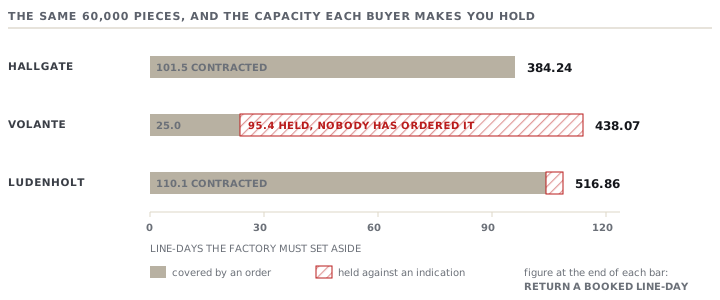
Commitment cover is the ratio this course exists to make you compute: line-days somebody owes you money for, divided by line-days you had to reserve. Hallgate is at 100%, because the order came first. Ludenholt is at 96.1%, because a delivery window is a small piece of insurance nobody pays you for. Volante is at 20.8%. Of the USD 3.06 of materials in a Volante polo, USD 2.59 is cloth. So the 48,000 pieces Ghannam must commit to on 13 July cost USD 124,320 against nothing at all.
What the block actually returns
The honest comparison is not contribution per piece. It is what the whole block of line-days you had to hold gives back. That block is what the buyer's shape asked you to set aside, and you can only sell it once.
Hallgate is plain arithmetic, with no probability in it. 60,000 pieces at USD 0.65 is USD 39,000 over 101.5 booked line-days: USD 384.24 a booked line-day.
Ludenholt starts at 60,000 at USD 1.19 — USD 71,400 — and then its terms document arrives. A settlement discount is money taken off the invoice for paying early. Ludenholt deducts 2.5% automatically from every invoice: 2.5% of USD 324,000 is USD 8,100. Ludenholt has also asked its suppliers to share the cost of its markdowns in two of the last five seasons, at 3% of invoice value, which is USD 9,720 when it comes: expected, USD 3,888. And the delivery window has been missed once in Ghannam's last twelve deliveries. The charge for missing it is 2% of that delivery's value, USD 2,160, so expect USD 180. Net USD 59,232 over 114.6 booked line-days: USD 516.86 a booked line-day.
Volante has a probability in it, and there is no honest way to remove it. Of the last twelve repeats Volante has signalled to Ghannam, eight happened: 66.7%.
- The firm 12,000 pieces earn 12,000 at USD 1.63 — USD 19,560 — whatever happens.
- If the repeat lands, 48,000 at USD 1.63 is USD 78,240.
- If it does not, the cloth is already dyed in Volante's three colours. Ghannam has sold that base cloth on before at 45% of what it paid, so USD 124,320 becomes a write-down of USD 68,376. The 95.4 line-days come free at five weeks' notice, and five weeks is enough notice to find filler work: Ghannam's own record is USD 120 a line-day above materials and making, so USD 11,448. This branch is worth minus USD 56,928.
- Expected: 19,560 plus two thirds of 78,240, less one third of 56,928 — USD 52,744 over 120.4 booked line-days: USD 438.07 a booked line-day.
| Hallgate | Volante | Ludenholt | |
|---|---|---|---|
| Quoted FOB | 4.62 | 5.95 | 5.40 |
| Margin a piece | 0.65 | 1.63 | 1.19 |
| Return a booked line-day | 384.24 | 438.07 | 516.86 |
The ranking reverses. Volante pays the highest price and earns the highest margin a piece. Once you count the line-days it makes you hold and the cloth it makes you buy, it is only the second-best use of the block. Ludenholt is quoted 9.2% below Volante, and returns 18.0% more for every line-day held.
And the gap at the bottom is far smaller than the price gap. Volante's price is 28.8% above Hallgate's. Its return a booked line-day is 14.0% above. So half the premium is not a premium at all. It is payment for risk Ghannam is carrying on Volante's behalf.
The number to take into the negotiation
The Volante figure is an expectation, so ask what it is sensitive to. Hold everything else still. The repeat conversion rate would have to reach 73.7% for Volante's block to match Ludenholt's, and 61.9% to match Hallgate's. Ghannam's measured record is 66.7%: comfortably above the second, and clearly below the first.
That is a real answer to a real question. Volante is worth more than the supermarket and less than the department store, on this factory's own conversion record, and the whole distance between those two verdicts is the cloth Ghannam buys before anyone orders it.
Check yourselfGhannam declines to buy the repeat cloth and keeps its exposure at zero. Is that the better decision?Show the answer
It removes USD 68,376 of downside, and it removes USD 78,240 of upside. Without cloth in the building the repeat cannot be made inside Volante's window, and somebody else will make it. The block then returns the firm order plus filler work: USD 19,560 plus USD 11,448 over the same 120.4 line-days, if they are still being held. Refusing the exposure is a real option, and at a 66.7% conversion rate it is worth less than taking it. The decision that beats both is in lesson 3: keep the cloth, and charge for the option.
Prompt · Price the capacity and cloth I am holding against nothing
When a buyer has hinted at a repeat, asked you to hold a block of capacity, or promised a programme that is not yet an order.
Act as a factory planning and costing analyst. Work out what an uncommitted block of work is really worth to me, and give me a number I can negotiate with. My engineering: operators per line [NUMBER]; productive minutes per operator per day [NUMBER]; the efficiency the line actually runs at [PERCENT]; and from those, the standard minutes earned in one line-day, which is one production line running for one day. Also: the cost of running one line for a day [AMOUNT]; standard minutes per piece for this style [NUMBER]; and the set-up and colour-change allowance in line-days [NUMBER]. My costs per piece: materials [AMOUNT], of which cloth is [AMOUNT]; freight, handling and documents [AMOUNT]. The order: firm quantity on a purchase order [QTY] at [PRICE]; hinted or expected quantity with no order behind it [QTY] at [PRICE]; the date I must commit cloth [DATE]; the date the buyer says they will decide [DATE]; the delivery window [DATES]. My history with this buyer: hints given [NUMBER]; hints that became orders [NUMBER]. If the hint does not turn into an order: what I can realistically recover on the dyed cloth, as a share of what I paid [PERCENT], and what a line-day of short-notice filler work returns above its own materials and making [AMOUNT]. Now compute, showing every step: pieces per line-day; the cost to FOB, the price at the port of shipment, and the margin per piece at each price; line-days BOOKED, which is everything I must hold open, against line-days CONTRACTED, which is what somebody owes me money for on the day I commit cloth, and the ratio between them; the value of cloth committed ahead of any order; the value of the block if the hint converts, the value if it does not, and the expected value at my measured conversion rate; and the return per BOOKED line-day, never per line-day used. Then give me three negotiating numbers: the conversion rate at which this block equals my best alternative use of the same line-days, and I will name that alternative here [ALTERNATIVE AND ITS RETURN PER LINE-DAY]; the option fee per hinted piece, credited back against the repeat, that would leave me indifferent; and that same fee as a share of the quoted price. Flag any input I have not given you as a gap. Do not assume a value for it.
AI can make mistakes — check anything you act on.
What to take away
- Cost the shape, not only the price. Line-days booked against line-days contracted is one division, and it changes rankings.
- Return a booked line-day is the comparison that survives across buyer types. Margin a piece does not, because different buyers buy different amounts of your capacity per piece.
- A high price with a low commitment cover is partly a fee for risk you are carrying. Work out how much of it, before you celebrate it.
- Put the conversion rate in writing and measure it. It turns an argument about a buyer's reliability into a break-even you can check.
- Never divide by the line-days you used. Divide by the line-days you held.