Lessons · Lesson 6 of 6
- 01 · You cannot see demand from here
- 02 · Your own order book, and what it is allowed to prove
- 03 · The buyer's behaviour arrives before the buyer's order
- 04 · Why a published forecast cannot answer your question
- 05 · A signal or a hope: what would it cost them to change their mind?
- 06 · Buy the option, not the bet
Buy the option, not the bet
Price three capacity routes and one fabric route against two futures, and turn a forecast nobody can make into a break-even probability you can judge.
Lesson 6 of 6 · 17 min
The decision, this season
Same calendar. Same buyer. One thing has changed. In February, Marrash approved Kanaan Sewing in Mafraq as a subcontractor — an audit, a trial order, and a signed rate. It took two weeks and two site visits by the merchandiser. It is the reason this lesson has a good answer in it.
The choice is due on 19 March. Trentham Sourcing wants a reply on filler work — a cheap order you take to keep the lines running. Ovenden has not placed anything. You have 8 line-weeks in weeks 30 to 33, and two futures: Ovenden places 48,000 pieces, or Ovenden does not.
Three routes, two futures
The table below is in contribution. Contribution is what one piece leaves behind after the costs that exist only because you made it — fabric, trims, sewing. It is the money left over to pay the factory's fixed costs.
| Route | If Ovenden places | If Ovenden does not |
|---|---|---|
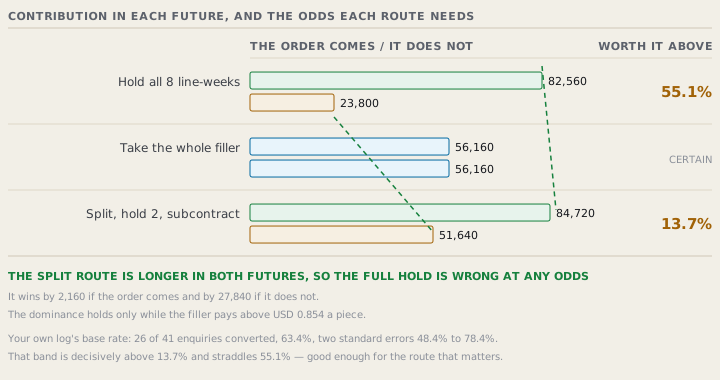
| Hold all 8 line-weeks for Ovenden | USD 82,560 | USD 23,800 |
| Take the whole Trentham filler, 62,400 shorts | USD 56,160 | USD 56,160 |
| Take 46,800 shorts, hold 2 line-weeks, subcontract 36,000 to Kanaan | USD 84,720 | USD 51,640 |
Here are the workings, so you can check them. Marrash makes USD 1.72 of contribution on an Ovenden top and USD 0.90 on a Trentham short. One line-week makes 6,000 tops or 7,800 shorts. Kanaan's rate leaves USD 0.61 a piece after the subcontract fee and the extra quality checking. If Marrash holds the lines and Ovenden does not place, it fills 5 of the 8 line-weeks with late spot work at USD 4,760 a line-week, and three lines stand idle.
So the split route earns 46,800 shorts at USD 0.90, plus 12,000 tops made in house at USD 1.72, plus 36,000 tops made at Kanaan at USD 0.61. If the order never comes, it earns the shorts plus two line-weeks of spot work.
The first result: one route is simply wrong
Read down the two columns. The split route earns USD 2,160 more than the full hold if Ovenden places. It earns USD 27,840 more if Ovenden does not.
It wins in both futures. So the full hold is wrong at every probability, including certainty. There is no belief about Ovenden, however confident, that makes it right. You do not need a forecast to rule it out. You need two columns.
The reason it wins is worth saying plainly. The thing you run out of is Marrash's own lines, and Kanaan gives you more lines. The split route fits more work into the same eight weeks by using somebody else's building.
Now the honest warning, because a result like this is fragile. It holds only while Trentham's contribution stays above USD 0.854 a piece. Trentham held its price on the smaller quantity. Had it charged USD 0.046 a piece more for the shorter run — under five cents — the split route would stop winning outright, and the two routes would have to be argued on probability like everything else.
The second result: the number you actually need
The full filler is certain money. The split route is not. Compare them.
The split route earns USD 84,720 with probability p, and USD 51,640 otherwise. Set that equal to USD 56,160 and p = 13.7%. That is the break-even probability: the chance at which the two routes are worth exactly the same.
Do the same sum for the full hold and it needs p = 55.1%.
This is the move the whole course exists for. You cannot know the probability that Ovenden places. You do not have to. You only have to know whether your honest belief is above 13.7%. A factory owner can answer that, because it is a question about a threshold, not a forecast.
What your own log says, and how precisely
Lesson 3 gave you a base rate: a capacity enquiry with dates turned into an order 26 times out of 41, or 63.4%. Ovenden has made the enquiry and gone further — tech packs sent, two price points asked for. That sits above the enquiry rung on lesson 5's ladder.
Now be honest about how precise 26 out of 41 really is. Its standard error is 7.5%. The standard error tells you how much a figure from a small sample can wobble. Two standard errors put the true rate somewhere between 48.4% and 78.4%.
Read that band against the three thresholds and it says something exact:
- It is entirely above 13.7%, so the split route is worth taking. Clearly.
- It is entirely above 23.7%, the figure worked out below for the fabric. Clearly.
- It straddles 55.1%, so the base rate is not precise enough to settle the full hold either way.
And the full hold was already ruled out by the two columns, so that imprecision costs you nothing. The evidence is exactly good enough for the decisions that matter, and not good enough for the one that does not. Knowing which is which is the difference between using a base rate and waving it about.
The cheaper option, on 2 June
Lesson 1 found that the fabric must be committed on 2 June, 37 days before the order. Thabet Knitting Mills will do it two ways.
One dyed order on 23 June: USD 5.28 a kg, so USD 106,444.80 committed for 20,160 kg, in Ovenden's colours, 16 days before the order arrives.
Greige booked on 2 June, colour confirmed on 15 July: USD 4.05 a kg for the greige and USD 1.32 for dyeing and finishing. Greige is cloth that has been knitted but not yet dyed, so it can still become any colour. That is USD 5.37 all in — a split premium of USD 0.09 a kg, or USD 1,814.40 on the order.
The dates matter more than the money. Booking greige commits USD 81,648 on 2 June. That is earlier and more than the dyed route commits on that date. But the part tied to this one style — the USD 26,611.20 of dyeing, which can never become anything else — is committed on 15 July, six days after the purchase order lands.
| Committed, and when | Lost if Ovenden never places | |
|---|---|---|
| One dyed order, 23 June | USD 106,444.80 on 23 June | USD 47,980.80 |
| Greige 2 June, colour 15 July | USD 81,648.00 on 2 June | USD 9,737.53 |
Dyed cloth in a dead programme's colours sells on as a job lot for USD 2.90 a kg. Greige goes into Marrash's own basics programme at a USD 0.32 a kg re-engineering discount, plus the cost of the money it ties up. Marrash's bank charges 1.15% a month, which is that factory's rate and not a market figure.
So a certain premium of USD 1,814.40 removes USD 38,243.27 of exposure. Every dollar of premium takes USD 21.08 of risk off the table. The break-even probability for booking greige at all is 23.7%.
Cash committed and information committed are different things
That table is the sentence to take away. The greige route commits more cash, and earlier. It commits less information. What you are buying is not a smaller number. It is the right to be wrong later, when being wrong is cheap.
Rank your options by break-even probability, not by price. The split capacity route pays above 13.7%. The greige booking pays above 23.7%. The full hold needs 55.1%, and it loses in both columns anyway. Then ask your own log one question — is my honest belief above the threshold? — and the forecast you could not get turns out not to have been needed.
Sometimes the answer is that no option clears its threshold. Then the right decision is to take the certain filler and tell the buyer no. That is not pessimism. It is a priced decision, and a priced decision is the only kind worth defending.
Prompt · Price the option instead of guessing the probability
When you have to answer a filler order today and the real order is months away and unconfirmed.
Act as a factory planner who turns unanswerable forecasts into break-even probabilities. I have to commit before I know, and I want routes priced rather than a prediction. The uncertain order: buyer [NAME], style [CODE], expected [QUANTITY] pieces, FOB [PRICE], my variable cost [AMOUNT], so contribution [AMOUNT] a piece. Capacity: [NUMBER] line-weeks free in weeks [RANGE], output [PIECES] a line-week on this style. The certain alternative: [FILLER OR OTHER ORDER], [QUANTITY], contribution [AMOUNT] a piece, output [PIECES] a line-week, answer due [DATE]. My fallback if I hold and nothing comes: [WHAT I COULD FILL AND AT WHAT CONTRIBUTION A LINE-WEEK]. Subcontract, if I have one qualified: [NAME], contribution [AMOUNT] a piece after their fee and my extra checking, capacity [PIECES]. Materials: [FABRIC KG A PIECE], greige price [AMOUNT] a kg, dyeing and finishing [AMOUNT] a kg, single dyed order price [AMOUNT] a kg, greige lead [DAYS], dye and finish lead [DAYS], fabric needed in house [DATE], salvage value of dyed cloth [AMOUNT] a kg, absorption discount on greige [AMOUNT] a kg, my cost of money [PERCENT] a month. Do the following. First, build the route table: every route I could take, and what each one earns in contribution in BOTH futures, the order comes and the order does not. Show the arithmetic line by line. Second, check for dominance. Say plainly if any route wins in both futures, because that route needs no probability at all. Then say how fragile the dominance is by giving me the input value at which it disappears. Third, give me the break-even probability for each remaining route against the certain alternative, and rank them. Fourth, do the same for the materials decision separately. Show me what is committed on each date, and how much of it is style-specific and unrecoverable. Fifth, if I give you a base rate from my own history with a count, give me its two-standard-error band, and tell me which thresholds that band settles and which it does not. Sixth, tell me what to buy in the next fortnight that would make a future version of this decision cheaper. Give me a break-even, never a forecast, and do not invent a probability I did not give you.
AI can make mistakes — check anything you act on.
Check yourselfYour buyer's programme has a break-even of 31%. Your log's base rate for this kind of signal is 34%, and two standard errors span 19% to 49%. What do you do?Show the answer
You have not settled it. The band straddles 31%, so the base rate cannot decide this route, and pretending otherwise is worse than admitting it. Look for a cheaper option with a lower break-even, or for something that raises the base rate. A paid sample order sits at 73.7% on lesson 5's ladder, and asking the buyer for one costs a phone call.
Check yourselfMarrash spent two weeks in February approving Kanaan. Which line of this lesson's arithmetic is those two weeks?Show the answer
All of it. Without an approved subcontractor there is no split route, nothing wins in both columns, and the choice collapses back to a 55.1% bet against a certain USD 56,160. The option you use in July was bought in February. That is the general shape: most of what makes a future decision cheap is work done long before the decision is even visible.