Lessons · Lesson 1 of 6
- 01 · You cannot see demand from here
- 02 · Your own order book, and what it is allowed to prove
- 03 · The buyer's behaviour arrives before the buyer's order
- 04 · Why a published forecast cannot answer your question
- 05 · A signal or a hope: what would it cost them to change their mind?
- 06 · Buy the option, not the bet
You cannot see demand from here
Measure how long a shop sale takes to reach your factory as an order, and find the day you had to decide.
Lesson 1 of 6 · 19 min
Where this course starts
This course is called market outlook. The first thing it owes you is a refusal.
You will not find a market size here. No growth rate, no category forecast, no statement about what shoppers are doing. Those numbers are easy to find. They are in slide decks, newsletters and vendor blogs. The problem is that almost none of them can be traced back to anybody who counted anything. A factory that commits money against a number it cannot trace has not reduced its risk. It has moved its risk into a slide.
What you get instead is a list of what one factory can really see from where it stands. Each thing on the list gets an honest price. Some of it is worth a lot. The cheapest item on the list turns out to be the most valuable thing in the course.
Every figure below belongs to an invented factory and its invented buyers. None of it is an industry statistic. Do not copy any of it into your own cost sheet.
The factory
Marrash Apparel is in Ramtha, in northern Jordan. It has eleven sewing lines. It makes jersey tops and light woven garments. It has three buyers of any size.
- Ovenden Stores, a British high-street chain with 340 shops.
- Hallgarten Mode, a German brand that sells wholesale to independent shops.
- Stilbrook, a British brand that sells online only and has no shops at all.
This course follows one order: Ovenden's autumn jersey programme. Style OV-2140, purchase order OV/AW/4471, 48,000 pieces at an FOB price of USD 6.85. FOB means the price with the goods loaded on the ship at the port of export; the buyer pays the freight from there. The order is worth USD 328,800.
Marrash's own variable cost is USD 5.13 a piece. Variable cost is what one more piece really costs to make: fabric, trims, thread, direct labour. So Marrash keeps USD 1.72 a piece, which is USD 82,560 on the order.
One sewing line at Marrash makes 6,000 of these in a week. So the order is 8 line-weeks of work.
Hold those five numbers. Every decision in this course is measured against them.
The relay
Somewhere in an Ovenden shop, a customer buys a jersey top. That purchase is the only real demand event in this whole course. Everything else is somebody's reading of it.
Marrash worked out how long that purchase took to reach the factory as an order. It used its own correspondence file, and whatever Ovenden was willing to tell it.
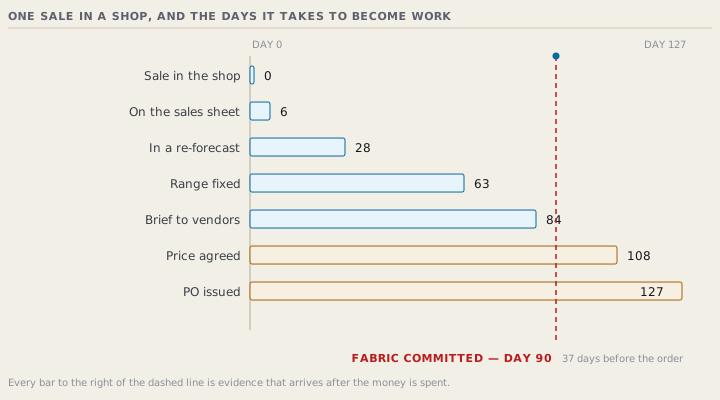
| Event | Date | Days from the sale |
|---|---|---|
| A customer buys a jersey top in an Ovenden shop | 4 March | 0 |
| The sale appears on Ovenden's weekly sales, stock and intake sheet | 10 March | 6 |
| It is inside a re-forecast at the monthly trading review | 1 April | 28 |
| The autumn range is fixed at the range meeting | 6 May | 63 |
| Open-to-buy is released and the sourcing brief goes to vendors | 27 May | 84 |
| Price agreed, counter sample approved | 20 June | 108 |
| Purchase order OV/AW/4471 issued to Marrash | 9 July | 127 |
Open-to-buy is the money a buyer is allowed to spend on new stock for a season. Until it is released, nobody at Ovenden can place an order, however sure they are about the style.
127 days. Eighteen point one weeks. Nobody in that chain was slow. Every handover is real work done by a competent person. A sales sheet has to close before anyone can read it. A re-forecast has to be reviewed before it can change a range. A range has to be fixed before money is released against it. A price has to be agreed before an order can be written.
The relay is not a failure. It is what a supply chain is.
Now find the day you had to decide
Here is the part that changes how you plan.
Ovenden needs OV-2140 in its distribution centre on 15 October. Marrash counts backwards from that date. Every step is a real lead time from a real supplier.
- Sea freight and customs clearance take 35 days. So the goods must leave the factory on 10 September.
- Sewing and finishing need the fabric in the factory 33 days before that. So the fabric must arrive on 8 August.
- Thabet Knitting Mills in Zarqa quotes 46 days for dyed and finished jersey, counted from a confirmed order. So the fabric order must be placed on 23 June.
- Those 46 days are 22 days of knitting and 24 days of dyeing and finishing. The greige can be booked on its own. Greige is fabric that has been knitted but not yet dyed. It must be booked on 2 June.
2 June is the day Marrash has to commit. That is 37 days before the purchase order arrives.
And the purchase order is not the information. The information is the customer who bought a jersey top on 4 March. That is 90 days before the commitment date, and Marrash never sees it at all.
Three things are wrong with every stand-in you will be offered
A stand-in is any number somebody offers you in place of real demand. Once you have measured your own relay, these stand-ins stop looking like answers.
It is late. Any number that describes what shoppers did reaches you after the day you had to act. That is not a fault in one data source. It is the shape of the relay. A signal that arrives on day 127 cannot help a decision made on day 90.
It belongs to someone else. A country's apparel imports, a category's performance, a competitor's expansion — none of these says anything about your own order book. Lesson 4 does the arithmetic on why a big total cannot describe you, and the result is worse than most people expect.
It is for sale. Anything you can buy, the three factories quoting against you can buy too. Same price, same day. A signal everybody has is not an advantage. At best it stops you being the last to know. That is worth something, and lesson 4 puts a price on it.
The signal ledger
The discipline this course builds is one sheet of paper. Every time something reaches Marrash that might bear on future demand, it gets a row. The row has three columns, and those three columns are the whole method.
- What was observed — the event itself, written as a fact, not as an interpretation. Ovenden asked what we have free in weeks 30 to 33. Not Ovenden is planning a big autumn.
- Whose demand it is about — this buyer, this category, this season, or somebody else's entirely.
- How old it was when it reached us — in days, counted from the event, not from the email.
The third column is the one that does the work. It turns an argument about whether a signal is any good into a simple sum: does it arrive before the day you have to decide? That question has an answer.
Check yourselfMarrash's owner says the factory should wait for confirmed orders and stop guessing. Using the dates above, what is he really choosing?Show the answer
He is choosing to be 16 days late. The fabric chain is 46 days, and making the garments takes another 33 days. The purchase order arrives on 9 July, against a 10 September date for leaving the factory. Waiting for the order is not a neutral, careful position. It removes the option to serve this buyer at all. The real question is never whether to commit before the evidence arrives. It is how much to commit, and lesson 6 prices that.
Check yourselfWhich single number in the relay table would you most want to shorten, and can you?Show the answer
None of them is yours. Every gap in that table happens inside Ovenden, or between Ovenden and its vendors. The factory cannot shorten the relay. It can only find out earlier that something is moving along it. That is the whole subject of lesson 3, and it is why the answer in this course is observation rather than forecasting.