Lessons · Lesson 3 of 6
- 01 · You cannot see demand from here
- 02 · Your own order book, and what it is allowed to prove
- 03 · The buyer's behaviour arrives before the buyer's order
- 04 · Why a published forecast cannot answer your question
- 05 · A signal or a hope: what would it cost them to change their mind?
- 06 · Buy the option, not the bet
The buyer's behaviour arrives before the buyer's order
Keep a log of what your buyer does, count how often each kind of behaviour turned into an order, and see why four people who were all right still missed the same signal.
Lesson 3 of 6 · 21 min
The thing nobody publishes
A buyer changes how it behaves before it changes what it orders. That is because a buyer's behaviour comes from its planning process, and the planning process runs months ahead of its purchase orders. Every one of those changes is visible to you. It is free, and it has a date on it.
This is the strongest finding in the course, and it is almost embarrassing: the earliest reliable demand signal a factory gets is a change in its own buyer's behaviour, and it costs one column in a spreadsheet.
Last season, in order
Marrash went back and listed the six things it noticed about Ovenden's autumn programme before the order came. Each one was written down somewhere at the time. No two were written down in the same place.
| Date | Seen by | What Ovenden did |
|---|---|---|
| 3 February | Merchandiser | Moved its autumn range review 21 days earlier, from 20 May to 29 April |
| 19 February | Sampling room | Asked for a hand-feel swatch in a 185 gsm interlock never quoted to them before |
| 27 February | Owner | Asked what the factory would have free in weeks 30 to 33, with no style attached |
| 11 March | Merchandiser | Sent autumn tech packs with a placeholder colour instead of a reference |
| 2 April | Costing | Asked for a price on 48,000 pieces, then asked again on 72,000 |
| 24 April | Merchandiser | Sent its own planner onto a vendor call, for the first time in four seasons |
Now put the factory's two decisions and the order on the same line.
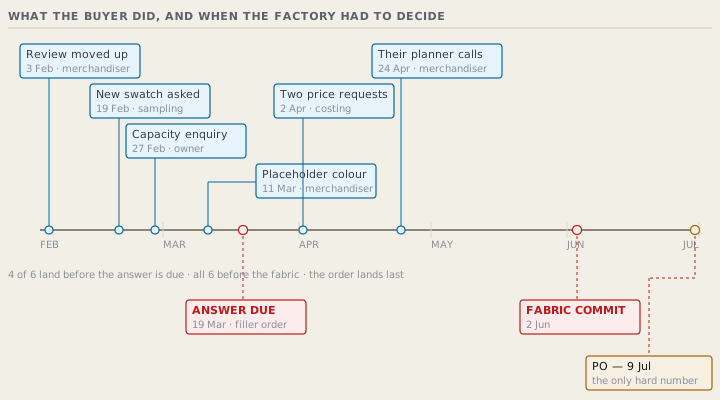
The agent, Trentham Sourcing, needed an answer on a filler order by 19 March. A filler order is a small job taken to keep a line busy. The fabric had to be committed by 2 June. The purchase order arrived on 9 July.
- The first observation lands 156 days before the order.
- It lands 44 days before the capacity decision. Four of the six observations arrive before that decision.
- All six arrive before the fabric decision.
- The order itself is the only hard number in the sequence. It arrives 112 days after the capacity decision was due.
So every reassuring number here arrives too late to use. Every number you can use is a behaviour.
The mistake nobody made
On 19 March, Marrash's owner took the Trentham filler. It was a fair decision made by an experienced man, and it cost the factory a lot.
Ovenden placed 48,000 pieces on 9 July. Marrash had no capacity. It found 12,000 pieces at short notice and turned down 36,000. At USD 1.72 a piece, that is USD 61,920 of contribution walking out of the door in one afternoon. The 36,000 also went to a competitor, who now has a season of Ovenden's history. Marrash cannot put a price on that, so it writes it down as unpriced instead of guessing.
Here is what makes this worth a lesson. Nobody was wrong.
The merchandiser saw the calendar move and filed the email under Ovenden. Correct. The sampling room logged the interlock swatch in the swatch register. Correct. The owner took the capacity call on his phone and remembered it as a pleasant chat. Correct. The tech packs went into the tech-pack folder. Correct. Four capable people, four correct filings, four different systems.
On 19 March the owner made the capacity decision holding exactly one of the four observations: the phone call he had taken himself three weeks earlier. He weighed one vague memory against a firm order from an agent, and chose the firm order. Given what was in front of him, that is the right call.
There was no place where the four sat on one page. That is the whole defect. The fix is a page.
Give it a base rate, or it is only a mood
A log with no denominator is a place to store optimism. So Marrash went back through six seasons and counted how often each kind of observation really turned into an order.
| What the buyer did | Times logged | Became an order | Conversion |
|---|---|---|---|
| Asked about free capacity, with dates and no style | 41 | 26 | 63.4% |
| Sent a written seasonal forecast | 19 | 7 | 36.8% |
A capacity enquiry converted 26.6 points better than a written forecast. Both cost the buyer the same in money: nothing.
The reason is simple. A seasonal forecast is written by someone filling in a template on a date set by their own calendar, whether or not they have anything to say. A capacity enquiry comes from someone who has already decided to do something and is checking whether it can be done. The signal is in how the buyer spends their own time, not in what they write down. Lesson 5 turns that into a rule you can apply to any statement a buyer makes.
The half that keeps you honest
Fifteen of the 41 capacity enquiries came to nothing. Marrash turned down two filler orders because of two of them, and lost USD 18,400 of contribution doing it.
That number belongs in the log next to the wins, for good. A signal at 63.4% is a good signal, and it is still wrong more than a third of the time. A factory that treats it as a promise will one day refuse real money for an order that never comes. Lesson 6 is about what to do instead of choosing between believing it and ignoring it.
And note what the base rate is not. Twenty-six out of 41 is a small sample. Lesson 6 measures how imprecise it really is: precise enough to settle some decisions, not others.
Check yourselfYour buyer's merchandiser asks, in passing, whether you could hold two lines in September. What goes in the log?Show the answer
The date, that it was the merchandiser and not the sourcing office, the exact weeks named, and that no style was attached. Not "they are planning a September programme". If the log fills up with your readings of events, you can no longer count anything: next season you will not be able to tell what was seen from what was guessed, and the base rate quietly stops meaning anything.
Check yourselfWhy is deleting the observations that came to nothing the worst thing you could do to this log?Show the answer
They are the denominator. A log holding only the observations that became orders shows a conversion of 100% and justifies any decision at all. The 15 enquiries that died are what turn 26 wins into 63.4%. You can act on 63.4%. 100% is a mood.