Lessons · Lesson 2 of 6
Bought, built, granted: how long until a rival has it
Price every advantage you claim by what it would cost a competitor to have it and how long they would wait, and find which of them is actually defensible.
Lesson 2 of 6 · 19 min
A different question about the same three classes
Course 26.6 sorts a factory's position into three classes: granted by a government, given by a location, built by the firm. The question it answers is who decided this. That sort is the right first move, and this lesson does not repeat it.
The question here is the second one, and it is the one that decides where to spend money: how long, and at what price, until a competitor who wants this advantage has it too?
Call it the imitation clock. Every advantage has one. Some clocks run in weeks, set by a machine builder's lead time. Some run in years, and cannot be shortened by spending more. And a clock you cannot see is why factories keep investing behind advantages that stopped being advantages two seasons ago.
Three classes, sorted by the clock rather than by the decider.
Bought. A purchase order and a lead time. Anyone with the money and the same lead time has it. The clock is the supplier's, not yours.
Built. Piled up over time, not bought. Nobody sells it, and spending twice as much does not halve the wait. The clock runs on your competitor's volume, or on their elapsed record. Those are two different clocks.
Granted. Not yours at all. Course 26.6 owns this class in full. The only thing to add here is that its clock belongs to somebody who has never seen your factory, and it can run backwards.
What a built advantage actually looks like, measured
Kelverin has been making coveralls for four years. Its own production records hold the standard minute value it achieved month by month. The standard minute value is the standard work content of one garment, in minutes. Beside each month, the records hold the total number of coveralls the factory had made by then.
| Month | Cumulative coveralls made | Standard minute value |
|---|---|---|
| 0 | 0 | 61.4 |
| 12 | 148,000 | 52.0 |
| 24 | 372,000 | 45.8 |
| 36 | 672,000 | 42.4 |
| 48 | 954,000 | 41.2 |
Two readings. The second is the one nobody expects.
The minutes fall with units, not with months. The curve does not flatten because four years have passed. It flattens because the easy method improvements were found early. The first 148,000 coveralls bought 9.4 minutes, which is a minute for every 15,745 coveralls. The last 282,000 bought 1.2 minutes, which is a minute for every 235,000 coveralls. That is 14.9 times as expensive.
So the clock runs at your competitor's volume, not at yours. Kelverin took 48 months to reach 41.2 because it makes about 282,000 coveralls a year. A rival with a 900,000-piece workwear book reaches 954,000 cumulative coveralls in 12.7 months. The same journey, at 3.8 times the speed, for no reason except that they are bigger.
That is worth having on a wall. A built advantage is not protected by how long it took you. It is protected by how long it takes them, and that is a different number.
Pricing the advantage against the right rival
Kelverin's cost per standard minute is USD 0.1120. Course 26.6 shows how that number is built from a line's own accounts; here it is simply used. So one minute of standard minute value is worth USD 0.1120 a coverall, and the advantage is worth whatever the gap is. Against whom?
Against a factory that has never made a coverall, the gap is 61.4 minus 41.2, which is 20.2 minutes:
20.2 x USD 0.1120  =  USD 2.26 a coverall
x 282,000 coveralls =  USD 637,997 a year
Against a serious rival that has already made 372,000 of them, the gap is 45.8 minus 41.2, which is 4.6 minutes:
4.6 x USD 0.1120   =  USD 0.52 a coverall
x 282,000 coveralls =  USD 145,286 a year
The same advantage is worth USD 637,997 or USD 145,286, depending entirely on who is standing opposite. A factory that prices its edge against a beginner will over-invest behind it, and will be surprised in the tender. Price it against the rival you actually lose to.
The clock on everything Kelverin claims
Zohdy listed seven things he believes make Kelverin hard to beat. Wassef priced each one the way a competitor would have to.
| Claimed advantage | What it costs a rival | How long | Class |
|---|---|---|---|
| Automated pocket-setting cell | USD 138,000 | 5 months, the builder's lead time | Bought |
| Seam-sealing line | USD 61,500 | 4 months | Bought |
| Protective-garment scheme certification | USD 26,400 | 9 months | Bought |
| Fourteen lines and 640 operators | the same per line as Kelverin paid | as fast as they can recruit | Bought |
| Coverall standard minute value of 41.2 | not for sale at any price | 954,000 coveralls | Built |
| Workwear on-time-in-full of 89%, measured over four years | not for sale at any price | four years, whatever the volume | Built |
| Duty treatment into this destination | not obtainable by a factory | set elsewhere, see course 26.6 | Granted |
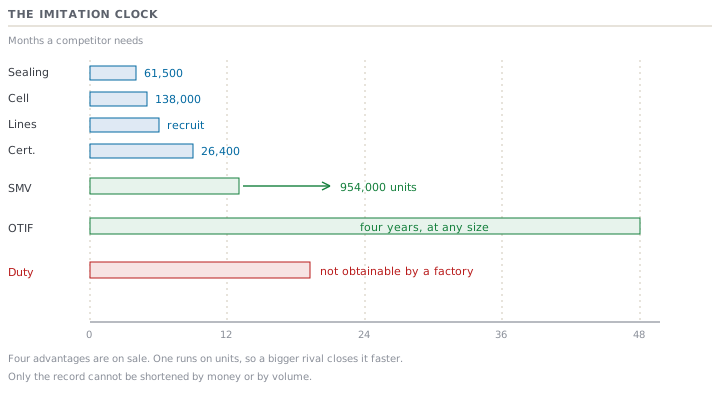
Four of the seven are available to anyone with a bank inside nine months. One is granted, and belongs to a ministry. Two are built. And one of those two, the standard minute value, is under thirteen months away for a rival with three times Kelverin's coverall volume.
That leaves exactly one line on the sheet whose clock cannot be shortened by money or by volume: on-time-in-full, measured over four years. On-time-in-full means the whole order shipped, complete, on the date confirmed. A rival cannot show four years of despatch performance in less than four years, at any price and at any size. The thing being sold is not a capability. It is a record, and a record is made of elapsed time. It is the only advantage in Kelverin's list with that property, and it is the one that appears on none of its marketing.
The mistake nobody made
Two years ago Kelverin bought the automated pocket-setting cell to defend its workwear position. Every step was correct.
The machine was demonstrated on Kelverin's own coverall. It took 1.8 minutes out of the standard minute value. At USD 0.1120 a minute across 282,000 coveralls that is USD 56,851.20 a year, against a price of USD 138,000. So the payback is 2.43 years, comfortably inside the machine's life. It was installed on time, it worked, and the quality of the pocket improved as well. Nobody was wrong about anything.
Sixteen months later, three competitors had the same cell. The builder sells it to anyone. One of the three put it on a casual-bottoms line, where the pocket count is much the same. At the next round of quoting, Kelverin's coverall price came down by USD 0.19 a piece, because the buyer had re-benchmarked against factories that now had the same machine.
| USD a year | Bought the cell | Did not buy it |
|---|---|---|
| Standard minute value saving | 56,851.20 | 0.00 |
| Price given back at re-benchmarking | -53,580.00 | -53,580.00 |
| Depreciation over five years | -27,600.00 | 0.00 |
| Maintenance | -4,200.00 | 0.00 |
| Net | -28,528.80 | -53,580.00 |
The price cut handed the buyer 94.2% of the saving. Kelverin still owns the USD 138,000, so the cell now costs it USD 28,528.80 a year and returns an advantage it no longer has.
And buying it was still the right decision. Not buying would have cost USD 53,580.00 a year: the same price cut, with none of the saving. So the purchase is USD 25,051.20 a year better than the alternative. Both are worse than the world before anyone bought one.
That is what a bought advantage is, stated exactly. It is not a reason to be chosen. It is the price of staying eligible. Once a machine exists in your category, you buy it to stay where you were. Nobody gets ahead, the buyer takes the saving, and the factory that bought first paid for the benchmark everyone is now measured against.
Check yourselfA competitor announces the same certification you spent nine months getting. How much of your advantage has gone?Show the answer
All of it. And the announcement was not the moment it went. It went the day the scheme became open to anyone who pays and passes. A certification is a bought advantage with a queue in front of it, so its life is the length of the queue, not the length of your certificate. What survives is anything the certificate merely evidences: the four years of failure data behind it, the auditor's history with your site, the people who know the standard. Those are built, and they were never on the certificate.
Prompt · Put an imitation clock on everything I claim
Before a capital approval, before rewriting a capability pack, and whenever somebody in the room says a competitor cannot match you.
Act as a competitor checking my factory over before deciding what to do about it. I will list the advantages my company believes it has. Your job is to price each one the way a rival who wanted it would have to. For every item, produce four columns: what it would COST a competitor in money, how LONG it would take them, whether that wait is set by a supplier's lead time, by a number of UNITS they must produce, or by ELAPSED time that no amount of money or volume shortens, and a class of BOUGHT, BUILT or GRANTED. Follow these rules. Anything with a price and a lead time is BOUGHT, however proud we are of it: machines, certifications, software, a building, headcount. Call something BUILT only if you can say why it cannot be purchased, and then say which clock it runs on. If it runs on units, note that a rival with more volume than me closes it faster than I did, and ask me for their volume. Call something GRANTED only if a government or a scheme decides it, and say plainly that I can qualify for it but never own it. Where I have given you no figure, write UNKNOWN rather than estimating. My claimed advantages are: [LIST]. My annual volume in the relevant category is [NUMBER]. Finish with three things: which of my advantages has the SHORTEST clock, which has the longest, and the single line on the list that a competitor could not shorten with either money or volume. If there is no such line, say so directly, because that is the finding.
AI can make mistakes — check anything you act on.