Lessons · Lesson 4 of 6
The arithmetic of narrowing
Work out how much of the capacity a refusal frees has to be re-sold before the refusal pays, and find the second threshold nobody mentions.
Lesson 4 of 6 · 18 min
The proposal, and the two objections it always gets
After lesson 3, Wassef put a proposal on Zohdy's desk. Three refusals.
- No five-pocket enquiry whose smallest colour is below 15,000 pieces.
- No hospitality tunics or aprons.
- No ladies woven blouses.
It gets the same two objections everywhere it is proposed, and both are reasonable.
You are throwing away contribution that is positive today. True.
You cannot fill the lines with work that has not been enquired about. Also true.
Neither is an argument. They are two quantities. This lesson is the arithmetic that puts a number on each, so the decision can be made rather than debated.
What the refusal costs and what it frees
Both sides come straight out of lesson 1's sheet.
| Line-days released | Contribution given up, USD | |
|---|---|---|
| Five-pocket below the threshold | 425 | 17,280 |
| Hospitality tunics and aprons | 233 | 22,490 |
| Ladies woven blouses | 141 | 9,120 |
| Total | 799 | 48,890 |
So the trade is exact: 799 line-days, for USD 48,890.
Note what those 799 line-days are worth as a group. 48,890 divided by 799 is USD 61.19 a line-day, against a factory average of USD 258.25. Nearly a quarter of Kelverin's capacity is being rented out at less than a quarter of the going rate.
The crossing point
The refused work has to be replaced by something. The natural replacement is workwear at USD 420.26 a line-day. So:
contribution given up                      USD 48,890
workwear contribution per line-day         USD 420.26
line-days that must be re-sold as workwear      116.3
freed line-days                                   799
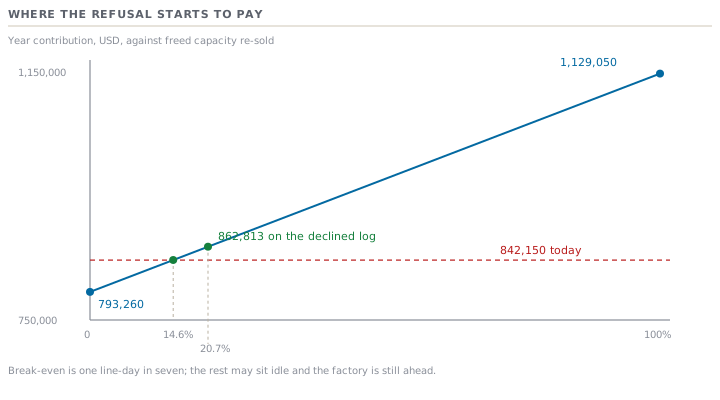
share of freed capacity that must convert       14.6%
A refusal pays for itself if it converts one line-day in seven. The other six may sit idle and the factory is still ahead.
That number is the whole reason this decision is not the gamble it feels like. It feels like trading 799 days of certain work for a hope. It is not. It is trading 799 days of very poor work for 116.3 days of good work, and the rest is upside.
Where the replacement work comes from
Three answers get given to this question. Two are evidence and one is a mood.
First: enquiries you already turned away. This is the strongest source, because it is measured rather than forecast. Kelverin's declined-and-lost-on-capacity log from lesson 3 holds 11 workwear enquiries in the year that it either declined or lost on lead time, totalling 268 line-days of work. At Kelverin's real workwear win rate of 61.8%, those are worth 165.5 expected line-days.
165.5 expected line-days
against 116.3 needed to break even
cover of 1.42 times
The refusal pays on evidence Kelverin already holds, before any new selling happens at all. 165.5 is 20.7% of the 799 freed, so four line-days in five may still go empty.
Second: a higher win rate on the enquiries you already get. A narrower factory samples faster, quotes sooner and has a better reference list, so its win rate should rise. That is a plausible mechanism, and it is still an assumption. So do not forecast it. Solve for it. Kelverin quoted 34 workwear enquiries and won 21, and its average won workwear order is 61.7 line-days. To gain 116.3 line-days from win rate alone, it needs 1.9 more orders out of the same 34.
21 wins becomes 22.9 wins
34 enquiries unchanged
win rate 61.8% becomes 67.3%
uplift required: 5.5 percentage points
5.5 points is a small, specific claim that can be proved wrong, and Kelverin will know within two seasons whether it happened. That is a completely different quality of number from "we will be more focused and therefore better".
Third: the mood. Being clearer about who we are will bring us work. It may well. It is not a number, it cannot be checked, and it must not be allowed to carry any part of the case.
The addressable book shrinks, and by how much
Now the cost side that gets left out. Kelverin answered 109 enquiries in the year. After the three refusals it would have answered 71.
| Category | Enquiries before | Enquiries after |
|---|---|---|
| Workwear | 34 | 34 |
| Five-pocket bottoms | 28 | 16 |
| Chino and flat-front bottoms | 21 | 21 |
| Hospitality tunics and aprons | 14 | 0 |
| Ladies woven blouses | 12 | 0 |
| Total | 109 | 71 |
A 34.9% cut in the book you can go after. That is the real price of a position, and it is why most factories never take one. The enquiry count is the number a sales manager watches, and it goes down on purpose.
Some of that is a saving rather than a loss. Kelverin spends about USD 410 of merchandising, costing and sample-room time on each enquiry it answers. So 38 refused enquiries release USD 15,580 a year of capacity, in the one department everybody says is overloaded.
The whole case, on Kelverin's own records
| USD a year | If nothing converts | On the declined log alone |
|---|---|---|
| Contribution given up | -48,890 | -48,890 |
| Contribution won back | 0 | 69,553 |
| Quoting cost released | 15,580 | 15,580 |
| Net | -33,310 | 36,243 |
The downside is USD 33,310 a year, which is 4.0% of the year's contribution. The evidence case is USD 36,243. And if the freed capacity fills completely, the year's contribution rises from 842,150 to 1,129,050, which is up 34.1%.
The second threshold, which nobody mentions
Run the evidence case all the way through, and something uncomfortable appears.
| Before | After | |
|---|---|---|
| Line-days used | 3,261 | 2,627.5 |
| Line-days idle, of 3,472 | 211 | 844.5 |
| Contribution, USD | 842,150 | 862,813 |
| Contribution per line-day, USD | 258.25 | 328.38 |
The factory earns more money and is emptier. Contribution per line-day rises 27.2%, and idle capacity rises from 211 line-days to 844.5, which is 24.3% of everything Kelverin owns.
So there are two thresholds, not one, and only the first is ever discussed.
- Convert 14.6% of the freed capacity and the refusal pays. This is a profit question.
- Convert 100% of it and the refusal costs the factory nothing in size. This is a capacity question.
Between the two you are running a better factory with emptier lines. You must decide which of those two facts you are managing. The honest options are three: sell harder into the narrowed category, find a second category that shares the same machines and skills, or be smaller. What you cannot do is take the position and pretend the capacity question is not attached to it. The quiet month will make the decision for you, and that is lesson 5.
Check yourselfYou free 500 line-days by refusing a category, and none of them converts. Have you lost money?Show the answer
Yes. The amount is exactly the contribution the category was making, less the quoting cost you no longer spend on it. Overhead does not fall when a line goes quiet. What has changed is the shape of the loss. It is a single, visible, decided number that you can watch and reverse, instead of a return per line-day nobody had ever measured. Size it before you commit, and set a date to review it against the enquiries that actually arrived.