Lessons · Lesson 2 of 6
Four regimes, one order: the choice is cash and admin
Price the four duty-relief regimes against the same order, and choose between them on money and administration rather than on tax, because the tax outcome is the same.
Lesson 2 of 6 · 20 min
The regimes end in the same place
Put drawback, bonded warehousing and inward processing side by side on TR-7715. The duty outcome is the same in all three: nothing. Halvern ends up bearing no Marnesa duty on cloth that left again in a chino.
So the choice cannot be made on tax. It is made on three other things: when the money moves, what has to stay true for the relief to survive, and how much administration it takes to keep it true. This lesson prices the first two on one order. Lesson 5 prices the third across a year.
The clock the money runs on
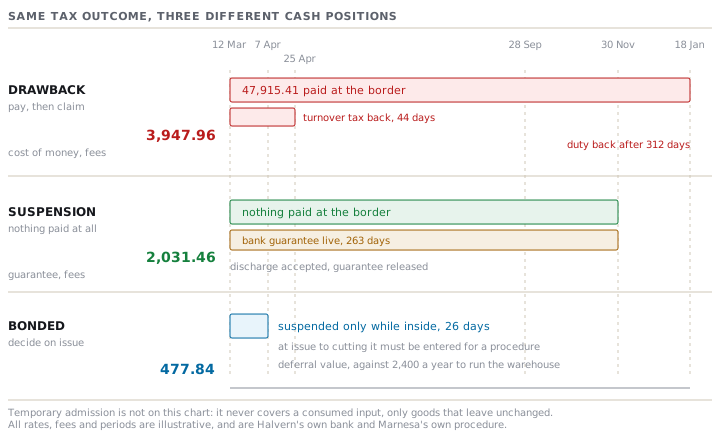
TR-7715's dates:
| Event | Date |
|---|---|
| Fabric lands, Presik | 12 March |
| Cutting starts | 7 April |
| First sailing | 3 July |
| Second sailing | 21 August |
| Last sailing | 28 September |
| Drawback claim filed | 20 October |
| Drawback paid | 18 January |
| Inward-processing discharge accepted | 30 November |
Halvern's bank charges 14.0% a year on its working-capital line. It issues customs guarantees at 1.8% a year on the guaranteed amount, plus a fixed issuance fee. Those two rates are Halvern's own, quoted to it by its own bank. They are not a market rate.
Regime one: pay it and claim it back
Halvern pays the full USD 47,915.41 on 12 March. The turnover tax comes back on the return filed for March, credited 25 April, which is 44 days. The duty comes back only after the goods are exported and a complete claim is filed and processed. That runs from 20 October to 18 January, so 312 days from the day it was paid.
- Duty out for 312 days: 20,772.58 × 14.0% × 312 ÷ 365 = USD 2,485.88
- Turnover tax out for 44 days: 27,142.83 × 14.0% × 44 ÷ 365 = USD 458.08
- Broker's drawback claim fee: USD 620.00
- Four clerk-days assembling the claim at USD 96 a day: USD 384.00
That is USD 3,947.96, and there is one risk that matters more than the number. The duty is already paid. If the claim is short of a document, or filed after the claim window closes, or the export entries do not tie to the import entries, the money simply stays paid. Drawback is the only one of the four where failing quietly costs you the whole duty, rather than producing a bill you can argue about.
Regime two: suspend it from the start
Under an inward-processing authorisation, Halvern declares the cloth for processing on 12 March and pays nothing. Marnesa requires a guarantee for 100% of the suspended duty and tax, which is USD 47,915.41. The bank issues it on 12 March and releases it when discharge is accepted on 30 November, so 263 days.
- Guarantee at 1.8% a year for 263 days: 47,915.41 × 1.8% × 263 ÷ 365 = USD 621.46
- Issuance fee: USD 260.00
- This order's share of the annual authorisation fee: USD 1,150.00
That is USD 2,031.46, against USD 3,947.96 for drawback. On one order the suspension route is USD 1,916.50 cheaper, and the gap is almost entirely the cost of money.
Regime three: put it in bond and decide later
A customs warehouse suspends the charges while the goods are inside it. The moment cloth is issued to the cutting room it has left the warehouse, and at that point it must be entered for something: home use, or a processing procedure. So bonded warehousing does not, on its own, get Halvern to the same place as the other two. It defers, and it defers the decision.
On this order the cloth sits 26 days between landing and cutting. Deferring USD 47,915.41 for 26 days at 14.0% is worth USD 477.84. Against that sits the cost of running an approved warehouse: in Halvern's case an illustrative USD 2,400 annual authorisation, a physically separate and lockable bay, and a monthly stock return. On TR-7715 alone, bonded warehousing loses money.
It is still the right answer in one situation, and lesson 6 comes back to it: when you genuinely do not yet know whether the goods will be exported or sold at home. Bonded storage buys you the right to decide later, and you can now put a number on that right. Track 23 owns the warehouse itself. This is only its customs status.
Regime four: the things that leave unchanged
Temporary admission is not an option for the fabric at all, and this is the most common misunderstanding in the group. It is for goods that come in and go out again in the same state. Inputs that get used up are excluded by definition, because the cloth leaves as a chino, not as cloth.
On TR-7715 it applies to exactly three things:
| Item | Value, USD | Duty if entered for home use, at 12.0% |
|---|---|---|
| Two fit forms supplied by Tolgate and Byrne | 4,900 | 588.00 |
| Salesman sample range, 46 pieces, out and back | 3,500 | 420.00 |
| Pocket-welt machine on trial from the supplier | 30,000 | 3,600.00 |
| Total | 38,400 | 4,608.00 |
The obligation attached is simple and unforgiving. The goods must physically leave again, identifiably, within the permitted period, or the whole amount falls due. A sample range that gets cut up for a fit session has not left. A trial machine the factory decides to keep has to be regularised, and the sooner the cheaper.
Reading the table the way a finance director does
| Drawback | Inward processing | Bonded warehouse | Temporary admission | |
|---|---|---|---|---|
| Cash at the border | 47,915.41 | nil | nil while inside | not available for cloth |
| Cost of money and fees, this order | 3,947.96 | 2,031.46 | 477.84 saved, 2,400 a year to run | per entry |
| Duty finally borne on exported cloth | nil, if the claim succeeds | nil, if the discharge is accepted | decided on issue | nil, if the goods leave |
| How it fails | claim rejected, duty stays paid | discharge refused, duty plus surcharge falls due | stock account does not tie | goods do not leave in time |
| Who is exposed while it runs | you | your bank, then you | you | you |
Read the bottom two rows before the top two. Every one of these regimes is a conditional relief. You are not exempt, you are trusted, and the condition is a record you have to be able to produce later. Which is why the next lesson is about a single number on that record.
Check yourselfYour finance director asks why the factory should pay a bank 1.8% for a guarantee when drawback costs nothing to enter. What do you say?Show the answer
Drawback costs nothing to enter and a great deal to carry. It puts the full border charge, on this order USD 47,915.41, into the customs authority's hands. The duty half of it stays there until the claim is processed, which is 312 days on this calendar. At Halvern's own 14.0% working-capital rate that is USD 2,485.88 on the duty alone. The guarantee costs USD 621.46 and leaves the money in the business. The bank fee is buying back nearly ten months of working capital.
What to take away
- All three of the real relief routes end with no duty borne. Choose on cash, on risk and on administration.
- On one order, suspension beat drawback by USD 1,916.50, almost all of it the cost of money.
- Drawback is the only route where a quiet failure costs you the whole duty with nothing to appeal.
- Bonded warehousing buys the right to decide later. Price that right. Do not assume it.
- Temporary admission never covers inputs that get used up. It covers sample ranges, fit forms and loaned machines, and it is enforced on whether the thing physically left.