Lessons · Lesson 1 of 6
The same cloth, taxed at two borders
See the two duty layers sitting on one order's fabric, work out which one a relief regime can remove, and price what happens if it is not removed.
Lesson 1 of 6 · 20 min
Two borders, one piece of cloth
A garment factory that imports its fabric is an importer before it is an exporter. That one fact is the whole of this course.
12 March, Presik. Halvern Apparel takes delivery of 41,712 metres of 320 gsm cotton twill from Nurbek Textile. It is for purchase order TR-7715 from the British menswear retailer Tolgate and Byrne: 26,400 men's chinos, style CH-208, FOB Presik USD 9.85, order value USD 260,040. FOB means the price of the goods loaded on the ship at Presik, before any sea freight. Three sailings, the last on 28 September.
The cloth lands at USD 4.15 a metre. So USD 173,104.80 of fabric crosses into Marnesa, where Halvern's factory is. Marnesa's customs charge duty on it, because it is an import. Six months later the finished chinos leave for Tolgate and Byrne's market. That market's customs charge duty on the garment, and the value of a garment includes the cloth it is made of.
The same cloth is taxed twice, by two administrations, and neither has done anything wrong. Duty relief is the set of procedures that removes the first layer. The reasoning behind it is simple. The cloth was never really for Marnesa. It only passed through on its way to becoming something else.
The first layer, in Marnesa
Marnesa charges an illustrative 12.0% duty on imported woven cotton fabric. On top of the duty-inclusive value it charges an illustrative 14.0% import turnover tax, which is a sales tax collected at the border. On this shipment:
| Line | Amount, USD |
|---|---|
| Fabric, 41,712 metres at 4.15 CIF Presik | 173,104.80 |
| Duty at an illustrative 12.0% | 20,772.58 |
| Value for the turnover tax | 193,877.38 |
| Turnover tax at an illustrative 14.0% | 27,142.83 |
| Paid at the border | 47,915.41 |
CIF is the value of the goods with sea freight and insurance included, which is the value most customs authorities charge duty on.
Those two numbers behave completely differently. Separate them now, because the choice of regime in the next lesson turns on the difference.
The turnover tax comes back. Halvern is registered for the tax, it goes on the next return, and it is credited. It is not a cost. It is USD 27,142.83 out of the bank for as long as the return takes. That is a cash-flow problem.
The duty does not come back through any tax return. Once it is paid on cloth that leaves again inside a garment, it is gone, unless a relief procedure returns it. That is a margin problem.
What the duty does to this order
Here is Halvern's cost sheet for CH-208, per piece, built on duty-free cloth:
| Line | USD per piece |
|---|---|
| Fabric, at the landed price with no duty | 6.30 |
| Trims | 0.62 |
| Cut, make and trim | 1.55 |
| Finishing, packing, inland to port | 0.28 |
| Factory overhead | 0.34 |
| Factory cost | 9.09 |
| Margin | 0.76 |
| FOB Presik | 9.85 |
A margin of USD 0.76 a piece is 7.72% of FOB. That is a normal, healthy chino. On 26,400 pieces it is USD 20,064.00 of profit.
Now put the duty back. USD 20,772.58 spread over 26,400 pieces is USD 0.7868 a piece. That is very nearly eight per cent of the FOB Halvern quoted.
Profit without duty relief: USD 20,064.00 − USD 20,772.58 = minus USD 708.58.
The order does not make money. It very slightly loses money. Nobody mispriced it, nobody negotiated badly, and the customer is not to blame. The relief is not a bonus on this order. The relief is the margin.
The second layer, and what relief cannot touch
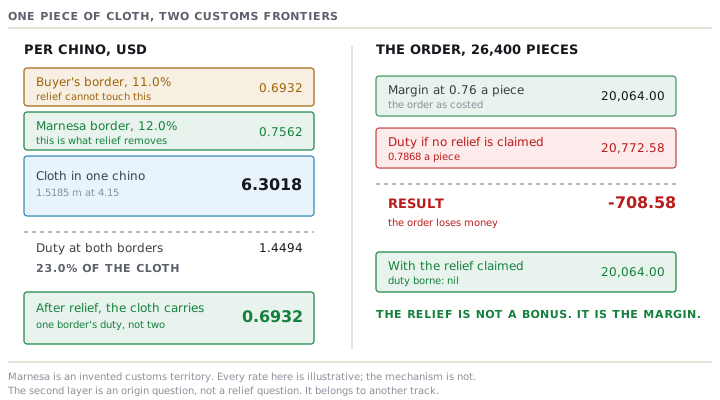
The chino arrives in Tolgate and Byrne's market at a CIF value of USD 10.40. That is the FOB of 9.85 plus 0.55 of ocean freight and marine insurance. At an illustrative 11.0% the duty is USD 1.144 a piece, or USD 30,201.60 on the order. The buyer pays it.
Of that USD 10.40, the cloth is USD 6.3018. That is the 1.5185 metres each chino really consumes, at 4.15. So the cloth alone attracts:
- USD 0.7562 at the Marnesa border, at 12.0%
- USD 0.6932 at the buyer's border, as its share of the garment duty at 11.0%
That is USD 1.4494 of duty on USD 6.3018 of cloth. 23.0%, on cotton twill, at two frontiers, on the way to a shop.
A relief regime removes the first of those two and leaves the second alone. The second layer is a different question with a different answer: does the garment qualify for a lower rate under a trade agreement? That is decided by where the cloth was made and what was done to it. That subject is origin, it is a large one, and track 26 owns it. Course 8.5 builds the customs value the second layer is charged on. Neither is repeated here.
Check yourselfA factory tells you its relief claim will save the buyer duty in the destination market. Is it right?Show the answer
No, and this is a common confusion. A relief regime in the manufacturing country returns the duty that country charged on the imported inputs. It has no effect on the rate the destination market charges on the finished garment. That rate is set by the garment's classification and its origin. The two are separate decisions taken by separate authorities, and a saving on one is not a saving on the other.
Four ways to not pay it, in one sentence each
The rest of this course prices them. For now, what each one physically does:
- Drawback. Pay the duty at import as normal. Then claim it back after the goods have been exported, against proof of what came in, what was made and what left.
- Bonded warehousing. Put the goods into premises under customs control. The charges are suspended for as long as the goods sit there, and nothing is decided until they come out.
- Inward processing. Declare at import that these inputs are coming in to be worked on and sent out again. The charges are suspended from the start, against a guarantee and an approved consumption ratio.
- Temporary admission. For goods that arrive and leave again unchanged: a sample range, a buyer's fit forms, a machine on trial. Not for anything that gets used up.
Three of those four leave you owing nothing at the end. They are not equally cheap, they are not equally safe, and the reason has almost nothing to do with tax.
Prompt · Price the relief regimes against my own order
Before you put an order's imported inputs into a regime, or the first time you import materials into a country whose relief procedures you have not used.
Act as a customs and trade adviser to a garment factory, briefing a merchandiser who is not a customs specialist. Do not tell me what any country's rules are. Work only from what I give you, and tell me what to go and confirm in writing from my own customs authority. My order: buyer [BUYER], purchase order [NUMBER], style [STYLE], quantity [QTY], FOB [PRICE] and [CURRENCY], order value [VALUE]. Imported inputs I am considering: for each one, description, quantity, unit price, incoterm and landed value [LIST THEM]. My country's charges as I understand them: import duty rate on each input [RATE], import turnover tax or VAT rate [RATE], and whether the tax comes back through my normal return and after how long [ANSWER]. Dates: inputs land [DATE], cutting starts [DATE], each shipment sails [DATES], last export [DATE]. My money: working capital rate [RATE], bank guarantee rate and issuance fee [RATE AND FEE], broker fees per import entry and per export entry [FEES]. Now do four things. First, tell me for each imported input whether it is USED UP in the exported goods or leaves UNCHANGED, because that decides which regimes are available to it at all. Second, build a table comparing pay-and-claim drawback, duty suspension for processing, and customs warehousing on this order: cash at the border, cost of money worked out to the day using my own rates and dates, fixed fees, the duty finally borne, and how each one fails. Third, name the single largest cost difference between them, and say which of my working capital, my guarantee capacity or my staff time it eats. Fourth, list every fact in your comparison that you took from me rather than knowing, and every question I must put to my customs authority in writing before acting. Where you do not know a rule, say so plainly rather than describing a typical one.
AI can make mistakes — check anything you act on.
What to take away
- A factory that imports fabric pays duty as an importer, and its customer pays duty again on the same cloth inside the garment. Relief removes the first layer only.
- Duty is a margin cost. Import turnover tax is a cash cost. They need different answers.
- On a fabric-heavy garment the first layer can be the whole margin. On CH-208 it is USD 0.7868 a piece against a margin of USD 0.76.
- Nothing in this course changes the duty the buyer pays in the destination market. That is origin, and it belongs to another track.