Lessons · Lesson 3 of 6
The consumption ratio that became a customs obligation
Work out the consumption ratio a relief regime is granted against, see why the cost sheet's figure is the wrong one, and price the failure in both directions.
Lesson 3 of 6 · 22 min
One number, two owners, opposite incentives
Every relief regime that covers inputs that get used up has to answer a question that has nothing to do with tax. How much of the imported material actually went into the exported goods? The answer is a ratio, metres of cloth per garment, and the authorisation is granted against it.
That ratio already exists in a garment factory. It is fabric consumption, it is on the cost sheet, and course 8.2 explains how it is built. What almost nobody notices is what happens when it is copied onto a customs application. It stops being a costing number and becomes a declaration: enforceable, audited, and read by somebody whose incentives are the reverse of the merchandiser's.
A merchandiser building a cost sheet is right to be careful. Consumption that turns out low costs the factory cloth it has to buy at short notice, at the spot price. Consumption that turns out slightly high costs a little margin nobody will ever see. So a good merchandiser rounds up. A customs authorisation reads exactly that rounding as a claim to import more duty-free cloth than the garments will contain.
Nobody in this story does anything wrong. That is what makes it expensive.
What Halvern declared, and what it should have declared
The cost sheet for CH-208 carried 1.58 metres a piece. It was signed in January, it was cautious, and it protected the fabric line. Halvern's compliance clerk, Osgar Talvik, filled the consumption box on the authorisation application from that cost sheet, because it was the number the file already had.
The number the application should have carried is built from two things, and both of them existed:
- the net marker consumption from the approved marker and lay plan: 1.4560 metres a piece. A marker is the cutting plan that shows how the pattern pieces are laid on the cloth.
- the waste addition the authorisation permits: an illustrative 5.0% on the net consumption, covering ends of lay, joins, remnants and rejected panels
1.4560 plus 5.0% is 1.5288 metres a piece. That is the ratio you can defend, and it is 0.0512 metres a piece below what was declared.
What the cutting room actually did
Production ran better than the allowance. Actual gross consumption across the order was 1.5185 metres a piece: the same 1.4560 net, plus 4.29% of waste rather than the permitted 5.0%.
So there are now three ratios in play, and they are all real:
| Ratio | Metres | Where it came from | What it is for |
|---|---|---|---|
| Declared on the authorisation | 1.5800 | The January cost sheet | The duty-free entitlement |
| Defensible | 1.5288 | Marker plus the permitted waste addition | What the authorisation should have said |
| Achieved in production | 1.5185 | The cutting room's lay records | What actually happened |
| Net, in the garment | 1.4560 | The approved marker | The physical fact underneath all three |
Every metre has to land somewhere
This is the discipline the whole regime rests on. A metre imported under a relief authorisation has exactly three legitimate destinations, and at discharge the three must add back to what came in.
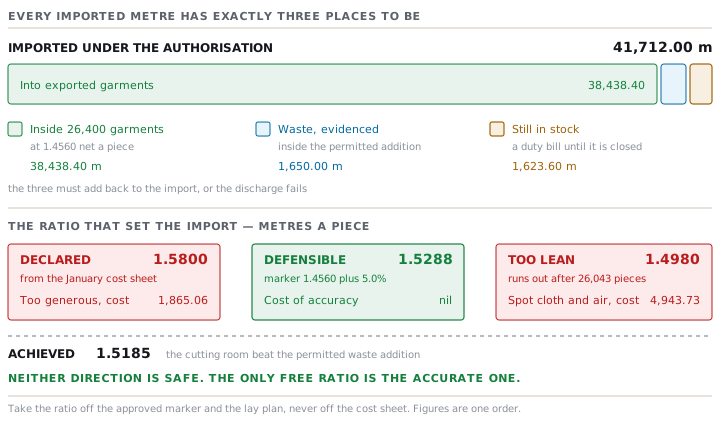
| Destination | Metres | How it is evidenced |
|---|---|---|
| Into exported garments, at 1.4560 net a piece | 38,438.40 | Export entries against 26,400 pieces |
| Waste, within the permitted allowance | 1,650.00 | Cutting-room lay records, weighed and logged |
| Still in stock under the authorisation | 1,623.60 | Bonded stock account, physically separated |
| Imported under the authorisation | 41,712.00 | The import entries |
The three lines add to the import exactly. That reconciliation is the deliverable of this lesson. A factory that can produce it on request has almost nothing else to fear.
The bill hiding in the third line
The 1,623.60 metres in the last row are not a mistake. They are cloth. They are worth USD 6,737.94, they are sitting in the store, and they entered Marnesa duty-free on a declaration that they were going to leave inside a garment. They did not.
There are four legitimate ways to close that line, and only four:
- Re-export it, as cloth, under the same authorisation.
- Roll it into the next order made under the same authorisation, so it discharges there instead.
- Pay the duty and the tax on it, and take it out of the regime into free circulation.
- Destroy it under customs supervision, if it is genuinely unusable.
Option three costs USD 808.55 of duty and USD 1,056.51 of turnover tax, so USD 1,865.06 in cash. Declared voluntarily, that is the whole bill. Found by an auditor two years later, Marnesa adds an illustrative surcharge of 25% of the duty short-paid, another USD 202.14, plus interest. More expensively, it also gives the auditor a reason to look at everything else.
Now compare that with the surplus a defensible ratio would have produced. At 1.5288, Halvern would have imported 40,360.32 metres, consumed 40,088.40, and been left with 271.92 metres instead of 1,623.60. The cost sheet's caution created 1,351.68 metres of unnecessary exposure, worth USD 1,552.71 in duty and tax. And it did so on a number that was correct for the purpose it was originally written for.
The other direction is worse
Writers of compliance procedures tend to read all that and conclude that the ratio should be set low, to be safe. It is not safe. It is the more expensive error.
Suppose Talvik had declared the marker figure with a token allowance, 1.4980 metres. The authorisation then covers 39,547.20 metres. The cutting room consumes 1.5185. Halvern runs out of authorised cloth after 26,043 pieces, with 357 chinos still to cut and a vessel booked.
| Line | USD |
|---|---|
| 541.20 metres from the mill's stock at 4.48 a metre, spot | 2,424.58 |
| Air freight and handling, 260 kg chargeable at 6.20 plus fees | 1,860.00 |
| Duty at 12.0%, outside the authorisation, unrecoverable | 514.15 |
| Broker's fee for a separate import entry | 145.00 |
| Total | 4,943.73 |
The same cloth inside the authorisation was worth USD 2,245.98. So a ratio 0.0205 metres too lean cost more than twice the value of the cloth it was short of, against USD 1,865.06 for a ratio 0.0512 metres too generous.
Neither direction is safe. The only free ratio is the accurate one.
Prompt · Build the consumption ratio the way an auditor will read it
Before a relief application is filed, and again whenever a marker or a lay plan changes on a style that is already running under an authorisation.
Act as a trade compliance manager reviewing a consumption ratio before it is declared to customs. Treat the ratio as a legal declaration, not an estimate. My style: [STYLE], quantity [QTY], sizes and ratio [BREAKDOWN], fabric [DESCRIPTION], width [WIDTH], unit price [PRICE]. The numbers I have: net marker consumption per piece from the approved marker [FIGURE] and the marker reference [REFERENCE], the fabric consumption on my cost sheet [FIGURE], the waste allowance my authorisation permits [FIGURE] and whether it is worked out on the net consumption or on the fabric issued to cutting [ANSWER], and the actual gross consumption achieved so far if there is any [FIGURE]. Do the following. First, tell me which of my figures is the right basis for the declaration and why the cost sheet figure is not, and say plainly how the incentives behind the two documents differ. Second, work out the defensible ratio both ways the allowance could be read, show me the difference in metres across the whole order, and tell me which question I must settle in writing before filing. Third, project the reconciliation at discharge: how much I will import, how much will sit inside the exported garments, how much will be waste and how much will be left in stock, and tell me what I must do with the leftover. Fourth, price the two failure directions on my own numbers: a ratio too generous, and a ratio so lean that I run out of authorised material before the last piece is cut, including spot purchase and air freight if that is what it would take. Fifth, give me the list of documents I must be able to produce two years from now to prove this ratio, and the one event that should trigger a re-declaration. Do not smooth over anything you are unsure of. Name it.
AI can make mistakes — check anything you act on.
Check yourselfYour cost sheet says 1.58 and your marker says 1.4560 with a 5.0% allowance. Which goes on the customs application, and what do you do with the other?Show the answer
The marker-derived figure, 1.5288, goes on the application. It is the one you can evidence from a document the auditor can read. The cost sheet's 1.58 stays where it is and keeps doing its job of protecting the fabric line. It is not wrong. It is answering a different question. What you must not do is let one file feed the other. If the two ever have to be the same number, make the cost sheet follow the marker, never the application follow the cost sheet.
What to take away
- A consumption ratio on a customs application is a declaration, not an estimate, and it is enforceable.
- Take it from the approved marker plus the permitted waste addition. Never from the cost sheet, whose caution is the wrong instinct here.
- Get the definition of the waste allowance in writing. Five per cent of issue and five per cent on net are different metres.
- At discharge, every imported metre must land in a garment, in evidenced waste, or in stock. The three must add back to the import.
- Too generous cost USD 1,865.06 on this order. Too lean cost USD 4,943.73. Accuracy is the cheapest of the three.