Lessons · Lesson 4 of 7
- 01 · Every mode charges you on the greater of two numbers
- 02 · The last cubic metres are the expensive ones
- 03 · What a shared box costs, and who chose what is in it
- 04 · The air chain is not a flight
- 05 · Two routes, one promise: choosing by the tail, not the average
- 06 · If you fly part of it, fly the right part
- 07 · A missed hour costs one interval of the service
The air chain is not a flight
Follow one air shipment from the packing floor to the distribution centre, and find where its nine days actually are.
Lesson 4 of 7 · 19 min
Nineteen hours of flying, nine days of shipment
Brantmere's purchase order carries an air allowance written into the costing at the start: USD 18,000. It pays for a pre-season tranche that lands weeks before the sea shipment. It is a planned expense, not a rescue. Course 27.6 prices a rescue. Course 8.4 prices a split after a plan has broken. This is neither.
Torsha books it as 2,900 snowsuits, which is 290 cartons.
| Line | Basis | USD |
|---|---|---|
| Actual gross weight | 290 cartons at 9.00 kg, 2,610 kg | |
| Volumetric weight | 290 cartons at 16.00 kg, 4,640 kg | |
| Chargeable weight | the greater of the two, 4,640 kg | |
| Air freight and handling | 4,640 kg at 3.77 | 17,492.80 |
| Air waybill | per shipment | 55 |
| Export customs entry | per shipment | 145 |
| Trucking, Bhaluka to the airport | per shipment | 165 |
| Total | 17,857.80 | |
| Per piece | 6.16 |
The flight from Dhaka to the carrier's hub is 5 h 05 m. The flight from the hub to Toronto is 14 h 20 m. That is nineteen hours and twenty-five minutes of aeroplane.
The goods were ready on Sunday 6 September. They were complete at the Mississauga distribution centre on Tuesday 15 September. That is nine days, and the aeroplane is 9.00% of it.
Everybody involved did their job correctly. Here is where the other 91% went.
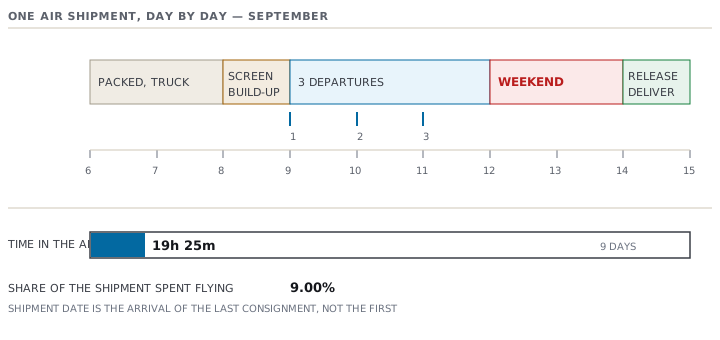
The chain, step by step
Sunday 6 September, packing floor. Cartons sealed, marked, weighed and measured. The measurement matters as much as the weight, and it gets taken far less often. That is lesson 1.
Monday 7 September, 18:00. The truck leaves Bhaluka. It does not leave earlier for two reasons. The road into Dhaka is a car park in daylight, and the agent's warehouse takes deliveries overnight.
Tuesday 8 September, 02:10. Arrival at the ground handling agent's off-airport bonded warehouse. Nothing happens for four hours. The screening line starts at 06:00.
Tuesday 8 September, 06:00 to 15:20. Screening. Torsha is not an approved consignor, so the whole shipment is screened at the airport instead of earlier, inside a secured chain. Thornbeck's allocation on the agent's X-ray line runs at about 32 cartons an hour. So 290 cartons take 9 hours 04 m, plus a changeover. Nine hours of the shipment's life, on a machine, for cargo everyone knows is padded snowsuits.
Tuesday 8 September, 15:20 to 19:00. Build-up. Loose cartons are stacked and netted onto unit load devices. Those are the contoured pallets and containers that fit an aircraft hold. This is where a badly dimensioned carton stops being a costing problem and becomes a physical one. Cartons that do not tessellate on the pallet base lose volume, and the aircraft charges for that volume.
Tuesday 8 September, 21:35. The airline's latest acceptance time for the 03:35 departure, six hours ahead of it. The first pallet makes it with two hours to spare.
The shipment that is really three shipments
Thornbeck holds a standing allocation of 1,600 kg of chargeable weight per flight on this route, in the belly of a passenger aircraft. There is one such flight a day.
4,640 divided by 1,600 is 2.90. The tranche needs three flights.
| Departs Dhaka | Chargeable kg | Lands Toronto | |
|---|---|---|---|
| First consignment | Wednesday 9 September | 1,600 | Thursday 10 September |
| Second consignment | Thursday 10 September | 1,600 | Friday 11 September |
| Third consignment | Friday 11 September | 1,440 | Saturday 12 September |
The third consignment lands on a Saturday. Canadian warehouses do not break down pallets at the weekend. So it is broken down and released on Monday 14 September, and delivered on Tuesday 15 September.
That is the finding. The first third of this shipment was in Toronto on Thursday, and the shipment arrived on Tuesday. An air shipment's date is the arrival of its last piece.
And it usually is the last piece that counts. The distribution centre allocates a style across stores. It cannot open a promotion in a third of the doors and wait five days for the rest. A third of an assortment is not a third of a launch. It is nothing, held in a bay, costing storage.
Flown as booked is a service, not a default
Two more things can move a consignment that has already been accepted. Neither is anybody's fault.
A booking is space on a nominated flight, and a passenger aircraft's hold is shared with baggage. On a full flight, or one carrying extra fuel for a headwind, cargo is offloaded to keep the aircraft inside its weight and balance limits. The carrier decides what gets offloaded. It ordinarily favours higher-yielding cargo, and consignments with a contractual guarantee. Some carriers sell that guarantee as a flown-as-booked product at a premium. If you have not bought it, you do not have it.
The second is the hub. A consignment that misses its onward connection waits for the next one. The frequency of the second leg is not the frequency of the first. Ask for both.
Where the screening could have been
Nine hours of the nine days were an X-ray machine at an airport. The international framework for aviation security is ICAO Annex 17. It is built around a secured supply chain: cargo handled under approved conditions from a known point onward does not have to be screened again at the airport. The regulated-agent and known-consignor schemes that put this into practice are run by each state's own civil aviation authority. What they require, what they cost, and whether they are open to a factory in your country are questions for that authority. They differ, and they change.
The reason to ask is a scheduling reason, not a security one. Screening at the airport sits on the critical path, between the truck arriving and the pallet being built, at a throughput you do not control. Screening inside a secured chain happens while the cartons are being packed. It is the same nine hours. It is nine hours in a different place.
Thornbeck's own quotation for sponsoring the approval and auditing it is USD 4,200 in the first year and USD 1,800 a year after that. Torsha ships by air perhaps six times a year. Whether it is worth it is arithmetic you can now do, and the answer is not obviously yes.
Whether these were the right 2,900 pieces
Everything above assumes the cargo is fixed, and asks how fast it moves. There is a prior question: of the 32,200 pieces on this purchase order, which ones should be on an aeroplane at all? It has a sharper answer than most people expect, and it is lesson 6.
Check yourselfYour forwarder quotes a 22-hour transit door to door on an air shipment of 6,000 kg. Do you believe it?Show the answer
Not until you have asked what allocation they hold per flight. Twenty-two hours is roughly one flight plus a connection. That is the transit of a consignment, not of a shipment. If they hold 1,500 kg a flight, then 6,000 kg is four departures, and the last of them may leave three days after the first. Ask for the allocation per departure, the number of departures a day, the latest acceptance time, whether the cargo will be screened at the airport, and what happens at the destination on a weekend. The answer is usually somewhere between five and nine days.
Prompt · Build the door-to-door clock and find the leg that owns the risk
Before you promise a buyer a delivery date, and before you accept a routing because its transit time looks shorter.
Act as a logistics planner who has been burned by transit estimates. I want a door-to-door clock for one shipment, built leg by leg, and an honest read on where the risk is. Facts: origin [PLACE], destination delivery point [PLACE], goods ready date [DATE], the date the consignee must have the goods [DATE], mode or modes offered [LIST], and for each routing the forwarder's leg-by-leg durations if they gave them. Working week at origin [DAYS], at destination [DAYS], and any public holidays in the window [LIST]. Value of the shipment [AMOUNT], and the penalty for missing the consignee's date [CLAUSE OR AMOUNT]. Do the following. First, lay out every leg with its duration, and say which are transit and which are dwell, queue or waiting. Second, for EVERY leg give me the FREQUENCY of the service: daily, three times a week, weekly, fortnightly. Next to it, put what one missed cut-off on that leg costs in days, because that is the interval, not the transit. Third, list every cut-off I own with the hour it falls, including the documentary and advance-filing ones, and mark the earliest. That is my real ship date. Fourth, tell me which legs connect to each other, and where a missed connection on a frequent leg can spend a whole interval of an infrequent one. Fifth, ask me for the forwarder's own arrival record on these routings: fastest, median, ninetieth percentile, slowest, and how many of the last thirty landed inside my required day. If I do not have it, tell me to go and get it before deciding, and say why the mean will not answer my question. Sixth, price being late using my penalty and each routing's hit rate, and put that next to the freight difference in one table. Do not present an average transit as a delivery date.
AI can make mistakes — check anything you act on.
What to take away
- The aeroplane is the short part. On this shipment it was 9.00% of the elapsed time.
- Divide the chargeable weight by the allocation per flight. That number is how many shipments you really have.
- An air shipment's date is the arrival of its last piece. A partial assortment is usually worth nothing at a distribution centre.
- Screening, build-up and the latest acceptance time are on the critical path at origin. Break-down, clearance and the destination's working week are on it at the far end.
- Flown as booked is a product you buy. Without it, your cargo can be offloaded.