Lessons · Lesson 1 of 7
- 01 · Every mode charges you on the greater of two numbers
- 02 · The last cubic metres are the expensive ones
- 03 · What a shared box costs, and who chose what is in it
- 04 · The air chain is not a flight
- 05 · Two routes, one promise: choosing by the tail, not the average
- 06 · If you fly part of it, fly the right part
- 07 · A missed hour costs one interval of the service
Every mode charges you on the greater of two numbers
Work out, once per style, whether you are buying weight or space, and why the heavier garment is the cheaper one to fly.
Lesson 1 of 7 · 20 min
One order, three garments, and three different answers
Torsha Apparels Ltd sits in Bhaluka, north of Dhaka. Purchase order BM-4412 comes from Brantmere Outdoor, a Canadian outdoor chain with a distribution centre in Mississauga. Three styles are on that one order, and they ship together:
- SN-4120, a children's padded snowsuit. Ten to a carton. FOB USD 23.60. FOB means the price of the goods loaded on board at the export port. The buyer pays the freight from there on.
- WT-2075, a men's canvas work trouser. Twenty to a carton. FOB USD 14.80.
- LS-6310, a heavyweight wool-blend crew-neck sweater. Twenty-four to a carton. FOB USD 26.50.
Ask the packing floor what a carton weighs. You get three numbers. Ask the forwarder what a carton costs to move. You get three completely different numbers, and they do not come in the same order. The snowsuit is the lightest garment on the order. It is also the most expensive one to fly.
That is not a quirk of one quotation. It is how every mode of transport is priced. And you can settle it with one division, done once per style, never repeated.
The three cartons, measured
| SN-4120 snowsuit | WT-2075 trouser | LS-6310 sweater | |
|---|---|---|---|
| Pieces a carton | 10 | 20 | 24 |
| Carton, external mm | 600 by 400 by 400 | 600 by 400 by 300 | 600 by 400 by 300 |
| Cubic metres | 0.096 | 0.072 | 0.072 |
| Gross weight, kg | 9.00 | 19.44 | 13.20 |
| Kilogrammes a cubic metre | 93.75 | 270.00 | 183.33 |
That last row is the whole lesson. It is the carton's density: gross kilogrammes divided by cubic metres. Every carrier on earth compares it against a number of their own.
The exchange rate between space and mass
No carrier sells you space alone. None sells you weight alone. A vehicle runs out of both, and never at the same moment. So every tariff carries a conversion. It says: this much space counts as this much weight. Then it charges you on whichever of the two comes out higher.
Air. The volumetric weight of a shipment is its volume turned into a weight by a divisor. In Thornbeck Freight's quotation to Torsha, and in general air-cargo use, that divisor is 6,000 cubic centimetres to the kilogramme. Check it on your own air quotation before you use it. It is a term of the carrier's tariff, not a rule of law. A shipment quoted on a different divisor is a different price.
One cubic metre is 1,000,000 cubic centimetres. So a cubic metre counts as 166.67 kg. That number is the charging line for air. Below it you pay for space. Above it you pay for weight.
Sea, in a shared container. Consolidated cargo is cargo from several shippers packed into one box. It is charged on the weight-or-measurement unit: the greater of the cubic metres and the metric tonnes. One cubic metre counts as 1,000 kg. So the charging line for shared ocean freight is 1,000 kg a cubic metre, six times higher than air's.
Road. Thornbeck's Canadian domestic tariff sells trailer floor by the loading metre: one metre of length across the full 2.40 m width. Their tariff counts a loading metre as 1,850 kg, and assumes cargo stacked to 2.60 m, which is 6.24 cubic metres. That puts their road charging line at 296.47 kg a cubic metre. Another carrier's tariff will say something else. Ask for the conversion, not just the rate.
Sea, in your own container. No conversion at all. You buy a box with a volume and a payload ceiling. You pay the same whether it is full or empty. That is a different kind of arithmetic, and it is the next lesson.
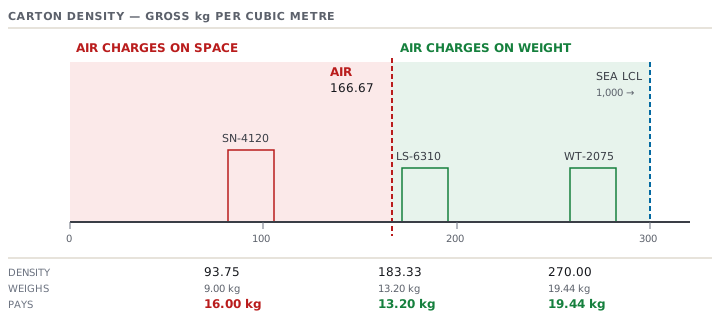
Where the three cartons fall
| Snowsuit | Trouser | Sweater | |
|---|---|---|---|
| Density, kg a cubic metre | 93.75 | 270.00 | 183.33 |
| Against air's line of 166.67 | below | above | above |
| Charged by air on | space | weight | weight |
| Volumetric weight a carton, kg | 16.00 | 12.00 | 12.00 |
| Actual gross a carton, kg | 9.00 | 19.44 | 13.20 |
| Chargeable weight a carton, kg | 16.00 | 19.44 | 13.20 |
| Against sea consolidation's line of 1,000 | below | below | below |
| Charged by sea consolidation on | space | space | space |
The snowsuit is charged on 16.00 kg and weighs 9.00 kg. Torsha pays for 7.00 kg of nothing in every carton. That is 77.78% more than the goods weigh. The trouser and the sweater are dense enough to be charged on what they really are.
At sea, all three are charged on space. Apparel never comes close to a tonne a cubic metre. In a shared container, apparel always measures. In the air, only some of it does. That one sentence saves you a great deal of guessing.
The heavier garment is the cheaper one to fly
Now put it per piece. That is the only unit a merchandiser can act on.
| Snowsuit | Trouser | Sweater | |
|---|---|---|---|
| Actual gross a piece, kg | 0.900 | 0.972 | 0.550 |
| Chargeable weight a piece, kg | 1.600 | 0.972 | 0.550 |
| Air freight a piece, at USD 3.77 a chargeable kg | 6.03 | 3.66 | 2.07 |
| Ocean freight a piece, at USD 51.04 a cubic metre | 0.49 | 0.18 | 0.15 |
The trouser weighs 8.00% more than the snowsuit. It costs 39.25% less to fly. Nothing about the snowsuit is heavy. It is bulky, and an aircraft sells its hold by the space.
Both rates above are Thornbeck's own, quoted to Torsha for this lane in one week. They are here so you can check the arithmetic. They are not a market. Your own quotation will differ. The relationships will not.
The distance to the line, and why you compute it once
For each style, work out the weight at which the carton would cross air's charging line. Multiply the carton's cubic metres by 166.67.
- Snowsuit: 0.096 cubic metres crosses at 16.00 kg. It weighs 9.00. It is 7.00 kg short. Nothing you can reasonably do to the packing closes that gap. The snowsuit will always fly on its size.
- Sweater: 0.072 cubic metres crosses at 12.00 kg. It weighs 13.20. It is over the line by 1.20 kg, which is 9.09% of the carton. Take 1.20 kg out of that carton, with a lighter yarn, a thinner polybag or four pieces fewer, and it stops being charged on weight. It starts being charged on size. The saving you thought you were making disappears.
- Trouser: crosses at 12.00 kg and weighs 19.44. It has 7.44 kg of room. It is safe.
That is the output of this lesson. Three numbers on a page, computed once. After that you know, without thinking, which of your styles are worth arguing about.
What this does not tell you
Density tells you the basis of the charge. It does not tell you the total. Every mode also carries fixed charges that do not scale with size: an air waybill, a bill of lading, an export entry, a truck. On a small shipment those dominate. The air freight per piece above leaves them out. The next lessons put them back.
Density also says nothing about the calendar. And the calendar is where most of the money on this order will be won or lost.
Check yourselfYour buyer asks whether it is cheaper to fly the jackets or the jeans. What do you need before you can answer?Show the answer
The external dimensions and gross weight of one carton of each, and the pieces in it. Divide gross kilogrammes by cubic metres for each one. Whichever falls below about 167 kilogrammes a cubic metre is being charged on space, not on weight. It will be dearer per garment than its weight suggests. The answer is very often the jackets, and very often the opposite of what the packing floor expects. But it is one division, so do not guess it.
Prompt · Price this shipment under every mode it could travel by
When a forwarder has quoted you one number for one mode, or when an order has grown and no longer fills whole containers.
Act as a freight pricing analyst working for the shipper. You have no interest in selling any particular mode. I want one shipment priced under every mode it could travel by, starting from carton dimensions. Shipment facts: origin [PLACE], port or airport of departure [NAME], destination [PLACE], consignee's delivery point [PLACE]. For EACH style: code, pieces on the order, pieces a carton, carton EXTERNAL length, width and height in millimetres, carton gross weight in kilogrammes, and FOB a piece. Quoted charges I have: full container [AMOUNT] a box, with the equipment type and what is inside that figure; consolidation [AMOUNT] a weight-or-measurement unit plus [AMOUNT] of fixed charges; air [AMOUNT] a chargeable kilogramme, with the weight breaks if you have them, plus [AMOUNT] of per-shipment charges; and the volumetric divisor on the air quotation. Do the following. First, for each style give cubic metres a carton, gross kilogrammes a cubic metre, volumetric weight a carton and chargeable weight a carton. Then say plainly whether that style is charged on space or on weight by air. Give the weight at which it would cross the line, and how far it is from it. Second, build a stow: cartons across, cartons along, tiers up, for each equipment type. Tell me the container count and exactly which cartons are left over. Third, price the leftover cartons four ways: inside a full box for comparison, a part-filled box of the same size, the next size down, and consolidated. Give me a table of dollars a cubic metre, not just totals. Fourth, derive the crossover volume between consolidation and each container size from my own quoted charges. Check each crossover against that container's real capacity for MY cartons, and tell me if a rung is unreachable. Fifth, tell me the rate at which each answer flips. Sixth, list every assumption you had to make. Do not give me a range where a number is possible. Do not quote market rates. Use only the figures I gave you.
AI can make mistakes — check anything you act on.
What to take away
- Every mode charges the greater of weight and space, and each uses its own conversion between them. Air converts at 6,000 cubic centimetres to the kilogramme. Shared ocean freight converts at a tonne to the cubic metre.
- Divide gross kilogrammes by cubic metres. That one number decides which side of the line a style sits on.
- In a shared container, apparel is charged on volume. In the air, only the dense half of it is.
- Compute each style's distance to the line once. Then you know which packing changes are worth money.
- Send dimensions with every weight. A carrier given only a weight has guessed the rest.