Lessons · Lesson 2 of 7
- 01 · Every mode charges you on the greater of two numbers
- 02 · The last cubic metres are the expensive ones
- 03 · What a shared box costs, and who chose what is in it
- 04 · The air chain is not a flight
- 05 · Two routes, one promise: choosing by the tail, not the average
- 06 · If you fly part of it, fly the right part
- 07 · A missed hour costs one interval of the service
The last cubic metres are the expensive ones
Price the tail of an order that no longer fills whole containers, and find the rung of the ladder most people skip.
Lesson 2 of 7 · 19 min
An amendment that added nothing to the freight quotation
PO BM-4412, as first issued on 11 June, was a beautifully shaped order. That was an accident.
| Cartons | Carton height, mm | Cubic metres | |
|---|---|---|---|
| SN-4120 snowsuit, 12,000 pieces | 1,200 | 400 | 115.20 |
| WT-2075 trouser, 12,000 pieces | 600 | 300 | 43.20 |
| LS-6310 sweater, 4,800 pieces | 200 | 300 | 14.40 |
| Total | 2,000 | 172.80 |
Thornbeck's loading plan put 100 cartons on each tier of a forty-foot high-cube: five across the 2,350 mm width on the 400 mm side, twenty along the 12,030 mm length on the 600 mm side. Course 8.4 works that count in full, and this course does not repeat it. Take it here as given. And take from 8.4 the rule that produced it: never divide a container's volume by a carton's volume.
The 2,690 mm of internal height then takes six tiers of the 400 mm snowsuit carton, or eight tiers of the 300 mm cartons. So: two containers of snowsuits at 600 cartons each. Then one container holding all 600 trouser cartons and all 200 sweater cartons, eight tiers, 800 cartons. Three containers, nothing left over, 172.80 cubic metres.
On 4 August Brantmere amended the order. They added 1,000 more snowsuits for a promotion and 2,400 more sweaters for a second door count. That is ten per carton and twenty-four per carton, so 100 cartons and 100 cartons: 200 extra cartons, 16.80 cubic metres, an increase of 9.72% on the volume.
Nobody costed the freight. A quantity amendment is a merchandising document, and the freight rate had not changed. The rate had not changed. The price had.
The rate you were quoted is not the rate you will pay
Here is Thornbeck's quotation to Torsha, per forty-foot high-cube, Chattogram to Montreal:
| Line | USD |
|---|---|
| Ocean freight including bunker adjustment | 2,180 |
| Origin terminal handling | 285 |
| Inland haulage, Bhaluka to Chattogram | 385 |
| Container stuffing labour | 60 |
| Verified gross mass filing and seal | 30 |
| Per container | 2,940 |
| Bill of lading and documentation | 85 |
| Export customs entry | 145 |
| Per shipment, whatever the container count | 230 |
A full container of snowsuits carries 57.60 cubic metres for USD 2,940. That is USD 51.04 a cubic metre. It is the number every merchandiser carries in their head.
The 200 amendment cartons are not in a full container. They are 16.80 cubic metres with nowhere to go. What they cost depends entirely on which of four things you do with them.
Four ways to move 16.80 cubic metres
| Total USD | USD a cubic metre | |
|---|---|---|
| Inside a full container, for comparison | 2,940 for 57.60 | 51.04 |
| A fourth forty-foot high-cube, 29.17% full | 2,940 | 175.00 |
| A twenty-foot container | 1,960 | 116.67 |
| Consolidated, at USD 72 the weight-or-measurement unit plus USD 260 of fixed charges | 1,469.60 | 87.48 |
| Held back for the next purchase order, five weeks later | 0 | not available |
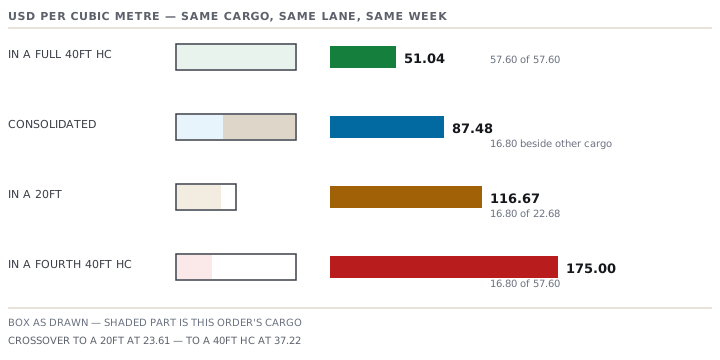
Read the right-hand column. The same cargo, on the same lane, in the same week, is priced between USD 51.04 and USD 175.00 a cubic metre. Nothing changes but how full the box it travels in is. The last cubic metres of an order cost roughly three and a half times the first ones.
The last row is priced at zero, and it is not free. The 1,000 extra snowsuits exist for a promotion with a date on it. Holding them is not a freight decision at all. It is a decision to miss the promotion, and it belongs to the buyer, not to you.
The rung most people skip
The twenty-foot container is the interesting line. Most merchandisers never consider it, and the ones who do usually reach for it too early.
A twenty-foot box measures roughly 5,900 by 2,350 by 2,390 mm inside. On the same 600 by 400 mm carton footprint that is nine along by five across, or 45 cartons a tier. Its height is only 2,390 mm, so five tiers of the 400 mm carton, or seven of the 300 mm one. Its useful capacity for this cargo is therefore about 22.68 cubic metres, against the forty-foot high-cube's 57.60. That is 39.38% of the bigger box's space for 66.67% of its price.
So the twenty-foot is bad value per cubic metre. And it is still cheaper than a forty-foot you cannot fill. It is a rung on a ladder, and the ladder is what you want.
Find the crossover the way you would find any break-even. Thornbeck's consolidation price is USD 72 a weight-or-measurement unit plus USD 260 of charges that do not scale. So it costs 72 times the volume, plus 260. Set that equal to the twenty-foot's flat USD 1,960:
72 times the volume, plus 260, equals 1,960. The crossover is 23.61 cubic metres.
Now compare that with the twenty-foot's own capacity of 22.68 cubic metres. The finding falls out: on this lane, at these rates, a twenty-foot container is never the right answer. It runs out of space at 22.68 cubic metres. And at 22.68 cubic metres consolidation still costs less: USD 1,892.96 against USD 1,960. The rung exists, and you can never stand on it.
That is not a general law. It is this lane in this week, and it comes with its own trigger. Solve the same equation for the rate instead of the volume. The twenty-foot starts winning at its full capacity once consolidation passes USD 74.96 a unit. Write that number on the file. Rates move. When your consolidation rate moves past it, the twenty-foot is worth a second look. Until then it is not.
Against the forty-foot high-cube the same sum gives a crossover of 37.22 cubic metres. Course 8.4 derives this crossover on a different lane and gets a different number. That is the point: the method transfers, the number does not.
Capacity is a property of the carton, not of the container
One more thing hides inside the loading plan. It is why a tail cannot be planned in cubic metres at all.
The container holding 600 trouser cartons and 200 sweater cartons carries 57.60 cubic metres. Now restow the same steel box: one tier of snowsuit cartons at 400 mm, three tiers of sweaters at 300 mm, four tiers of trousers at 300 mm. That is 2,500 mm of the available 2,690. It now carries 800 cartons and 60.00 cubic metres. Same box, 4.17% more cargo, purely because of which cartons went into it.
There is no such thing as "a forty-foot holds 57.60 cubic metres". There is only what these cartons, in this order, stow to. So a mixed order has no container count until somebody fixes the stow. And whoever fixes the stow has also fixed the size of your tail, and what is in it. That is the next lesson.
Check yourselfYour order grows by 4% and the forwarder says the rate is unchanged. What do you check?Show the answer
Whether the extra volume fits inside the containers you were already paying for. If it does, the extra freight really is zero. If it starts a new box, the marginal cubic metres are charged at the price of a whole container divided by however little you put in it. On this order that was three and a half times the full-box rate. The rate did not change. The price did. Ask for a restow before you accept the amendment, not after.
Prompt · Price this shipment under every mode it could travel by
When a forwarder has quoted you one number for one mode, or when an order has grown and no longer fills whole containers.
Act as a freight pricing analyst working for the shipper. You have no interest in selling any particular mode. I want one shipment priced under every mode it could travel by, starting from carton dimensions. Shipment facts: origin [PLACE], port or airport of departure [NAME], destination [PLACE], consignee's delivery point [PLACE]. For EACH style: code, pieces on the order, pieces a carton, carton EXTERNAL length, width and height in millimetres, carton gross weight in kilogrammes, and FOB a piece. Quoted charges I have: full container [AMOUNT] a box, with the equipment type and what is inside that figure; consolidation [AMOUNT] a weight-or-measurement unit plus [AMOUNT] of fixed charges; air [AMOUNT] a chargeable kilogramme, with the weight breaks if you have them, plus [AMOUNT] of per-shipment charges; and the volumetric divisor on the air quotation. Do the following. First, for each style give cubic metres a carton, gross kilogrammes a cubic metre, volumetric weight a carton and chargeable weight a carton. Then say plainly whether that style is charged on space or on weight by air. Give the weight at which it would cross the line, and how far it is from it. Second, build a stow: cartons across, cartons along, tiers up, for each equipment type. Tell me the container count and exactly which cartons are left over. Third, price the leftover cartons four ways: inside a full box for comparison, a part-filled box of the same size, the next size down, and consolidated. Give me a table of dollars a cubic metre, not just totals. Fourth, derive the crossover volume between consolidation and each container size from my own quoted charges. Check each crossover against that container's real capacity for MY cartons, and tell me if a rung is unreachable. Fifth, tell me the rate at which each answer flips. Sixth, list every assumption you had to make. Do not give me a range where a number is possible. Do not quote market rates. Use only the figures I gave you.
AI can make mistakes — check anything you act on.
What to take away
- The full-container rate per cubic metre is the price of a full container. The last cartons of an order are priced by how empty their box is.
- Build the ladder in dollars a cubic metre: inside a full box, consolidated, a twenty-foot, a part-filled forty-foot. Choose by the ladder, not by the rate card.
- Derive the crossover between consolidation and a container from your own quoted charges. Then check it against the smaller box's real capacity, because the rung may not be reachable.
- Write down the rate at which the answer flips. Rates move, and the answer moves with them.
- A container has no fixed capacity in cubic metres. Fix the stow first. Only then is there a container count.