Lessons · Lesson 1 of 6
Four promises, not one
Separate the four promises that stand between a shipment and getting paid, and see why treating them as one promise is expensive.
Lesson 1 of 6 · 17 min
The line on the order that nobody costed
24 April 2026, Nabaruh, in the Egyptian delta. Nabaruh Garment Industries confirms purchase order TH-4470 with Thurlemont N.V., a menswear retailer in Antwerp.
- 18,400 men's cotton canvas chore jackets, style CJ-118, 340 gsm, three colours
- FOB Damietta USD 21.75 (Incoterms 2020)
- Order value USD 400,200.00
- On board 14 October 2026
FOB means free on board. The factory's price covers everything up to the moment the goods are loaded on the vessel at Damietta. Incoterms are the standard trade rules that say where the seller's job ends and the buyer's begins.
The cost sheet behind USD 21.75 took the costing team three weeks. Two mills quoted the fabric. The trims were re-sourced. The sewing minutes were timed again after the second fit sample. Every line on that sheet was argued over.
One line was not argued over at all. It is not on the cost sheet. It sits on the front page of the purchase order, and it reads:
Payment: irrevocable documentary credit at sight, issued by Scheldt Bank N.V., Antwerp, advised through Rasheed Commercial Bank, Damietta.
One sentence. Nobody priced it. By the end of lesson 4 you will have priced that line three ways on this same order. The cheapest and the dearest of the three are USD 8,656.81 apart. The whole margin on the order is USD 35,880.00.
That is the argument of this course, so here it is plainly:
A payment term is a price. It is not paperwork, it is not a formality, and it is not only the finance department's business. It is part of the number you quoted. If you left it out of that number, you paid it out of your margin.
Four promises, and they break separately
Ask most people how an export order gets paid and they describe one event: the goods go, the money comes. That one sentence hides four separate promises. Four different parties make them, under four different contracts. Each promise can be kept or broken on its own.
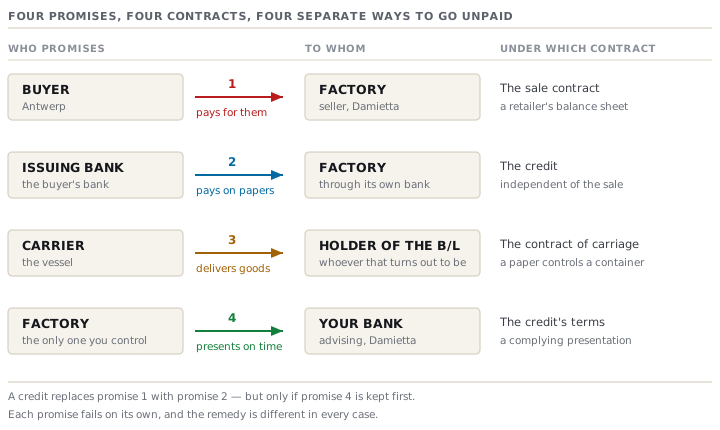
One: Thurlemont promises Nabaruh to pay for the jackets. This is the sale contract: the purchase order, its terms, and the law that governs it. It is a promise from a clothing retailer, backed by a clothing retailer's accounts.
Two: Scheldt Bank promises Nabaruh to pay against documents. This is the documentary credit, and it is a separate promise. The bank is not promising that the jackets are good, or that Thurlemont can pay, or that anybody is happy. It promises to pay if a stated set of papers reaches a stated place by a stated date, saying stated things.
Three: the carrier promises to deliver the goods at Antwerp to whoever presents the bill of lading. This is the contract of carriage. The bill of lading is the carrier's receipt for the goods, and whoever holds it can claim them. That is why a piece of paper in a courier bag can control a container.
Four: Nabaruh promises to present. This one is easy to miss, because it is the factory's own promise. It is also the only one on the list that the factory controls completely. Under a credit, Nabaruh is not paid for shipping jackets. It is paid for handing a set of documents across a bank counter, on time, saying the right things.
Now the point. Four promises means four different ways an order can go wrong, and the remedy is different each time.
| What actually failed | You are unpaid because | Who you deal with |
|---|---|---|
| Thurlemont will not pay | the buyer's promise broke | the buyer, or a court, or an insurer |
| Scheldt Bank cannot pay | the bank's promise broke | the bank's regulator, or nobody |
| The container is lost or damaged | the goods never arrived | the carrier and the cargo insurer |
| Your documents do not comply | your own promise broke | your own bank, today, before the courier leaves |
The last row is the one that catches factories. It catches them because it does not feel like a payment problem at all. The jackets are perfect. The vessel sailed on time. The buyer is happy. And the bank refuses the documents, because the packing list says chore jackets where the credit says men's chore jackets. Now you are back in row one. You depend on Thurlemont's goodwill, which is the exact thing the credit was bought to avoid.
Who owes whom, and when
The four promises also fall due at different moments. The order of those moments is your whole cash position.
Here is TH-4470 written out as obligations rather than as activities.
| Date | Who owes what to whom |
|---|---|
| 2 June | Nabaruh owes the mill a deposit against the canvas |
| 20 July | Nabaruh owes the mill the balance, before the cloth ships |
| August and September | Nabaruh owes its own operators, weekly, in cash |
| Early October | Scheldt Bank owes Nabaruh nothing yet, because nothing has been presented |
| 14 October | the carrier's obligation begins; the goods are on board |
| Around 20 October | Nabaruh owes Rasheed a complying set of documents |
| Around 26 October | Scheldt Bank owes Nabaruh the money, and pays |
Read the gap between the first row and the last. Nabaruh's money starts leaving on 2 June and arrives on 26 October. Somebody funds everything in between, and that somebody is the factory. Lesson 2 puts a number on it.
Notice too that Thurlemont's own obligation is almost invisible in that table. Under a sight credit, a bank's promise has replaced the buyer's for practical purposes. At sight means the bank pays as soon as it has checked the documents and found them in order. That swap is the whole product, and it is what the bank charges buy.
Where this course sits, and where it stops
This is the map course for track 13. So here are its edges, named now rather than left for you to find.
- Course 13.2 takes the documentary credit apart: the terms that will get your documents refused, the check, the discrepancy and the fix.
- Course 13.4 takes the cash cycle deeper: the working capital of a factory running several orders at once, rather than the single order used here.
- Course 13.5 is what you do with money owed to you that you would rather not hold: discount it, sell it, or insure it.
- Course 12.1 owns the document set as a customs and carriage matter. Here the same documents are treated only as a bank matter: what makes a presentation comply. Where the two meet, 12.1 is the one that tells you what customs needs.
- Courses 8.3 and 8.5 own Incoterms, the point where cost and risk pass to the buyer, and the landed cost on the buyer's side.
What this course owns is the map itself, and one argument that runs through all of it: the same FOB, on three different payment terms, is three different prices.
Check yourselfUnder a sight credit, whose promise are you actually relying on to be paid?Show the answer
The issuing bank's, and only against documents. Scheldt Bank's promise stands on its own, apart from the sale contract. It does not change because Thurlemont dislikes the jackets, or because Thurlemont cannot pay. But it depends on your own promise being kept first: the documents must comply. If they do not, the bank's promise is not engaged, and you fall back on Thurlemont's promise, which is where you started. That is why a credit turns a commercial risk into a paperwork risk rather than removing risk.
What you should be able to do now
- Name the four promises on your own live order, and say which party makes each one.
- Say which promise broke when an order does not turn into money. The remedy is different for each, and starting with the wrong one wastes the week you have.
- Read a payment line as a price, not as a formality. One sentence on the front page of TH-4470 is worth more than several of the lines the costing team spent three weeks arguing about.