Lessons · Lesson 2 of 6
The gap between paying the mill and being paid
Build one order's cash gap from every dated payment out, price it at what the factory's own money costs, and see how much of it the payment term cannot reach.
Lesson 2 of 6 · 17 min
The order is a loan you made without noticing
TH-4470 is a sale. It is also, for about five months, a loan from Nabaruh Garment Industries to Thurlemont N.V. Nobody wrote a loan agreement. Nobody set an interest rate. The loan appears nowhere on the cost sheet. It is real all the same, and this lesson prices it.
Start with what actually leaves the building. The FOB is USD 21.75, and it breaks down like this:
| Line | Per jacket, USD | On the order, USD | Cash out against this order? |
|---|---|---|---|
| Fabric and trims | 9.85 | 181,240.00 | yes, to the mill and the trim suppliers |
| Cut, make, finish, pack | 6.40 | 117,760.00 | yes, as wages and consumables |
| Factory overhead | 3.55 | 65,320.00 | mostly no — the building and the staff exist anyway |
| Margin | 1.95 | 35,880.00 | no |
| FOB Damietta | 21.75 | 400,200.00 |
So the cash this order actually costs Nabaruh is the first two lines: USD 299,000.00. Overhead is left out, and not because it does not matter. It matters a great deal. But the building and the salaried staff are there whether or not this order is taken, so funding them is not a cost this order caused.
Three dates, not one
Cash does not leave in one lump either. The mill, Damira Canvas, sells on 30% with the order and the balance before the cloth ships. Wages are paid weekly through production.
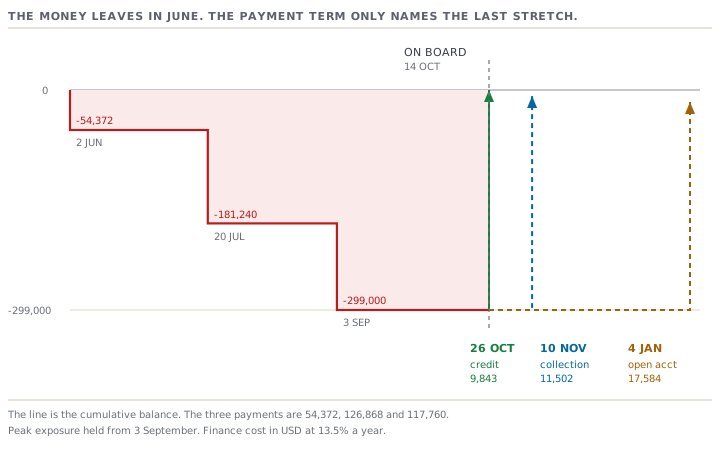
- 2 June — deposit against the canvas and trims, 30% of USD 181,240.00: USD 54,372.00
- 20 July — the balance to the mill, before the cloth leaves: USD 126,868.00
- 10 August to 26 September — cutting, sewing, finishing and packing: USD 117,760.00 in wages, thread, cartons and power, paid as the work is done. Treat it as leaving on 3 September, the middle of the run.
The goods go on board on 14 October. Under the sight credit on the purchase order, the money reaches Rasheed Commercial Bank on 26 October.
What a day costs
Nabaruh funds all of this on a working-capital facility from Rasheed Commercial Bank at 13.5% a year. A working-capital facility is a bank line the factory draws on to pay bills before the customers pay it. That rate belongs to this factory, at this bank, in this year. Every figure in this course belongs to a named party for exactly that reason. Your own rate will be different, and it is the first thing to find out.
The cost of one slice of cash is amount times rate times days divided by 365. Do it for each of the three.
| Cash out | Date | Amount, USD | Days to money in the account | Cost at 13.5%, USD |
|---|---|---|---|---|
| Deposit to the mill | 2 June | 54,372.00 | 146 | 2,936.09 |
| Balance to the mill | 20 July | 126,868.00 | 98 | 4,598.53 |
| Cut, make, finish, pack | 3 September | 117,760.00 | 53 | 2,308.42 |
| Total | 299,000.00 | 9,843.04 |
USD 9,843.04. That is 27.4% of the order's whole margin of USD 35,880.00, and it is nowhere on the cost sheet.
Two numbers inside that table are worth carrying away on their own.
The peak. On 3 September, Nabaruh has USD 299,000.00 of its own money in this one order and nothing back. That is not a cost. It is a limit. It is why a factory with a full order book still cannot take the next order, and it is the number a bank asks for when you want a bigger facility.
The length. The gap runs from 2 June to 26 October. That is 146 days on the first slice, on an order that ships on time and is paid at sight without a single problem. Nothing has gone wrong here. This is the good case.
The half of the gap the payment term cannot reach
Now the mistake. It is the ordinary one, not a foolish one.
Ask a merchandiser what the payment term on TH-4470 costs and the answer comes back quickly. The credit pays at sight. The money arrives twelve days after the goods go on board. The order is worth USD 400,200.00 at 13.5%, which is USD 148.02 a day. Twelve days is USD 1,776.23. Small, and not worth arguing about.
Every step of that can be defended, and the answer is wrong by a factor of 5.5. It is wrong in two directions at once.
- It treats the invoice value as the money being funded. You are not funding USD 400,200.00; you never had it. You are funding USD 299,000.00 of your own cash, and less than that for most of the period.
- It treats the tail as the period. The payment term names the stretch from shipment to payment, so that is the stretch everybody prices. But the money went out in June.
The second error is the expensive one, and it has a useful consequence. The payment term controls the back of the gap. The mill's terms control the front, and the front is longer. Of the 146 days on the first slice, only 12 fall after shipment.
So there are two places to shorten this, and only one of them involves the buyer.
Damira Canvas has offered Nabaruh 30 days from delivery on the balance, instead of payment before the cloth ships, in exchange for a firmer forward commitment on next season's yardage. That moves USD 126,868.00 from 20 July to 19 August. Thirty days on that slice is USD 1,407.71, which is 14.3% of the whole finance cost of the order. You get it from a supplier conversation, not from a buyer who has no reason to help you.
Check yourselfThe buyer offers to pay ten days earlier. Your mill offers thirty days on the balance. Which is worth more here?Show the answer
The mill, by a long way. Ten days earlier on the sight credit saves ten days on all three slices, and by 26 October all three are still outstanding. So it is USD 299,000.00 for ten days at 13.5%, which is USD 1,105.89. The mill's offer moves USD 126,868.00 by thirty days and is worth USD 1,407.71. The buyer's concession is the harder one to win and the smaller one, and most merchandisers would have spent the week on it.
What you should be able to do now
- Know what your own money costs, as a rate and as a figure per day per hundred thousand. Without it, every payment discussion is adjectives.
- Build the gap from dated payments out, not from the invoice value and not from the tail. Amount, date, days, rate.
- Report the peak as well as the cost. The cost comes out of margin. The peak decides what you can take on next.
- Look at the front of the gap first. It is longer, and the person on the other side of it wants next season's business.