Lessons · Lesson 4 of 6
One FOB, three prices
Cost the same order under three payment terms, all the way to a total and to a break-even FOB, so a request for longer terms can be answered with a price instead of a refusal.
Lesson 4 of 6 · 17 min
The same jacket, three times
Everything so far has been assembly. This lesson runs the machine.
TH-4470 is going to be priced three ways: same jackets, same dates, same factory. Nothing about the garment changes.
- A sight credit — the term actually on the purchase order. Money in the account 26 October, twelve days after the goods go on board.
- A documents-against-payment collection — no bank promise, documents released against payment. Thurlemont's own history on this route says the money clears on 10 November, twenty-seven days after shipment.
- Open account, 75 days from the bill of lading — what Thurlemont's sourcing office asked for in March. Seventy-five days from 14 October is 28 December. Allowing for the buyer's payment run, the last three orders on this term cleared on 4 January, eighty-two days after shipment.
Three prices are built from three ingredients: the cost of money over the whole gap, what the banks and the insurer take, and the risk you are carrying that nobody has charged you for yet.
Ingredient one: the cost of money
Lesson 2 built this for the sight credit. Same three slices of cash, same rate, three different end dates.
| Cash out | Amount, USD | To 26 October | To 10 November | To 4 January |
|---|---|---|---|---|
| Deposit to the mill, 2 June | 54,372.00 | 2,936.09 | 3,237.74 | 4,343.80 |
| Balance to the mill, 20 July | 126,868.00 | 4,598.53 | 5,302.39 | 7,883.20 |
| Cut, make, finish, pack, 3 September | 117,760.00 | 2,308.42 | 2,961.74 | 5,357.27 |
| Total cost of money, USD | 9,843.04 | 11,501.87 | 17,584.27 |
Ingredient two: what the banks and the insurer take
These are Rasheed Commercial Bank's charges to this customer, and Meerlan Credit Insurance's quoted premium on this buyer. They are illustrative. They are not a tariff you can quote anywhere else, because every bank publishes its own and then negotiates around it. What does transfer is the shape: a credit costs more in charges than a collection, and open account replaces the bank charges with an insurance premium larger than both.
| Charge | Sight credit | Collection | Open account |
|---|---|---|---|
| Advising the credit | 60.00 | ||
| Examination and negotiation, 0.125% of the drawing | 500.25 | ||
| Collection commission, 0.15% capped | 350.00 | ||
| Courier of documents | 65.00 | 65.00 | |
| Foreign bank charges deducted | 90.00 | ||
| Inward transfer | 35.00 | ||
| Credit insurance premium, 0.42% of turnover | 1,680.84 | ||
| Total charges, USD | 625.25 | 505.00 | 1,715.84 |
Read that table on its own and the collection is the cheapest of the three. Hold that thought for two minutes.
Ingredient three: the risk nobody has invoiced
Most cost comparisons leave this ingredient out, and leaving it out is what makes the wrong answer look right.
Under the sight credit, your risk is a discrepancy. A discrepancy is any point where your documents do not match what the credit asked for. Nabaruh has presented twenty-four sets through Rasheed in the last two years, and nine came back with at least one discrepancy. That is a rate of 0.375. When it happens, the issuing bank deducts a discrepancy fee of USD 95.00, and on this factory's own record the money arrives about nine days late. Nine days on USD 400,200.00 at 13.5% is USD 1,332.17, so one event costs USD 1,427.17. At a rate of 0.375, the expected cost of a discrepancy on this order is USD 535.19.
Under open account, your risk is the buyer. Meerlan will insure Thurlemont, and like most policies it pays most of an invoice rather than all of it. Here it pays 90%, after a waiting period. So the uninsured first loss is USD 40,020.00, which is more than the whole margin on the order. Meerlan's own credit committee puts Thurlemont's chance of default in a year at 0.9%. At that figure, the expected uninsured loss is USD 360.18.
Under the collection, your risk is a refusal. Lesson 3 priced that event at USD 188,282.00. It is deliberately not in the table below. To put a number in, you would have to claim a probability for it, and nobody at Nabaruh has one. Leaving it out is honest. Forgetting that it is out is not.
The three prices
| Sight credit | Collection | Open account | |
|---|---|---|---|
| Days from on board to money in the account | 12 | 27 | 82 |
| Cost of money, USD | 9,843.04 | 11,501.87 | 17,584.27 |
| Charges, USD | 625.25 | 505.00 | 1,715.84 |
| Priced risk, USD | 535.19 | not priced | 360.18 |
| Total, USD | 11,003.48 | 12,006.87 | 19,660.29 |
| Per jacket, USD | 0.60 | 0.65 | 1.07 |
| Share of the order's margin | 30.7% | 33.5% | 54.8% |
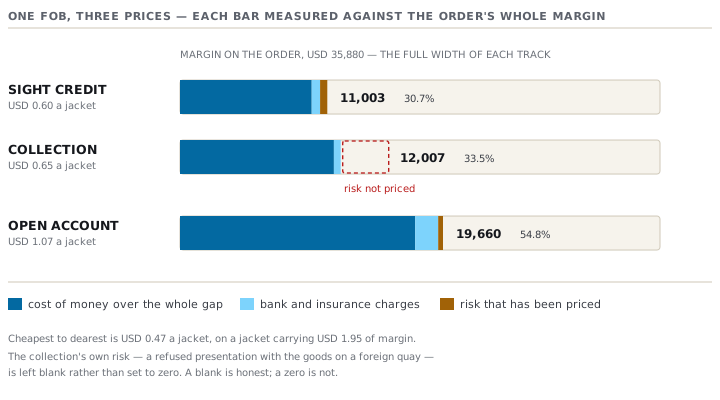
Three things fall out of that table, and each one changes a conversation.
The payment term is worth more than most cost-sheet lines. The gap between the cheapest and the dearest column is USD 8,656.81, or USD 0.47 a jacket. A costing team that would re-source a trim to save half a cent is signing away forty-seven of them on the front page.
A term can eat half the margin without anybody noticing. Open account at 75 days costs 54.8% of this order's margin. The order still makes money. It makes less than half of what the cost sheet said it would, and no report anywhere in the factory blames the payment line for the difference.
The collection is the trap. It has the lowest charges of the three and the second-lowest total. On a charges-only comparison it wins outright, and on a full comparison it looks like a reasonable middle. It is neither. It is dearer than the sight credit and it carries the one risk in the table with no number against it. There is no case for it here on price. It exists on the ladder for one situation: the buyer will not open a credit, and you will not go to open account.
Turning it into a price
Now the part that changes what you say on the telephone. If the sight credit at USD 21.75 works for Nabaruh, then any other term works at the FOB that leaves the factory equally well off. That is one subtraction and one division.
- Collection: 12,006.87 minus 11,003.48 is 1,003.39, over 18,400 jackets, so USD 21.80
- Open account: 19,660.29 minus 11,003.48 is 8,656.81, over 18,400 jackets, so USD 22.22
So the answer to Thurlemont's March request is not we prefer credits. That is a refusal wearing a preference. It is this:
Seventy-five days on open account works for us at USD 22.22 rather than USD 21.75. That is 2.16%, and it is the cost of funding the order for the extra seventy days plus the credit insurance we would have to carry. Here is the build-up. If you would rather stay at USD 21.75, the sight credit does that today.
You have replaced a no with two priced options, and shown your arithmetic. That is a different kind of conversation. Course 16.4 teaches the negotiating of it. What you own is the number.
Prompt · Price the payment line three ways, and give me an FOB for each
Before the FOB is agreed, when nobody has read the payment term on the draft purchase order.
Act as a trade finance manager in an export garment factory. I need the payment term on one order priced properly, in money, and turned into a break-even FOB. Order facts: buyer [BUYER], purchase order [NUMBER], style [STYLE], quantity [QTY] pieces, agreed price [PRICE] per piece [INCOTERM AND NAMED PLACE], on board [DATE]. My cost breakdown per piece: fabric and trims [AMOUNT], cut make finish and pack [AMOUNT], factory overhead [AMOUNT], margin [AMOUNT]. Dated cash going out against this order: [DATE AND AMOUNT FOR EACH SUPPLIER PAYMENT, DEPOSIT AND WAGE RUN — LIST THEM ALL]. My working capital facility costs [RATE] a year. Terms to compare: [LIST THEM — FOR EXAMPLE SIGHT CREDIT, USANCE CREDIT AT NINETY DAYS, DOCUMENTS AGAINST PAYMENT, DOCUMENTS AGAINST ACCEPTANCE, OPEN ACCOUNT AT SIXTY DAYS]. For each term, the number of days from the on-board date until the MONEY IS IN MY ACCOUNT, from my own history if I give it: [DAYS FOR EACH]. My bank's charges: [ADVISING, NEGOTIATION OR COLLECTION COMMISSION, COURIER, FOREIGN BANK CHARGES, INWARD TRANSFER]. Credit insurance, if quoted: premium [RATE] of turnover, payout [PERCENT], waiting period [DAYS]. My own discrepancy rate on documents, if I know it: [NUMBER OF FAULTY SETS OUT OF NUMBER PRESENTED], the discrepancy fee [AMOUNT] and the delay it causes [DAYS]. Do the following. First, build the cash gap as a table of dated payments out, with days until the money arrives and a finance cost for each slice, for every term, and give me the peak exposure and the date it happens. Second, add the bank and insurance charges. Third, price the risk where a real probability exists. Where it does not, leave the cell BLANK and say in words what event is unpriced and what it would cost if it happened. Never put a zero where you mean unknown. Fourth, total each term, and express it per piece and as a share of the order's margin. Fifth, give me the break-even FOB for every term against the cheapest one. Sixth, write the three sentences I would say on the telephone to offer the buyer a priced choice rather than a refusal. List every assumption you had to make at the end, and tell me which single missing input would change the answer most.
AI can make mistakes — check anything you act on.
Check yourselfThurlemont offers open account at 75 days with a 1.5% uplift on the FOB. Take it?Show the answer
No, and you can say why in one line. A 1.5% uplift on USD 21.75 is USD 0.33 a jacket, or USD 6,003.00 on the order. The change costs USD 8,656.81. You are short by USD 2,653.81, which is 7.4% of the order's margin. The reply is not a refusal, it is 2.16%. And it is worth saying that the 2.16% is money, not a negotiating position: it is two calculations you can put on one page.
What you should be able to do now
- Build all three ingredients, not just the first. A comparison of bank charges alone reverses the answer.
- Say what your discrepancy rate is. If you do not know it, that is the number to go and find, because it is the price of the instrument you use most.
- Convert every payment term into an FOB. A term is a price, so quote it as one.
- Leave an unpriced risk visibly unpriced, and say so. A blank in the table is honest. A zero is not.