Lessons · Lesson 6 of 6
- 01 · The order that paid well and nearly closed the factory
- 02 · A margin problem and a timing problem need opposite remedies
- 03 · Why a good year is the dangerous one
- 04 · What one day costs, and which day it is
- 05 · Six levers, priced — and who owns each one
- 06 · Buying days: the discount that cost more than the gap
Buying days: the discount that cost more than the gap
Rank every source of cash for one real shortfall, and see why the cheapest annual rate is sometimes the most expensive decision.
Lesson 6 of 6 · 18 min
29 May, a Friday
Kalabsha's rolling cash forecast is run every Friday. That week it showed the Hierakon facility going over its USD 250,000.00 limit by USD 41,600.00, from 24 June to 6 July. That is 12 days. After that, an earlier Elverdinge shipment, PO ELV-7719, would be paid and bring the balance back under.
Twelve days, forty-one thousand six hundred dollars, starting in four weeks. That is the whole problem. Hold on to its size, because the rest of this lesson is about what happens when nobody does.
The commercial manager was told to close the gap. He telephoned Vindelund on Monday and came back with a good result: 2% off the invoice for payment at 15 days from the bill of lading instead of 60. Vindelund's treasury runs an early-payment programme and was pleased to be asked. Finance booked the discount. The gap closed. Everybody involved did their job.
It cost the factory USD 1,110.48 more than the cheapest way of closing the same gap.
What the discount actually was
Vindelund pays 45 days earlier and keeps 2% of USD 331,800.00.
- Given up:
331,800.00 × 2%= USD 6,636.00 - Interest saved: 45 days of funding on USD 331,800.00 at 12.0% a year = USD 4,908.82
- Net cost of the discount: USD 1,727.18
There are two common ways of reading that wrongly, and it is worth killing both here.
"It only cost 2%." No. It cost 2% less the interest it saved. And the comparison that matters is not against zero. It is against every other way of getting the same cash.
"It cost USD 6,636.00 where USD 616.70 would have done, nearly eleven times too much." Also no. That ignores the USD 4,908.82 the early payment genuinely saved. The honest figure is USD 1,727.18 against USD 616.70. Overstating a mistake is its own kind of error. The person who made it stops listening, and the real lesson goes with them.
The four sources of cash in the room
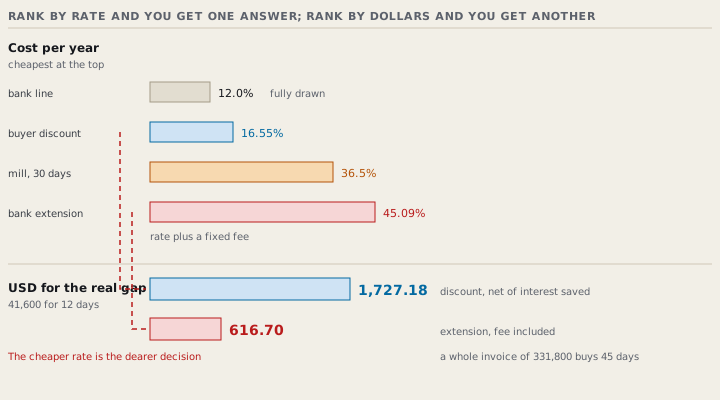
| Source | Price as stated | Annual rate | How much | Shape |
|---|---|---|---|---|
| Hierakon pre-shipment line | 12.0% a year | 12.0% | 250,000.00 | Fully drawn |
| Hierakon temporary extension | 19.5% a year plus a 350.00 fee | see below | 50,000.00 | Draw what you need |
| Vindelund early payment | 2% for 45 days | 16.55% | Whole invoice only | All or nothing |
| Athribis thirty extra days | 1.5% on the fabric | 36.5% | 72,912.00 | Prices next season too |
Every rate in that table is illustrative. It belongs to this bank, this buyer and this mill in this course. Yours are on your own facility letter and in your own supplier's quotation.
The annual rate on the buyer's discount comes from the standard conversion. It is worth doing slowly, because it is the one merchandisers get wrong. You are giving up 2 to receive 98, forty-five days early:
(2 / 98) × (365 / 45) = 16.55% a year
Rank the three available sources by that column and the discount wins. 16.55% beats 19.5%, and it beats 36.5%. That is exactly why an intelligent, numerate commercial manager took it.
Where the ranking breaks
The extension is not a rate. It is a rate plus a fixed fee. And a fixed fee behaves very differently depending on how much you draw and for how long.
Draw the gap that actually exists, USD 41,600.00 from 24 June to 6 July:
- Interest:
41,600.00 × 12 × 0.195 / 365= USD 266.70 - Arrangement fee: USD 350.00
- Total: USD 616.70
Turn that into a yearly rate and it looks appalling: 616.70 / 41,600.00 × 365 / 12 = 45.09% a year, nearly three times the discount's rate. And it is still the right answer, by a distance:
| Discount route | Extension route | |
|---|---|---|
| Cash obtained | 331,800.00, on 23 June | 41,600.00, on 24 June |
| Cash needed | 41,600.00, for 12 days | 41,600.00, for 12 days |
| Gross cost | 6,636.00 | 616.70 |
| Interest saved | 4,908.82 | — |
| Net cost | 1,727.18 | 616.70 |
USD 1,110.48 of difference. The discount is 2.80 times the cost of the extension.
What actually went wrong
Not the rate. Not the negotiation either. The discount was well negotiated and Vindelund's terms were generous. What went wrong is sizing.
An annual rate is a price per dollar per year. It only ranks two sources correctly when the amount and the duration are the same for both. Here they were not, and in two directions at once:
- The discount is all or nothing on a whole invoice. To obtain USD 41,600.00 it had to be applied to USD 331,800.00. That is eight times the cash required.
- The discount buys 45 days when the gap is 12 days. Thirty-three of those days are paid for and not needed.
Meanwhile the fixed fee that made the extension look expensive per year is a fixed fee. It is USD 350.00 whether the gap is twelve days or ninety. So the shorter and smaller the gap, the worse the annual rate looks and the better the dollar cost gets. Annual rates and fixed fees pull in opposite directions on short, small gaps, and that is precisely the shape of most factory cash problems.
Two things that were right, and one that was not on the list
The commercial manager was right to refuse the mill. Athribis's 36.5% a year was the most expensive money in the room on any reading. It would also have set a fabric price the factory would still be paying next season. It is the only option in the table whose cost does not stop when the gap closes.
He was right to act on 29 May rather than on 23 June. A gap identified four weeks out has four sources. A gap identified on the morning wages are due has one, and it is whichever one answers the phone.
And there was a fifth option nobody raised, because it is not a finance instrument. Lesson 5 showed that the invoice for VLD-2209 was logged with the buyer nine days after the bill of lading. Issuing and chasing it on the day of shipment was free, it was inside the factory's own control, and it was worth USD 846.99. That is more than the whole extension route cost. The cheapest source of cash in the building is the money you are already owed, arriving on the day the contract says it should.
Check yourselfYour buyer offers 1.5% for payment 30 days early. Your line has room at 12.0% a year on a 365-day basis. Take it or not?Show the answer
Not on price. The annual cost of that discount is 1.5 divided by 98.5, times 365 over 30, which is 18.53% a year. That is well above your 12.0% line, so borrowing the same money is cheaper. Take it only if the line has no room, or if there is a reason outside the arithmetic: a buyer relationship you want to be easy to deal with, or a bank covenant that penalises drawing the line at a period end. Say which of those it is when you book it. A discount taken for a reason that was never written down is indistinguishable next year from one taken by mistake.
What to take away
- Size the gap before you price anything. Amount, start date, end date.
- Compare sources in dollars for that gap, not in annual rates, whenever the amounts or the durations differ.
- A fixed fee makes a small, short facility look expensive per year and be cheap in cash. That is the exact shape of most factory shortfalls.
- An early-payment discount is an all-or-nothing instrument on a whole invoice. It is the right tool when the gap is nearly the size of the invoice, and an expensive one when it is not.
- The cheapest cash available to a factory is usually an invoice sent on time.