Lessons · Lesson 1 of 6
- 01 · The order that paid well and nearly closed the factory
- 02 · A margin problem and a timing problem need opposite remedies
- 03 · Why a good year is the dangerous one
- 04 · What one day costs, and which day it is
- 05 · Six levers, priced — and who owns each one
- 06 · Buying days: the discount that cost more than the gap
The order that paid well and nearly closed the factory
Build the cash calendar of one export order, and put a price on every day between paying the mill and being paid.
Lesson 1 of 6 · 20 min
The situation
7 August 2026, 09:40. A payment lands in Kalabsha Sportswear's account in Sohag: USD 331,800.00. It comes from Vindelund, a casual and outdoor retailer in Gothenburg, against purchase order VLD-2209. The style is KSP-6215, a men's half-zip midlayer in brushed-back cotton and elastane. 28,000 pieces. The price is FOB Alexandria USD 11.85. FOB means the factory's price with the goods loaded on board the ship; everything after that is the buyer's cost. The goods went on board on 8 June. The terms are open account, paid by telegraphic transfer, 60 days from the date of the bill of lading. Open account means there is no bank guarantee behind the payment. The buyer simply pays when the clock runs out.
The cost sheet for that order says the factory made USD 45,556.00 on it. That is a margin of 13.73% on the FOB price. The bank statement says something the cost sheet never mentions. Between 26 January and 7 August, Kalabsha never once had that money. It had the opposite of that money.
This lesson builds the second document. Nobody printed it.
Profit is a rate, cash is a calendar
A cost sheet answers one question. For every dollar of FOB price, how many cents are left after the fabric, the trims, the making and the freight? That is a rate, and a rate has no dates in it. Course 8.1 builds that sheet properly. This course does not rebuild it.
Cash answers a different question, and it is the only question a bank asks. On any given morning, how much of the factory's own money is sitting inside this order? That is a calendar, and it has no percentages in it at all.
The two are not versions of each other. A factory can be right about the rate and still not survive the calendar. You pay the mill in January with money you will not see again until August. Nobody lends you seven months for nothing.
The calendar of PO VLD-2209
| Date | What happened | Cash out | Cash in |
|---|---|---|---|
| 12 Jan | PO VLD-2209 confirmed, no deposit | — | — |
| 26 Jan | Fabric ordered, Athribis Knitting Mills, 50% with the order | 72,912.00 | — |
| 9 Feb | Trims ordered, Nekhen Trims, 100% with the order | 21,560.00 | — |
| 6 Mar | Fabric delivered to the factory | — | — |
| 16 Mar | Cutting starts | — | — |
| 5 Apr | Fabric balance, 50% at 30 days from delivery | 72,912.00 | — |
| 22 Apr | Wages, power and factory overhead, cash mid-point | 112,000.00 | — |
| 29 May | Last carton finished | — | — |
| 30 May | Inland freight, inspection, documents, port charges | 6,860.00 | — |
| 8 Jun | On board, bill of lading issued | — | — |
| 7 Aug | Vindelund pays, 60 days from the bill of lading | — | 331,800.00 |
Two things about that table before the arithmetic.
The wage line is a simplification, and it is worth naming. Wages, power and overhead are not paid on 22 April. They are paid every week from 16 March to 29 May. Spread evenly, the middle of that run, weighted by cash, falls on 22 April. Treating the whole USD 112,000.00 as one payment on that date is wrong by less than a day of interest. Say so out loud when you build one of these. Then nobody later mistakes the simplification for a fact.
Fabric is bought in two payments because the mill said so, not because the factory chose it. Athribis takes half with the order and half thirty days after delivery. Those thirty days are the only credit anybody gave Kalabsha on this order. Lesson 5 prices what they were worth, and what the mill wanted for them.
The cycle, in days
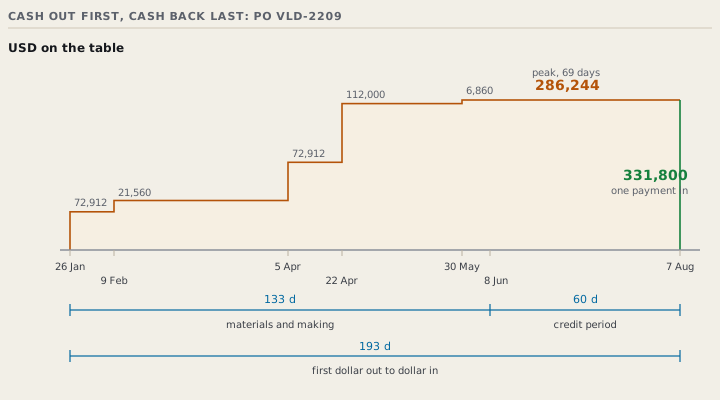
From the first dollar out to the dollar in:
- 26 January to 8 June: 133 days. Money is in materials and in making. Nothing has shipped.
- 8 June to 7 August: 60 days. The shipment has gone, the invoice is out, and you wait.
- Total: 193 days.
You will meet the textbook version of this. It is days inventory plus days receivable minus days payable. That is the same idea taken across a whole company, from its accounts. On one order you do not need the subtraction, and you are better off without it. The credit a supplier gives you is already in the calendar, as a later date. Athribis's thirty days are not deducted from anything. They simply move USD 72,912.00 from 6 March to 5 April, and the calendar records that.
That is the first real advantage of working from an order instead of from a ratio. The ratio tells you your cycle is long. The calendar tells you which line made it long, and therefore which line you could move.
Dollar-days: the unit that prices a calendar
A calendar of dates cannot be added up. So turn it into a unit that can: one dollar, funded for one day. Call that a dollar-day.
| Outflow | Amount | Days to 7 Aug | Dollar-days |
|---|---|---|---|
| Fabric deposit | 72,912.00 | 193 | 14,072,016 |
| Trims | 21,560.00 | 179 | 3,859,240 |
| Fabric balance | 72,912.00 | 124 | 9,041,088 |
| Wages and overhead | 112,000.00 | 107 | 11,984,000 |
| Freight, documents, port | 6,860.00 | 69 | 473,340 |
| Total | 286,244.00 | 39,429,684 |
Kalabsha's working-capital facility is with Hierakon Commercial Bank in Cairo. A working-capital facility is a bank line a factory draws on to pay for an order before the buyer pays for it. The pre-shipment line runs at an illustrative 12.0% a year, calculated on a 365-day basis. That rate belongs to this bank and this factory in this course. It is here so the arithmetic can be checked, not because it is anybody's real price. Your own rate is on your own facility letter, and lesson 4 shows why the day-count basis printed beside it matters.
At 12.0% a year, one dollar-day costs 0.12 / 365 = USD 0.00032877. So:
39,429,684 dollar-days × 0.12 ÷ 365 = USD 12,963.18.
That is what the calendar of PO VLD-2209 cost to fund. Spread across the order it is USD 0.4630 a piece, or 3.91% of the FOB price. It is a line that appears on no cost sheet in the building.
What is left
| Amount | Share of FOB | |
|---|---|---|
| Order value | 331,800.00 | 100% |
| Cost of goods, freight and documents | 286,244.00 | 86.27% |
| Margin on the cost sheet | 45,556.00 | 13.73% |
| Cost of funding the calendar | 12,963.18 | 3.91% |
| Margin after finance | 32,592.82 | 9.82% |
Funding the calendar took 28.45% of the margin. Not 28.45% of the price. It took 28.45% of everything the order was for.
One more number decides whether the factory can take the order at all, and it is not in that table either. It is the peak: the most cash the order ever had on the table at once. Nothing comes in until 7 August, so the peak is simply the total, USD 286,244.00. It sits there from 30 May until the payment lands, which is 69 days at full stretch. That is 86.3% of the order's whole value, and 6.28 times the margin it earns.
Check yourselfThe fabric arrives eight days late but the vessel is unchanged and the factory still ships on 8 June. What does the delay cost in finance?Show the answer
Nothing. Every payment on this order was made on the date it was made, and the money still arrives on 7 August. So not one dollar is funded for one extra day. Late fabric costs plenty of other things: overtime, air freight risk, a missed booking. But if no cash date moves, the finance cost does not move. Lesson 4 sorts the delays that cost money from the ones that do not, and the answer is not the one most people expect.
What to take away
- A cost sheet is a rate and has no dates. A cash calendar is dates and has no rate. You need both, and only one of them is normally written down.
- Build the calendar from the order, not from ratios. Take every payment on the day it actually leaves, and the receipt on the day it actually lands.
- Dollar-days turn a calendar into a number you can price. Multiply each outflow by the days it waits, add them up, multiply by your rate, then divide by the day-count basis.
- The peak decides whether you can take the order. The total dollar-days decide what it earns. They are different numbers and they fail in different ways.