Lessons · Lesson 4 of 6
- 01 · The order that paid well and nearly closed the factory
- 02 · A margin problem and a timing problem need opposite remedies
- 03 · Why a good year is the dangerous one
- 04 · What one day costs, and which day it is
- 05 · Six levers, priced — and who owns each one
- 06 · Buying days: the discount that cost more than the gap
What one day costs, and which day it is
Price a single day of the cash cycle, and learn which delays cost money and which cost nothing at all.
Lesson 4 of 6 · 20 min
Not all days are the same day
Ask a factory owner what a day of delay costs and you will usually get one number for the whole order. That number is always wrong. A day is priced by how much money is standing outside on that particular day. On PO VLD-2209 the amount outside ran from USD 72,912.00 in late January to USD 286,244.00 in June.
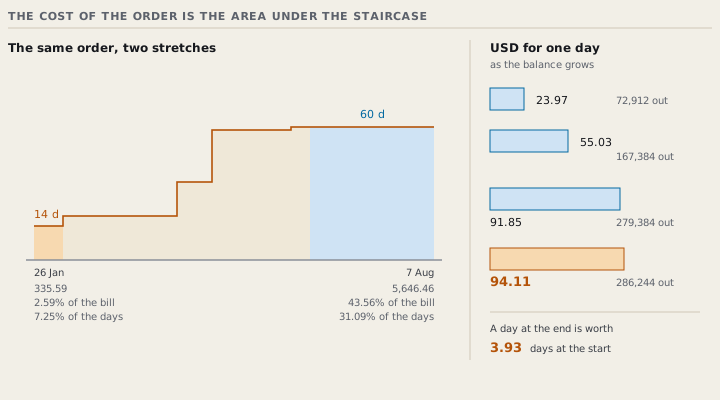
The picture is a staircase. Each payment lifts it. Nothing lowers it until the money arrives. The cost of the whole order is the area under the steps. So the last stretch, which is tall and wide, carries most of the bill.
| Days | Share of the cycle | Cost | Share of the cost | |
|---|---|---|---|---|
| 26 Jan to 9 Feb, first outflow only | 14 | 7.25% | 335.59 | 2.59% |
| 8 Jun to 7 Aug, credit period | 60 | 31.09% | 5,646.46 | 43.56% |
The credit period is 31.09% of the days and 43.56% of the cost. The opening fortnight is 7.25% of the days and 2.59% of the cost. A day at the end of this order is worth 3.93 times a day at the beginning of it. That ratio is simply USD 286,244.00 divided by USD 72,912.00.
The four numbers to have in your head
At an illustrative 12.0% a year on a 365-day basis, one dollar costs USD 0.00032877 a day. Multiply that by the balance outstanding:
| Point in the order | Balance outstanding | One day |
|---|---|---|
| After the fabric deposit only | 72,912.00 | 23.97 |
| After fabric, trims and the balance | 167,384.00 | 55.03 |
| After the wage run | 279,384.00 | 91.85 |
| After shipment, full exposure | 286,244.00 | 94.11 |
USD 94.11 a day. That is the number worth memorising for this order. It prices every argument that happens after the vessel sails.
Which delays cost money
Now the part that surprises people. Take four delays of exactly eight days each and price them.
1. The buyer pays eight days late. The balance outstanding is USD 286,244.00, and it stays outstanding for eight more days.
8 × 94.11 = USD 752.88
2. The vessel is rolled and the bill of lading is dated eight days later. Rolled means the shipping line moves your container to a later sailing. The credit clock starts eight days later, so payment lands eight days later. Every outflow was already made on its own date, and none of them moves.
8 × 94.11 = USD 752.88
3. The fabric arrives eight days late but the ship date holds. Cutting starts late, the line works overtime, everyone is furious.
USD 0.00.
Not one cash date moved. The mill was paid when it was paid. The wages were paid when they were paid. The money arrives on 7 August as planned. The delay costs overtime, air-freight risk and somebody's weekend. It costs nothing at all in finance.
4. The factory pays the fabric balance eight days early, on 28 March instead of 5 April, to keep the mill sweet.
8 × 72,912.00 × 0.00032877 = USD 191.77
The asymmetry that decides where to put your effort
Compare the last two. Eight days of buyer delay costs USD 752.88. Eight days of paying a supplier early costs USD 191.77. Both are eight days. The first is worth 3.93 times the second, for the same reason as before. The balance behind it is bigger.
So the effort follows the money, and the money is almost always at the back of the order:
- Anything that moves the payment date is worth roughly USD 94 a day.
- Anything that moves the bill of lading date is worth the same, and it is usually easier to move.
- Anything that moves a supplier payment is worth a quarter to a third of that.
- Anything that moves a production date and nothing else is worth nothing here.
That ordering is the practical output of this whole course. It tells a merchandiser which fight to pick on a Tuesday morning.
One line on the facility letter that changes the answer
Every figure above uses a 365-day year, because that is how Hierakon's letter to Kalabsha is written. Many US dollar facilities are written the other way, on actual over 360. The day count is real days, but the year is treated as 360 days long. The daily rate is then 0.12 / 360 = USD 0.00033333 rather than USD 0.00032877.
Apply that to this order's 39,429,684 dollar-days and the funding cost becomes USD 13,143.23 instead of USD 12,963.18. That is USD 180.05 more, on the same money at the same quoted rate.
It is not a trick, and nobody is hiding it. It is a convention, and it is printed on the letter. But it means two facilities quoted at "12.0%" are not the same price. Comparing them requires reading the basis. Convert both to a daily rate first, then compare the daily rates.
Check yourselfTwo proposals land on the same morning: pull the ship date forward by 4 days at a cost of USD 2,100.00 in overtime, or chase the buyer's accounts team so the invoice is logged 4 days sooner, at no cost. Which is worth doing?Show the answer
Both save the same USD 376.44, because both move the payment date by four days. The overtime proposal spends USD 2,100.00 to save USD 376.44. On finance grounds alone that is a clear no. It may still be right for a booking or a season, but not for cash. Chasing the invoice is free and saves the same amount. That makes it the best-value action available on the whole order, and the one nobody is measured on. Lesson 5 puts a number on that neglect.
What to take away
- A day costs the outstanding balance times the daily rate. There is no single cost-per-day for an order.
- Days at the end of the cycle are the expensive ones. The credit period is a third of the days and nearly half the cost.
- A delay is only a finance cost if it moves a cash date. A production delay inside a fixed ship date costs nothing on this line.
- Read the day-count basis on your facility. Actual over 360 and actual over 365 are different prices wearing the same number.