Lessons · Lesson 1 of 6
Three products, one word
Three quotes arrive in the same week and all three are called financing. Read what each one really sells, then price all three on the same shipment.
Lesson 1 of 6 · 17 min
The week the three quotes arrived
Zohairy Home Textiles makes cotton terry bathrobes in Kafr Shukr, north of Cairo. Last year it sold USD 9,976,000. More than half of that went to one customer: Steinmark Home, a German home-textiles retailer. Steinmark repeats its order nine times a year. That is USD 5,387,400, or 54.0% of the book.
The shipment on the desk today is purchase order SMK-7714: 41,000 bathrobes, style RB-620, 480 gsm cotton terry. The price is FOB Alexandria USD 14.60. FOB means the price covers the goods loaded on the ship at Alexandria, and nothing after that. The invoice is USD 598,600.
The container sailed on a bill of lading dated 12 March 2026. Steinmark buys on open account. Open account means no bank guarantee and no letter of credit: the factory ships, sends the invoice, and waits. The term is 90 days from the bill of lading date, so the money is due on 10 June. Steinmark pays its suppliers on the 24th of each month, so the money will really arrive on 24 June. That is 104 days after the container sailed.
Zohairy paid its yarn supplier in January. It has paid its people every week since. It paid the electricity bill in February. It gets paid in June. That gap is the subject of this whole track, and course 13.4 measures it.
This course is about what it costs to close the gap. Three institutions offered to close it in the same week. They offered three completely different products. All three covering emails used the same word: financing.
What each of the three is really selling
Selmawy Commercial Bank offers invoice discounting. Zohairy assigns the Steinmark invoice to the bank and gets 80% of the invoice value at once. Selmawy charges a discount of 7.8% a year on the money it advances, plus a service fee of 0.35% of the invoice value. Steinmark is not told anything. Zohairy still sends the statements and takes the calls. When the money lands in the collection account, the bank takes what it is owed and releases the rest. If Steinmark has not paid within 90 days of the due date, the bank takes its money back from Zohairy.
That is a loan against an invoice. What it sells is time.
Lindengate Receivables offers factoring. Factoring means selling the invoice and the job of collecting it. Lindengate advances 85%. It charges a discount of 8.4% a year on the advance, plus a factoring commission of 0.9% of every invoice assigned, with a minimum of USD 24,000 a year. It also takes over the sales ledger. Steinmark is told in writing that the debt has been assigned, and is told to pay Lindengate directly. Lindengate issues the statements, runs the aged debt report, sends the reminders and makes the collection calls in four languages.
That is an outside credit-control department that also lends you money. What it sells is the collection and the ledger.
Crossfell Trade Credit offers a whole-turnover credit insurance policy. Whole-turnover means the policy covers all your sales, not one shipment. Crossfell advances nothing at all. It checks each of Zohairy's buyers, sets a credit limit for each one, and promises to pay 90% of an insured debt that goes bad. On Steinmark, Zohairy asked for a limit of USD 700,000 and got USD 450,000. The premium is 0.42% of insured sales, plus a policy fee of USD 3,200 a year.
That is not financing. Not one dollar reaches the bank account any earlier. What it sells is protection against a buyer who does not pay. It also sells something quieter: the opinion of an institution that watches Steinmark's whole market, which Zohairy cannot see.
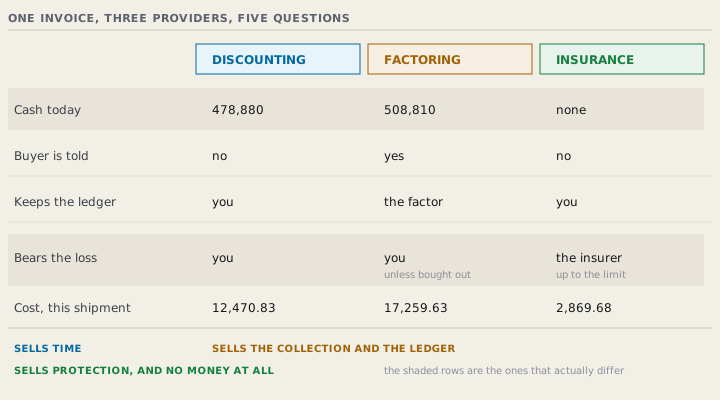
The questions that separate them
Put any offer of financing against these four questions and the confusion goes away.
| Selmawy — discounting | Lindengate — factoring | Crossfell — insurance | |
|---|---|---|---|
| Cash today, on this invoice | 478,880 | 508,810 | nothing |
| Who chases the buyer | Zohairy | Lindengate | Zohairy |
| Does the buyer know | no | yes, notified | no |
| Who loses if the buyer fails | Zohairy | Zohairy, unless bought out | Crossfell, up to the limit |
| Cost on this shipment | 12,470.83 | 17,259.63 | 2,869.68 |
Every number in that table is worked out later in this course. The third column is the one that catches people. Crossfell is the cheapest line on the table, and it is not competing with the other two at all. It solves a different problem. A factory that buys the insurance and still cannot pay its yarn supplier in April has bought exactly what it asked for, and nothing it needed.
The opposite trap is worse. A factory that takes the bank's 80% and thinks it has sold the invoice has not sold anything. It has borrowed against it. It still carries the whole of Steinmark's credit risk, on 100% of the invoice. It will find that out in the one week it can least afford to.
The names really are unstable, and that is not your fault
Invoice discounting, receivables discounting, invoice finance, bill discounting, factoring, supply chain finance, forfaiting, payables finance. These overlap in ordinary speech, and the people selling them use one word for another. That is why the International Chamber of Commerce and four industry bodies published a set of Standard Definitions for Techniques of Supply Chain Finance. It was not an academic exercise. It was written because buyers of these products could not tell them apart.
So do not argue about the word. Argue about the four questions. And when you sign, make the contract answer them in writing. The salesman's word for the product will not appear in the clause that takes your money back.
Where this course goes
Lesson 2 turns every one of those prices into a single annual rate you can compare. It finds that the smallest-looking percentage on the desk is the most expensive money Zohairy could take. Lesson 3 prices the difference between recourse and non-recourse, then watches a quality complaint cancel both. Lesson 4 reads Crossfell's policy for the conditions that void a claim, and finds a shipment with no cover at all that four people signed off correctly. Lesson 5 is about one buyer being 54.0% of the book. Lesson 6 is about not selling the same invoice twice, and about the cheapest financing in this whole course, which is a conversation.
Prompt · Put every price on my desk on one annual rate
When three financing quotes, a buyer's early-payment offer and a supplier's settlement discount are all in the same inbox, and none of them can be compared with the others.
Act as a trade finance analyst working for a garment exporter, not for a bank. I want every price in front of me restated as one annual percentage I can compare, so I can rank them. My facts: currency [CURRENCY], buyer [BUYER], invoice value [AMOUNT], bill of lading date [DATE], payment terms [DAYS FROM WHAT EVENT], and the dates this buyer's money has ACTUALLY arrived on the last three shipments [DATES]. Number of shipments a year through this facility [NUMBER]. For each financing offer I will give you: provider [NAME], advance percentage [PERCENT], discount or interest rate [PERCENT] and its day-count basis [ACTUAL OVER 360, ACTUAL OVER 365, OR AS QUOTED], every fee with its basis [PER INVOICE, PER ANNUM, PERCENT OF WHAT], any minimum annual charge [AMOUNT], and whether it is with or without recourse. I will also give you any settlement discounts offered TO me by suppliers [PERCENT FOR HOW MANY DAYS EARLIER], and any early-payment discount asked FROM me by buyers [PERCENT FOR HOW MANY DAYS EARLIER]. Do the following. First, for each financing offer, work out the total charge in money on ONE named shipment. List every component separately. Then give the annual rate: total charge, divided by the money actually received, divided by the days it was held, times 365. State the denominator you used and why. Second, restate any rate quoted on a 360-day year onto a 365-day basis, and show the difference in points. Third, annualise every settlement and early-payment discount: the discount divided by one minus the discount, times 365 over the number of days bought. Fourth, put them all in one table ranked from cheapest to dearest, with my own all-in cost of funds marked as the line. Label each row take, refuse or use-first. Fifth, tell me in money what I gain a year by acting on the ranking. Sixth, list what the annual rate does NOT capture for each offer: recourse, minimums, concentration caps, covenants, withdrawal rights. Ask me for any input you need rather than assuming it. Never give me a range where a number is possible.
AI can make mistakes — check anything you act on.
Check yourselfZohairy buys the Crossfell policy and the March cash gap gets worse rather than better. What went wrong?Show the answer
Nothing went wrong with the policy. Credit insurance pays out after a buyer fails. It does not advance money against a good invoice, so it cannot close a timing gap. Zohairy bought protection against a bad debt, when its problem was that a good debt was 104 days away. These are two separate purchases. Either one can be right. Only one of them puts money in the account in March.