Lessons · Lesson 4 of 6
What the insurer covers, and what quietly voids the claim
Read a credit insurance policy for its five load-bearing numbers, then follow two claims that failed — one because of a shipping calendar and one because of a polite email.
Lesson 4 of 6 · 17 min
Five numbers hold the whole policy up
Crossfell Trade Credit's whole-turnover policy runs to thirty pages. Five numbers in it decide whether a claim is paid.
- The insured percentage — 90%. Crossfell pays that share of an insured loss. The other 10% is Zohairy's, and it cannot be insured by design. An insurer that paid 100% would be paying a seller who has no reason to care who they sell to.
- The credit limit — USD 450,000 on Steinmark. This is the largest outstanding balance Crossfell will cover on that buyer at any moment. It is not per invoice. It is not per shipment. It is not per year.
- The discretionary limit — USD 30,000. On a buyer with no Crossfell limit, Zohairy may decide for itself up to this amount. But only if it meets the conditions the policy names: a clean payment record, and a current credit report on file. No report, no cover, whatever the amount.
- The maximum extension period — 60 days. Zohairy may give a late-paying buyer up to 60 extra days beyond the original due date on its own authority. Beyond that it needs Crossfell's written consent.
- The overdue notification period — 30 days. Any debt still unpaid 30 days after its due date must be reported to Crossfell inside that window.
Behind the five sit the exclusions. The one that matters most is short: a disputed debt is not covered until the dispute is resolved in the insured's favour. Lesson 3 showed why that sentence is where a garment factory's real credit risk lives.
The mistake nobody made
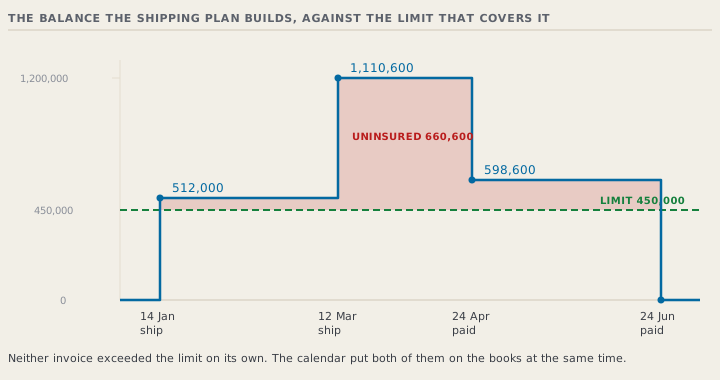
A credit limit is a balance, and a shipping calendar creates balances. Nobody at Zohairy had ever put the two on the same page.
| Bill of lading | Invoice | Due | Balance after | |
|---|---|---|---|---|
| Shipment SMK-7690 | 14 January | 512,000 | 14 April | 512,000 |
| Shipment SMK-7714 | 12 March | 598,600 | 10 June | 1,110,600 |
The limit is USD 450,000. On 12 March the outstanding balance on Steinmark was already USD 512,000, because the January shipment was not due for another month. So the March container sailed into a balance of USD 1,110,600, against a limit of USD 450,000. USD 660,600 of it was uninsured, and not one person made a mistake.
- The credit controller applied for USD 700,000 in December, was granted USD 450,000 in January, and filed the notification.
- The merchandiser shipped on the confirmed date, against a confirmed purchase order.
- Finance drew the usual 80% from Selmawy on 16 March.
- The managing director had approved the Crossfell policy precisely so that this buyer was covered.
Had Steinmark failed on 13 March, the claim would have been USD 450,000 at 90%, which is USD 405,000, against a loss of USD 1,110,600. That is 36.5% of it. Everybody would have been astonished, and the policy would have performed exactly as written.
The fix is one column, and it is free
Add running insured exposure to the shipping plan: the outstanding balance on this buyer, plus this shipment, against the limit. When the number goes past the limit, the plan shows it weeks before the container is booked. That is when every option is still cheap.
There are four options, and only the last one is an accident.
- Ask for a limit increase. It costs nothing and takes days. Crossfell would very likely have raised Steinmark to USD 600,000 in January, on a clean two-year record. It will not raise it in June, against a balance of USD 1,110,600 and a request that smells of a problem. The time to ask for a limit is when you do not need it.
- Sequence the shipments so the balance stays under the ceiling. This is expensive, because it delays revenue, but it is a decision.
- Ship the excess against payment security. A documentary credit or a standby, for the amount above the limit, takes that part out of the exposure entirely. Course 13.2 covers the credit. Course 13.7 covers the standby.
- Ship uninsured, knowing it. Perfectly legitimate. It is only a failure when nobody knew.
The second claim, killed by good manners
Ossory Living is a smaller UK customer with a Crossfell limit of USD 150,000. Invoice OSL-3318, USD 118,400, was due on 20 July.
Ossory went quiet. On 4 August its finance office asked for more time. Zohairy's merchandiser was protecting a customer of six years, and doing what any good merchandiser does. She replied agreeing to 90 extra days.
That email is the entire loss. The policy's maximum extension period is 60 days. Granting 90 without Crossfell's written consent takes the debt outside cover. When Ossory went into administration in November, the claim was declined: USD 106,560 of cover, destroyed by a courtesy that took two minutes to type.
There is a second, separate ground on the same debt. The invoice went overdue on 20 July. Zohairy reported it on 3 September, which is 45 days later, against a notification period of 30. Either failure alone would have been enough.
The correct action was free and took no longer. Reply to the buyer saying you will come back within 48 hours. Email Crossfell asking for consent to a 90-day extension. Then reply. Insurers grant these routinely, and that is what the consent mechanism is for. What they will not do is grant one afterwards.
Is a broken condition always fatal
Not automatically, and it is worth knowing why before you accept a declined claim. Under English law, an insurer cannot use a breached term to refuse a claim if that breach could not have made the loss that actually happened any more likely. A term about storing samples securely, say, has nothing to do with a buyer's insolvency, and cannot be used to defeat that claim.
But that reasoning does not rescue Zohairy. Late notification and an over-long extension go straight to the heart of a credit loss. Both take away the insurer's chance to stop further shipments, start collection and limit the damage. These are exactly the conditions that survive the argument.
Which leads to the only safe operating rule. Never grant time, never settle, never write off, and never stop shipping to a distressed buyer, without telling your insurer first. Every one of those is a decision the policy has an opinion about.
Check yourselfA buyer with no Crossfell limit orders USD 26,000 of goods and has paid you on time for three years. Are you covered under the discretionary limit?Show the answer
Only if you also hold what the policy requires. On this schedule that is a current credit report on file. The amount is inside the USD 30,000 discretionary limit and the payment record is clean. But the discretionary limit is a set of conditions, not just a number, and the report is the condition most often missing. Get the report before the goods leave, not after the claim.