Lessons · Lesson 2 of 6
What the discount actually costs, as a rate
Turn a quoted discount, a service fee and an arrangement fee into one annual rate, then use that rate to accept one settlement discount and refuse another.
Lesson 2 of 6 · 17 min
The number on the term sheet is not the price
Selmawy Commercial Bank's term sheet says 7.8%. That is not what Zohairy pays. The gap is not a trick. Every part of it is printed on the same page. The problem is that a rate, a fee and a day-count rule are three different kinds of number, and nobody adds them up for you.
Here is the drawdown on purchase order SMK-7714. A drawdown is the moment the bank actually pays you. The invoice is USD 598,600. The documents reach the bank on 16 March 2026, and the advance of 80% — USD 478,880 — is paid in on the same day. Steinmark's money arrives on 24 June. So Zohairy has the bank's money for 100 days.
Now the three charges.
One: the discount, on an actual/360 basis. Actual/360 is a day-count rule. The bank counts the real days that passed, but divides by a year of 360 days. So the charge is USD 478,880 at 7.8% for 100 days over 360: USD 10,375.73.
The calendar year has 365 days and the bank's year has 360. So over a full year this rate collects more than it looks like. It collects 365 divided by 360, which is about 1.4% more interest than the headline. Put on a 365-day basis, that 7.8% is really 7.91%.
Two: the service fee. It is 0.35% of the invoice value, or USD 2,095.10, taken off at the drawdown. It is a fee, not a rate. Nothing about it changes if Steinmark pays early or late.
Three: the arrangement fee. This is USD 4,500 a year, paid for having the facility at all. Zohairy puts nine shipments a year through it, so USD 500 belongs to this one.
| Amount | Points of annual cost | |
|---|---|---|
| Discount, 7.8% actual/360 for 100 days | 10,375.73 | 7.91 |
| Service fee, 0.35% of invoice face | 2,095.10 | 1.60 |
| Share of the annual arrangement fee | 500.00 | 0.38 |
| All in, on the money actually advanced | 12,970.83 | 9.89 |
The right-hand column is one line of arithmetic, and it is the most useful line in this course:
cost, divided by the money you actually received, divided by the days you had it, times 365.
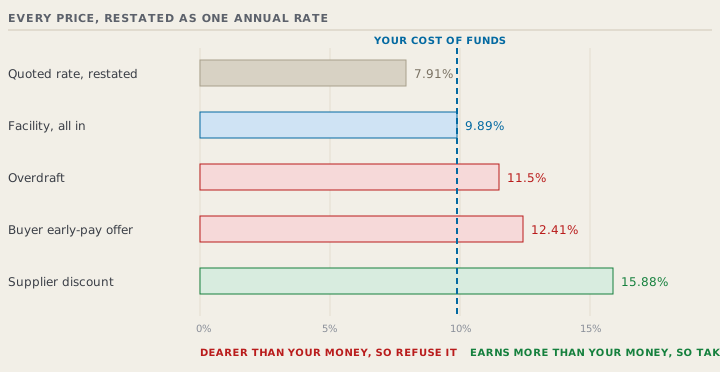
USD 12,970.83 over USD 478,880 is 2.7086% for 100 days. Multiply by 365, divide by 100, and you get 9.89% a year. The quoted 7.8% understates the real cost by more than two points. Every one of those points is printed on the term sheet.
Now the rate is useful, because you can compare things with it
Zohairy has three other ways of moving money across time. Nobody has put them on the same axis before.
Its overdraft with Selmawy costs 11.5% a year on the balance drawn, with no fee per drawdown. That is dearer than the facility. So use the discounting line first, and keep the overdraft for what the facility will not fund.
Steinmark has offered to pay at 30 days instead of 90, for 2.0% off the invoice. A settlement discount, in other words: money off in exchange for paying sooner. This is the offer that looks like nothing and is the most expensive money on the desk.
Two per cent buys 60 days. To turn a settlement discount into an annual rate, divide the discount by what you would actually have received, not by the invoice:
2.0 divided by 98.0 is 2.0408% for 60 days. Times 365 over 60 is 12.41% a year.
Now in dollars, on this shipment. Taking the offer costs USD 11,972.00. Financing the same 60 days on the same net amount, at Zohairy's all-in 9.89%, costs USD 9,537.12. So the offer is USD 2,434.88 worse per shipment. Over nine shipments that is USD 21,913.88 a year. The sales director would describe it as helping the customer with their cash flow.
Qabbani Terry Weaving has offered Zohairy 1.5% off its cloth invoices for payment at 10 days instead of 45. Same arithmetic, opposite answer:
1.5 divided by 98.5 is 1.5228% for 35 days. Times 365 over 35 is 15.88% a year.
The March cloth invoice is USD 214,000. Taking the discount saves USD 3,210.00. Funding the early payment for 35 days at 9.89% costs USD 1,999.04. Net gain: USD 1,210.96 on one invoice, from borrowing money to pay a bill early.
The line that decides everything
Look at what just happened. The same facility, at the same 9.89%, made one decision wrong and the other right.
- Anything that costs more than 9.89% a year to get money — Steinmark's 12.41% offer, the 11.5% overdraft — should be refused while the facility has room.
- Anything that earns more than 9.89% a year — Qabbani's 15.88% discount — is worth funding on the facility.
The number you compare against is not the bank's rate in the abstract. It is your own next-best use of the same dollar. A factory with no facility and no cash answers both questions differently. A factory whose facility is already fully drawn answers them differently again.
Do this once for every price on your desk
Every financing offer, settlement discount, early-payment programme and late-payment penalty a merchandiser meets can be reduced to one annual percentage, with the two formulas above. Most of them never are. That is why a 2.0% concession gets agreed in a meeting, and a 15.88% opportunity sits unread in a supplier's email footer.
Course 16.4 covers negotiating payment days as a commercial term. This lesson is the other half of that conversation: what those days are worth in money, before you trade them.
Check yourselfA buyer offers 1.0% for payment at 15 days instead of 45. Is that cheap money?Show the answer
It is 1.0 divided by 99.0, which is 1.0101% for 30 days, times 365 over 30 — about 12.29% a year. Whether it is cheap depends entirely on the alternative. At Zohairy's 9.89% it is expensive and should be refused. To a factory with no facility and an overdraft at 18%, it is the cheapest money available. The percentage on its own means nothing until you annualise it and set it against your own cost.