Lessons · Lesson 2 of 6
- 01 · The price was a bet, and it was placed in January
- 02 · The exposure schedule, and the hedge that costs nothing
- 03 · Two currencies, one company: which one is your profit?
- 04 · The exposure that appears on no schedule
- 05 · What the instruments do, and what each one costs
- 06 · When not to hedge, and the policy that replaces guessing
The exposure schedule, and the hedge that costs nothing
Write one order's currency risk down as a list of dated cash flows, net it off, and find the part of the loss that comes from dates rather than from rates.
Lesson 2 of 6 · 18 min
You cannot manage a number you have never written down
Ask Ardessa's treasurer in March what the currency exposure on LKM-9126 is, and he says "half a million dollars". That is the order value. It is the wrong number, by nearly double.
An exposure is not a total. It is a list of dated cash flows in a currency that is not yours. Until you write it in that shape, you can do nothing with it.
Here is the list for this one order.
| Cash flow | Direction | Currency | Amount | Due | Certainty |
|---|---|---|---|---|---|
| Fabric, thread and trims, 60 days from mill invoice | out | USD | 226,800 | 19 May | contracted |
| Larkmoor invoice, 90 days from bill of lading | in | USD | 497,700 | 8 September | confirmed order |
| Cut, make, trim, overhead, wages | out | sela | 9,576,000 | March to June | contracted |
Three rows. Two in dollars, one in sela. Ardessa is a Corvane company: its shareholders, wages, rent and tax are all in sela.
So the third row is not exposed at all. It is money in the currency the company actually lives in. Only the first two rows can move.
Net, do not total
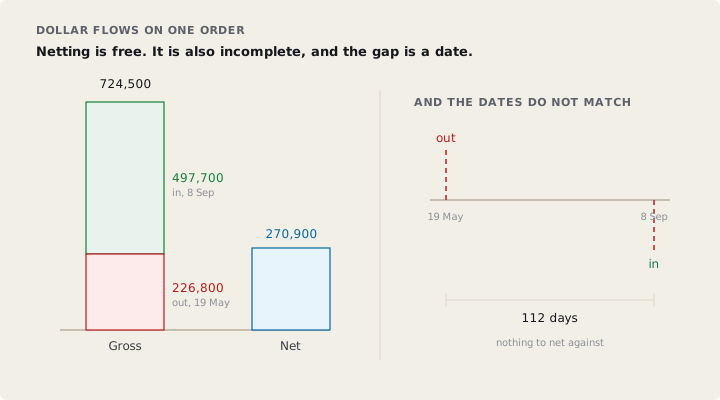
Add the two dollar rows without looking at their direction and you get USD 724,500 of exposure. That is the gross figure. It is what a factory quotes when it is frightened.
Now look at the direction. Ardessa receives 497,700 dollars and pays out 226,800 dollars. Whatever the dollar does, it does to both. If the dollar weakens against the sela, the money coming in is worth less — and the money going out costs less. The two partly cancel.
- Gross exposure: USD 724,500
- Net exposure: USD 270,900, long dollars
Netting has removed USD 453,600. That is 62.6% of the gross figure, and it cost nothing. No bank, no premium, no contract, no phone call. It was already there. It had just never been written down in a shape that let anyone see it.
This is the natural hedge: two opposite flows in the same currency, cancelling each other. It is the most under-used tool in this course, precisely because it is not a product. Nobody sells it, so nobody offers it to you.
A factory that buys fabric in dollars and sells garments in dollars is far less exposed than one that buys locally and sells in dollars. And the second factory usually believes it has the safer position, because it has "no import exposure".
The half of the natural hedge that fails
Now the part that costs Ardessa real money. Almost every explanation of netting leaves it out.
The two dollar flows are not on the same day. The fabric is paid on 19 May. The money comes in on 8 September. That is 112 days apart. Through those 112 days, Ardessa has already paid its dollars out and has not yet received any. For that stretch there is nothing to net against.
Matching is by currency and by date. A match on currency alone is half a hedge.
Here is what it cost. Rhosden Bank's spot rate was 45.10 on 19 May and 43.10 on 8 September.
| Sela | |
|---|---|
| Expected receipt, 497,700 dollars at the January rate of 46.00 | 22,894,200 |
| Expected fabric payment, 226,800 dollars at 46.00 | 10,432,800 |
| Local cost | 9,576,000 |
| Expected margin | 2,885,400 |
| Actual receipt, 497,700 dollars at 43.10 | 21,450,870 |
| Actual fabric payment, 226,800 dollars at 45.10 | 10,228,680 |
| Local cost | 9,576,000 |
| Actual margin | 1,646,190 |
The margin fell by 1,239,210 sela. That is 42.9% of what was costed. Now split that loss in two, because the two halves have different cures.
The rate effect. Suppose both dollar flows had settled on the same day, at 43.10. The margin would have been 2,099,790 sela, and the loss 785,610 sela, or 27.2%. That is the pure result of being net long 270,900 dollars into a rate that fell from 46.00 to 43.10. Check it in one line: 270,900 multiplied by 2.90 is 785,610.
The timing effect. The rest of the loss is 453,600 sela, which is 36.6% of the total damage. It comes from nothing but the calendar. The fabric was paid on 19 May at 45.10, not on 8 September at 43.10. So Ardessa converted its dollars out at a worse moment than it converted them in. Check that too: 226,800 dollars multiplied by the 2.00 sela difference between the two dates is exactly 453,600.
More than a third of the loss on this order had nothing to do with being wrong about the currency. It came from paying on one date and being paid on another.
Prompt · Turn my order into an exposure schedule
When somebody asks what the currency risk on an order is, and the only answer anyone has is the order value.
Act as the treasurer of a garment export factory. Build me a currency exposure schedule for one order, then tell me what it says. Facts: my company is registered in [COUNTRY] and its functional currency is [HOME CURRENCY]. Order: buyer [BUYER], purchase order [NUMBER], style [STYLE], quantity [QTY], price [PRICE] per unit [INCOTERM], order value [AMOUNT]. Quotation issued [DATE], valid [NUMBER] days. Order confirmed [DATE]. Materials contracted [DATE] for [AMOUNT] in [CURRENCY], payable [TERMS]. Local conversion cost [AMOUNT] in [HOME CURRENCY], spent between [DATE] and [DATE]. Shipment [DATE]. Payment terms [TERMS], so cash expected [DATE]. Spot rate when I quoted: [RATE]. Do the following. First, list every cash flow as a row with direction, currency, amount, due date, and a certainty class of contracted, confirmed order, or forecast. Mark which rows are NOT in my functional currency, because only those are exposed. Second, give me the gross exposure and the net exposure by currency, and state the percentage the netting removes. Third, show me where the netted flows fall on different dates, give the gap in days, and price what a move of [PERCENT] over that gap would cost me. Fourth, tell me the number of days from my quotation to my cash, and compare it with the number of days my finance report measures. Fifth, say which instrument each certainty class allows and which it forbids, and why. Sixth, list what you had to assume. Do not give me a range where a number is possible.
AI can make mistakes — check anything you act on.
Certainty decides which instrument you are even allowed
The last column of the schedule is the one people skip. It is the column that chooses the instrument.
- Contracted — a signed fabric contract at a fixed dollar price. The cash flow will happen. You may fix it with a forward, because a forward obliges you to deliver, and you know you can.
- Confirmed order — the buyer has issued a purchase order. Very likely, but not certain. Orders get cut, and lesson 6 is about what happens when one does.
- Forecast — next season's expected business. You may not fix this with a forward. If the business does not happen, you are left holding a currency contract with nothing behind it. That is a bet you placed by accident.
An outstanding quotation, like the one in lesson 1, is a fourth case. The exposure exists, and it is not yours to control, because the buyer decides whether it becomes real. That is exactly the shape an option is built for. It is why Rhosden quoted an option on that one, not a forward.
Check yourselfA factory imports all its fabric in dollars, sells all its garments in dollars, and pays wages and overhead locally. Its finance director says the company has no currency exposure because dollars in and dollars out cancel. What is wrong with that?Show the answer
Two things. First, the dollar flows only cancel as far as the smaller of them. Here the fabric is roughly 46% of the invoice value, so more than half the receipt is unhedged and long dollars. Second, they only cancel if they land on the same dates. Fabric is paid months before a garment is, so even the part that does net is exposed across the gap. Netting is a real and free reduction. It is a reduction, not an elimination.
What to take away
Write the exposure as dated cash flows. Give each one a currency, an amount, a date and a certainty. Net it before you hedge it, because netting is free and instruments are not. Then look at the dates. A natural hedge that is right on currency and wrong on timing will still take a third of your loss out of you. And that part is fixed by negotiating terms, not by buying anything.