Lessons · Lesson 5 of 6
- 01 · The price was a bet, and it was placed in January
- 02 · The exposure schedule, and the hedge that costs nothing
- 03 · Two currencies, one company: which one is your profit?
- 04 · The exposure that appears on no schedule
- 05 · What the instruments do, and what each one costs
- 06 · When not to hedge, and the policy that replaces guessing
What the instruments do, and what each one costs
Price a forward, an option and a contract clause on the same order so they can be compared, and learn why a forward rate is never a forecast.
Lesson 5 of 6 · 20 min
One exposure, four ways to treat it
It is 23 February. Larkmoor has confirmed LKM-9126. Rhosden Bank's spot rate is 45.60, and Ardessa will receive USD 497,700 on 8 September, 197 days away.
This lesson prices four responses to that one cash flow. All four are on the same order, so for once they can be compared.
Before the bank is called at all, there is the free one from lesson 2. Ardessa also owes USD 226,800 on 19 May. It should cover that separately, by buying dollars forward for 19 May. It should not leave it to net against a receipt that arrives 112 days later. Rhosden quotes 46.32 for that value date. Everything below is about the remaining, larger question.
One: do nothing
Ardessa receives 497,700 dollars on 8 September and sells them at whatever the rate is that morning. No cost, no contract, no credit line, complete flexibility. And a result nobody can state in advance.
At the rate that actually arrived, 43.10, that is 21,450,870 sela.
Doing nothing is a position. It is not the absence of one. "We decided not to hedge" and "nobody looked at it" produce the same bank statement and two completely different companies.
Two: the forward
A forward outright is an agreement made today to exchange a fixed amount of one currency for another, on a fixed future date, at a rate fixed now. No money changes hands at the start. Both sides are obliged.
Rhosden quotes Ardessa 47.26 for value 8 September. The first thing to notice is that this is better than the spot rate of 45.60. Sell dollars forward and you get more sela than you would today. That looks like a gift. It is not.
At 43.10 the forward is worth 2,070,432 sela more than doing nothing. It could also have been worth less. At 49.00 the forward pays 23,521,302 while doing nothing pays 24,387,300, so Ardessa would have given up 865,998 sela. A forward removes the outcome, not the loss. That is what it is for.
Its real cost is not on the bank's quote sheet. A forward uses up credit line, because the bank is carrying Ardessa's promise to deliver. That line is the same line the working-capital facility in course 13.4 draws on. And it is an obligation. Lesson 6 is about the day that matters.
Three: the option
An option is the right, without the duty, to deal at a stated rate. Rhosden quotes Ardessa the right to sell 497,700 dollars at 46.50 on 8 September. The premium is USD 6,720, payable on 23 February. That is 306,432 sela, or 0.62 sela for every dollar covered.
Below 46.50, Ardessa exercises the option and gets 46.50, less the 0.62 it already spent. That is a floor of 45.88 sela a dollar. Above 46.50, it lets the option lapse, sells at the market, and is 0.62 worse off than doing nothing.
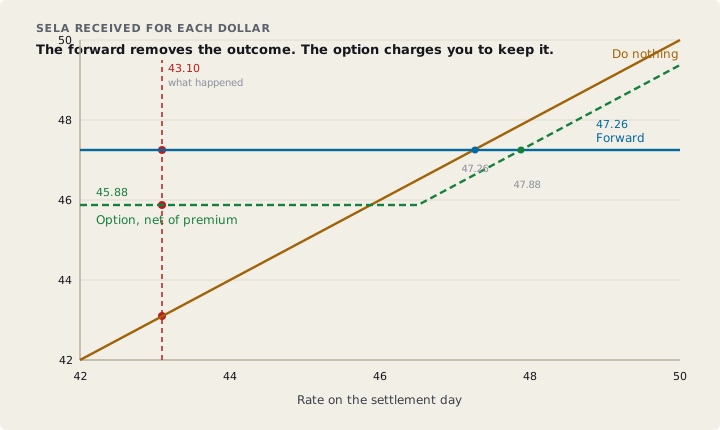
| Rate on 8 September | Do nothing | Forward | Option, net of premium |
|---|---|---|---|
| 43.10, what happened | 21,450,870 | 23,521,302 | 22,834,476 |
| 47.26 | 23,521,302 | 23,521,302 | 23,212,728 |
| 49.00 | 24,387,300 | 23,521,302 | 24,078,726 |
Read the two break-even points off the table, not off the drawing.
- Doing nothing beats the forward above 47.26. That is simply the forward rate, by definition.
- The option beats the forward only above 47.88, which is the forward rate plus the premium per dollar. Below that, the forward wins at every single rate — and it wins with no cash paid up front.
So why buy the option at all? Not for the outcome. On this order it was worse than the forward by 686,826 sela. You buy it for the one thing the table cannot show: it does not oblige you. If the order is cut, the option simply lapses. The forward does not, and lesson 6 puts a number on that.
Prompt · Price a forward, an option and doing nothing on my numbers
Before you ring the bank, so you arrive knowing what each answer is worth and where the break-even points sit.
Act as a corporate treasury adviser who is paid by me, not by a bank. I have one foreign-currency receivable, and I want the three options priced side by side. Facts: receivable [AMOUNT] in [CURRENCY], due [DATE], which is [NUMBER] days away. My functional currency is [HOME CURRENCY]. Today's spot from my bank is [RATE]. My bank's indicative deposit rates for that period are [PERCENT] in my home currency and [PERCENT] in the receivable currency. My bank quotes a forward outright of [RATE], and an option to sell the receivable currency at a strike of [RATE] for a premium of [AMOUNT] payable today. My costed margin on the underlying order is [AMOUNT] in my home currency. Do the following. First, check the forward rate against the interest difference and tell me whether it is consistent with the deposit rates I gave you. Show the money-market alternative — borrow, convert at spot, deposit — and where it lands. Second, express the option premium as a cost per unit of the receivable currency, and as a percentage of my costed margin. Third, build a table of my home-currency proceeds under all three treatments, at five settlement rates spanning a plausible range. State the two break-even rates: where doing nothing beats the forward, and where the option beats the forward. Fourth, tell me plainly which is best on outcome and which is best on flexibility, and name the circumstance in which the more expensive one is the right buy. Fifth, tell me what the forward does to my bank credit line, and what happens if my order is cut before settlement. Do not recommend a currency view, and say so if I have implicitly asked you for one.
AI can make mistakes — check anything you act on.
Four: a clause in the sale contract
This is the instrument nobody sells, because it is not a financial product. It is a paragraph in the sales contract. It says the price holds while the rate stays inside a band, and that beyond the band the two parties share the move.
Ardessa proposed one to Larkmoor: the price is fixed while the dollar is between 44.00 and 48.00 sela, and outside that range the difference is split equally.
It costs nothing. It uses no credit line. And it is the only instrument on this list that a merchandiser negotiates, rather than a treasurer. It also carries a trap, and the trap is entirely in the drafting.
Ardessa's draft measured the rate on the invoice date. On 10 June the rate was 44.40, which is inside the band. So the clause paid nothing.
Had it measured on the payment date, the rate was 43.10. That is 0.90 below the floor, and Larkmoor would have compensated 0.45 sela a dollar: 223,965 sela.
It is the same clause either way. The word that decides whether it is worth a quarter of a million sela or nothing at all is the date it measures on. On a 90-day payment term, the invoice date is exactly the wrong one, because it stops the clock a quarter of a year before the money moves.
Check yourselfYour bank quotes a six-month forward well above spot for selling your dollars. Your sales director says the bank clearly expects the local currency to weaken, so you should wait rather than hedge. What do you say?Show the answer
That the forward is above spot because local interest rates are above dollar interest rates, and for no other reason. The bank is not giving a view. It is quoting an arbitrage. If you want to test it, price the money-market alternative: borrow dollars, convert at spot, deposit locally. You will land in the same place. Waiting is a decision to take a currency position. That may be defensible, but it cannot be defended by misreading the forward as a prediction.
What to take away
Net first, because it is free. Then choose by what you need, not by what you expect. A forward fixes the outcome and obliges you. An option keeps the upside and charges you for it. A contract clause costs nothing, but it needs the buyer's signature and it lives or dies on the date it measures. And never, ever read a forward rate as somebody's opinion about the future.