Lessons · Lesson 1 of 6
- 01 · The price was a bet, and it was placed in January
- 02 · The exposure schedule, and the hedge that costs nothing
- 03 · Two currencies, one company: which one is your profit?
- 04 · The exposure that appears on no schedule
- 05 · What the instruments do, and what each one costs
- 06 · When not to hedge, and the policy that replaces guessing
The price was a bet, and it was placed in January
Find the day the currency risk on an order really begins, and put a price on the part of it everybody gives away for free.
Lesson 1 of 6 · 20 min
The order
Ardessa Garments makes woven trousers in Tulhan, in Corvane. On 14 January it quotes Larkmoor Retail, a clothing chain in Vessland, for style CH-7480: 42,000 men's cotton twill chinos. One fabric, three colours, four sizes.
The price is FOB USD 11.85. FOB means the price with the goods loaded on the ship — freight and insurance after that are the buyer's cost. Order value is USD 497,700. The quotation says it is valid for 45 days.
Larkmoor confirms on 23 February, as purchase order LKM-9126. Materials are ordered in March. The goods go on board on 10 June. Larkmoor pays 90 days after the bill of lading date, so the money reaches Ardessa's bank on 8 September.
Nothing goes wrong. The fabric arrives on time. The line runs to plan. The inspection passes first time. The ship sails on schedule. Larkmoor pays on the day it said it would.
And Ardessa loses 1,239,210 sela of the margin it costed in January. That is 42.9% of it. The sales director looks for the person who made the mistake and cannot find one. Nobody made a mistake.
The cost sheet, and the assumption buried in it
Here is the cost sheet Ardessa signed on 14 January. That morning Rhosden Bank's spot rate was USD 1 = 46.00 sela. Spot means the rate for money exchanged today.
| Line | Currency it is actually incurred in | Per unit |
|---|---|---|
| Imported fabric, thread and trims | US dollars | USD 5.40 |
| Cut, make, trim, finishing, packing, factory overhead | sela | 228.00 sela |
| Local cost restated at 46.00 | USD 4.9565 | |
| Total cost | USD 10.3565 | |
| FOB quoted | USD 11.85 | |
| Margin | USD 1.4935 |
That margin is 12.60% of the selling price. It is the number the sales director carries in his head all year.
Look at the third row again. USD 4.9565 is not a cost. It is a cost divided by a rate. And the rate is a number somebody read off a screen on a Tuesday morning in January.
The cost sheet has no column for that rate. No cell shows it. No note says it was used. It is the biggest single assumption on the page, and it is the only one you cannot see.
Every merchandiser knows the fabric price can move. Almost nobody thinks of the CMT line the same way. CMT is cut, make and trim — the factory's own making cost. In sela it does not move. It moves because the thing you translate it into moves.
When did the risk start?
Ask this in a factory and you get three answers, in this order.
- When we invoiced. Wrong, and the most common answer. The invoice writes down a price that was decided months earlier. Raising it now changes nothing.
- When we shipped. Also wrong. By 10 June the fabric is cut and the wages are paid. There is nothing left to decide.
- When we confirmed the order. Closer. Still wrong.
The risk started on 14 January, the morning the quotation went out. That is the moment the price stopped being adjustable.
From that moment Ardessa was committed to receiving a fixed number of dollars, against a cost base that was mostly in sela. There was no way back, except to withdraw the quotation and lose the customer.
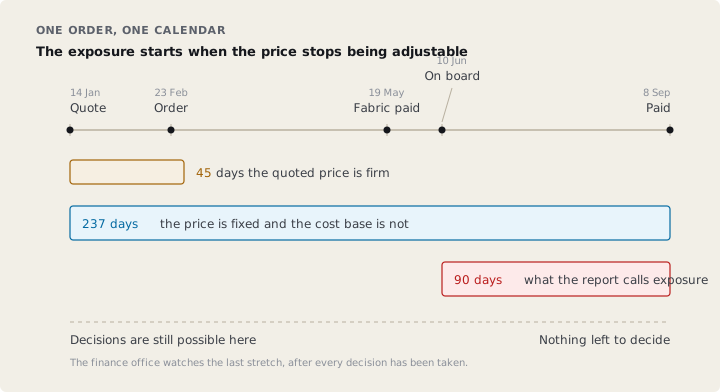
Count the days. Quotation to cash is 237 days. Order confirmation to cash is 197. Shipment to cash is 90 — and that is the period the credit-control report measures. It is the one everybody calls "the exposure".
So the finance office is watching the last 38% of the risk. And it is watching the part that is already decided.
The 45-day validity is a real thing with a real price
There is a second, sharper way to see that the clock starts at the quotation.
Larkmoor confirmed on 23 February. That is day 40 of a 45-day validity. Buyers use the whole window. They are collecting quotations, running the range review, waiting for a fit session. There is nothing improper about it.
But for those 40 days, Larkmoor held a firm price it could take or leave. And Ardessa held a promise it could not withdraw.
That arrangement has a name in every bank in the world. It is an option: the right to do something, without the duty to do it. Options are sold for money.
So Ardessa's treasurer did something useful. He asked Rhosden Bank what it would charge for the mirror image. That is the right — but not the duty — to sell dollars for sela at 46.00 at any time in the next 45 days, on the sela part of this order's cost base, about USD 208,000.
Rhosden quoted USD 1,150.
Sit with that number for a moment.
- It is 0.23% of the order value.
- It is 1.8% of the margin Ardessa costed.
- It is 2.7 US cents a unit. That is less than the care label costs.
Ardessa gave that away for free, on every quotation it sent that season. None of the three people who signed the quotation knew it had a price.
This is not a scandal. A firm price for a stated period is normal commercial courtesy, and buyers rightly expect it. But it is a cost. And a cost you cannot see is a cost you cannot decide about.
What the merchandiser actually controls
This is not the treasurer's problem alone. Three of the four levers sit in the merchandising office, not in finance.
- The validity period on the quotation. 45 days is a habit, not a rule. 21 days costs the buyer nothing they cannot live with, and it halves the option you are writing.
- The currency the price is quoted in. Course 8.3 treats this as a payment term. It is also a decision about who carries the move.
- The rate used to convert the local cost line. Lesson 6 gives this a name and a policy.
- How fast a confirmed order turns into cash. Course 13.4 owns the cash cycle. Every day you take out of it is a day of risk you do not carry.
The one thing a merchandiser truly does not control is the rate itself. Which is why the rest of this course is about everything else.
Check yourselfArdessa's credit-control report shows 'FX exposure: 90 days'. What is that number actually measuring, and what is it missing?Show the answer
It is measuring the receivable — the time between the invoice and the cash. That is the only stretch the accounting system knows about, because before the invoice there is no ledger entry to attach a currency to. It is missing the 147 days between the quotation and the shipment. In those days the price was fixed, the materials were committed and the wages were paid. That is 62% of the total risk, and it is the part where a decision was still possible.
What to take away
The currency risk on an order begins the moment the price stops being adjustable. That is the quotation, not the invoice. A cost sheet hides the rate it used inside a translated cost line. A validity period is an option, and your bank will quote you its price. And by the time the exchange rate is a topic in the finance meeting, the decision that mattered was taken two seasons earlier — by somebody in merchandising who was not thinking about currency at all.