Lessons · Lesson 1 of 6
The enquiry, and what it does not say
Read an enquiry for the facts it leaves out, put a price on each gap, and choose the few questions worth asking.
Lesson 1 of 6 · 20 min
An ordinary Thursday
12 February 2027. An email arrives at Zaouali Confection in Ksar Hellal. It is addressed to nobody in particular. It comes from a sourcing assistant at Vardo Retail A/S in Aarhus. Vardo sells children's outdoor clothing through forty-one shops and a website. The subject line is Rainwear enquiry SS28.
The body is six lines long.
We are looking for a supplier for a children's two-piece rain suit, jacket and trousers, waterproof and breathable. Approximately 24,000 sets. Sizes 2 to 12 years. Delivery to our Aarhus warehouse in the second half of September 2027. Please quote your best FOB price and lead time. Our target is around USD 13.
That is the whole enquiry. It is not unusually thin. Most enquiries arrive in this shape. The person who wrote it will not approve the price, and she has been told to get three quotations by Friday.
FOB is the price basis she asks for. FOB means free on board: your price covers the goods loaded onto the ship at your own port. Everything after that is the buyer's cost.
Zaouali gives the email the reference ENQ-2027-0144 and prices it as style RS-812. By the end of this course you will have followed it to a quotation, to an order, and to one dispute.
Start with the only question that matters on the morning it arrives: what does this email not say?
Sixteen facts, seven given
You cannot price a rain suit without sixteen facts. The enquiry gives you seven: the garment type, the quantity, the size range, the destination, the ship window, the price basis and a target price. Nine are missing. Every one of the nine moves the price.
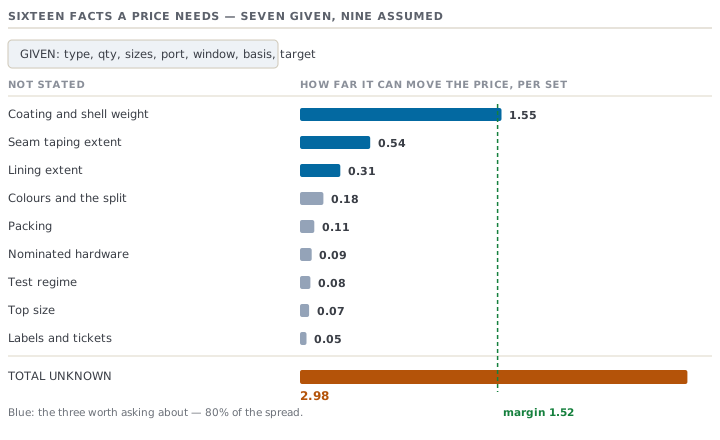
Here is the same thing as money. For each missing fact, Zaouali prices the cheapest reading it could defend and the dearest reading it could defend, then takes the difference. That difference is the spread. This is not a cost sheet — track 8 owns those. It is a measure of what you do not know.
| Not stated in the enquiry | Cheapest reading | Dearest reading | Spread |
|---|---|---|---|
| Coating and shell weight | light PU-coated taffeta | heavier three-layer laminate | 1.55 |
| How much of the seam is taped | critical seams only | every seam | 0.54 |
| Lining | body only | full mesh lining | 0.31 |
| Colours and the split between them | one colour dominant | three even colours | 0.18 |
| Whether hardware is nominated | our own zip supplier | the buyer's nominated one | 0.09 |
| Whether 12 years is really the top size | to 10 years | to 12 years | 0.07 |
| Packing | ratio-packed, bulk | solid-size, individually bagged | 0.11 |
| Test regime | one hydrostatic head test | retest after washing | 0.08 |
| Labels and swing tickets | our standard set | a full branded set | 0.05 |
Add the spreads up: USD 2.98 a set. The margin Zaouali will eventually quote on this order is USD 1.52 a set. So the things the enquiry does not say are worth 1.96 times the whole margin.
That one ratio is the argument of this lesson. It is worth saying plainly:
A quotation written on an under-specified enquiry is not a price. It is a bet on nine assumptions, and the stake is bigger than the prize.
You cannot ask nine questions
Having built that table, you will want to reply with all nine questions. Zaouali's own log says what happens then.
For two years the desk recorded the replies it sent to first enquiries, and whether the buyer answered. Where the reply asked more than four questions, the buyer came back 4 of 19 times — 21.1%. Where it asked three or fewer, the buyer came back 15 of 21 times — 71.4%.
The reason is simple. The sourcing assistant has three quotations to get by Friday. She reads a nine-question reply as this factory is going to be difficult, and the other two factories have already sent a number.
So the real decision in lesson 1 is not what do I not know. It is which of the things I do not know are worth my one question budget.
Sort the table by spread and take the top three: coating and shell weight, how much of the seam is taped, and lining. Together they are USD 2.40 of the USD 2.98. Three questions buy 80.5% of the uncertainty. The other six unknowns are worth USD 0.58 between them. That is less than half a margin, and small enough to assume.
Assume, then say so
The six unknowns you did not ask about do not go away. They become assumptions. An assumption has exactly two honest homes: the cost sheet, where it is a number, and the quotation, where it is a sentence.
An assumption written only on the cost sheet is the one that costs you money later. The buyer never agreed to it and never saw it. When the packing specification arrives in July asking for solid-size cartons and individual bags, the USD 0.11 is a claim rather than a price. It is a claim Zaouali will probably lose, because nothing in writing said otherwise.
The discipline is small and nearly free. Every quotation Zaouali sends carries a short block headed This price assumes. It lists every fact the desk had to invent. On ENQ-2027-0144 that block has six lines. It costs the merchandiser about eight minutes. Lesson 6 puts a number on what those eight minutes are worth when the order is disputed.
Check yourselfThe buyer answers only one of your three questions — the shell. Do you re-price?Show the answer
Yes, and only that line. The shell answer removes USD 1.55 of the USD 2.98 spread, so your next price rests on firmer ground than the first one. The other two stay as written assumptions. What you must not do is treat one answered question as permission to firm up the other eight. A fact you were told is a different thing from a fact you guessed, and the quotation should show which is which.
What you owe the enquiry, and what it owes you
There is a legal edge here. It matters more than it looks, because it decides who is exposed.
An enquiry is normally not an offer. It is an invitation to make one. Nothing in that email binds Vardo to anything at all: not to buy, not to buy 24,000, not to buy in September. Your quotation may well be an offer: a definite proposal, addressed to a named party, showing that you mean to be bound by it. That imbalance runs through the whole course. The buyer sends a wish. You send a commitment.
Which is why the reading you do on the first morning is not paperwork. It is the only moment when being wrong still costs nothing.
Prompt · Tell me what this enquiry does not say, and price each gap
On the morning an enquiry lands, before anybody starts costing it.
Act as an export merchandiser in a garment factory. Below is an enquiry exactly as it arrived; do not tidy it up or fill in anything it does not contain. ENQUIRY: [PASTE THE FULL TEXT OF THE EMAIL, INCLUDING THE SUBJECT LINE AND ANYTHING THE BUYER ATTACHED]. My product category is [CATEGORY] and my usual margin on this kind of order is [AMOUNT] a piece or [PERCENT] of the selling price. First, list every fact a quotation in this category cannot be built without, and mark each one GIVEN, IMPLIED or MISSING against the enquiry above. Say which words in the enquiry you relied on for each GIVEN and each IMPLIED, and never treat an implication as a statement. Second, for every MISSING fact, give me the cheapest defensible reading and the dearest defensible reading, and the difference between them per piece; total that column. Third, compare the total against my margin and say plainly whether I am pricing or gambling. Fourth, rank the missing facts by how far they move the price and tell me which three are worth asking about, with the rest left as assumptions. Fifth, draft the reply: no more than three questions, each with the default I have priced attached so the buyer can answer by saying nothing, in under one hundred and twenty words. Sixth, draft the assumptions block that will sit on the quotation, one line per assumed fact, in the buyer's language of business. If any fact I have not listed would move the price more than the ones you found, say so.
AI can make mistakes — check anything you act on.
What to do on Monday
- Write your own list of the facts a quotation in your category cannot be built without. Build it from your last ten disputes, not from a textbook.
- Take the next enquiry that lands and mark each fact given, missing, or assumed.
- Price the spread on each missing one, cheapest defensible reading against dearest, and total it.
- Compare that total against your normal margin. If it is larger, you are not pricing. You are gambling.
- Ask the three questions that carry the most spread, each with your default attached. Assume the rest, and write the assumptions on the quotation itself.