Lessons · Lesson 4 of 6
Win rate and margin pull in opposite directions
Price a quotation for what it is expected to earn rather than for what it earns if it wins, and see why a win-rate target quietly destroys contribution.
Lesson 4 of 6 · 18 min
Two people, both right, arguing
The costing team has RS-812 at USD 12.43 a set: materials USD 8.42, making USD 2.96, absorbed overhead USD 1.05. Track 8 owns that build and this course will not re-open it.
Now two people look at the same number.
The sales manager wants USD 13.20. Vardo said around USD 13, the factory has no relationship yet, and a first order opens an account worth several seasons.
The commercial director wants USD 14.90. The order is technical, the sealing capacity is scarce, and a factory that quotes near cost on a first order has taught the buyer what its price is forever.
Both arguments are correct. They answer different questions, and neither question is what will this quotation earn?
Zaouali's own curve
Over two years the desk logged sixty-one quotations against a stated buyer target. It recorded how far above the target it had quoted, and whether it won. Group those by price and you get a chance of winning at each one. It is not a law of the market and it is not anybody else's curve. It is this factory's history, on its own products, and that is exactly what makes it usable.
| FOB price | Above the buyer's target | Chance of winning | Margin a set | Margin on price | Expected contribution |
|---|---|---|---|---|---|
| 13.20 | 1.5% | 0.70 | 0.77 | 5.83% | 12,936.00 |
| 13.60 | 4.6% | 0.55 | 1.17 | 8.60% | 15,444.00 |
| 13.95 | 7.3% | 0.46 | 1.52 | 10.9% | 16,780.80 |
| 14.40 | 10.8% | 0.30 | 1.97 | 13.68% | 14,184.00 |
| 14.90 | 14.6% | 0.16 | 2.47 | 16.58% | 9,484.80 |
The last column is the whole lesson. It is the chance of winning, multiplied by the margin a set, multiplied by 24,000 sets. That is what this quotation is worth on the morning it is sent, before anybody knows the answer.
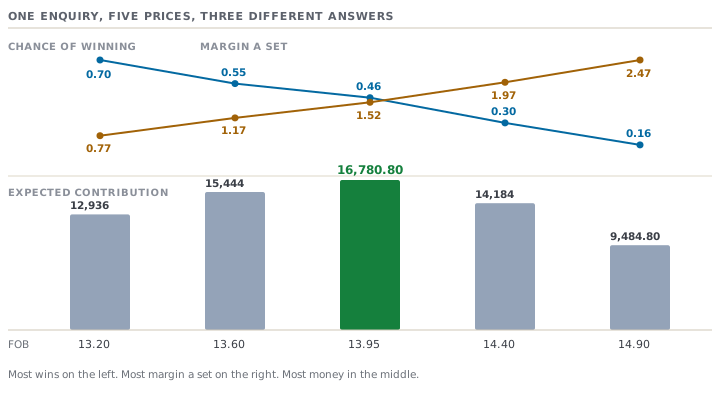
Read the three peaks:
- The highest chance of winning is at the lowest price. The sales manager is right about his question.
- The highest margin is at the highest price. The commercial director is right about his.
- The highest expected contribution is at neither. It is at USD 13.95.
Quoting at the sales manager's price gives up USD 3,844.80 of expected contribution. Quoting at the commercial director's gives up USD 7,296.00. Both are large against an order whose full margin at the middle price is USD 36,480.00.
Win rate and margin are two ends of one lever. The only quantity that can be maximised without argument is the product of them.
Prompt · Price this quotation for what it is expected to earn
When sales wants a lower number and the commercial side wants a higher one, and neither has a figure to show.
Act as a commercial manager in a garment factory. I need one quotation priced for expected contribution rather than for margin. Order facts: buyer [BUYER], product [PRODUCT], quantity [QTY] pieces, delivery term and named place [TERM], ship window [DATES]. My cost per piece from the cost sheet: materials [AMOUNT], making [AMOUNT], absorbed overhead [AMOUNT]. The buyer's stated or implied target price is [AMOUNT]. My own record of past quotations, as far as I have it: for each past quotation, how far above the buyer's target I quoted and whether I won [PASTE THE LIST, OR SAY YOU HAVE NONE]. Build me a table of five candidate prices spanning from just above my cost to well above the target, and for each give the percentage above target, the chance of winning read from my own record, the margin a piece, the margin as a percentage of price, and the expected contribution on the whole order. Say which price maximises the chance of winning, which maximises margin a piece, and which maximises expected contribution, and how much the other two give up against the third. Then adjust for two things and show each adjustment separately: whether my capacity in this window is free or already sold, and how many other factories are quoting. If there are several, add a correction for the fact that winning selects my most optimistic cost estimates, and tell me what you assumed for it. If I gave you no past record, say so at the top, use a stated placeholder curve, and tell me exactly what to log from now on so that next quarter the answer comes from my own data.
AI can make mistakes — check anything you act on.
Why the middle is not always the middle
Nothing here says quote in the middle. Where the peak sits depends entirely on the shape of the curve, and the curve moves.
If the factory has spare capacity in the window, losing costs more, and the peak moves down the price scale. If the sealing machines are already full, an order won at a thin margin pushes out a better one, and the peak moves up. If the buyer is new and the account is worth several seasons, a win is worth more than one order's contribution, and the peak moves down again. But that is a judgement about the future. It belongs in the open, with a number attached, not smuggled in as strategic pricing.
The table does not give you the right answer. What it does is force every argument about price to be an argument about a number in a column — the chance of winning, the margin, or the value of the account — rather than an argument about who feels more strongly.
What an hour of the desk is worth
There is a second use for the same idea, and it decides which enquiries get answered at all.
Lesson 3 measured a quotation at 22.5 hours and put the desk's contribution at USD 5,629.41 for each quotation issued. That is USD 250.20 an hour of desk time.
Now take one of the quarter's long shots: an enquiry from a buyer who already has a supplier, quoted because it seemed rude not to, with a chance of winning of about 0.05. At the quarter's average contribution per order of USD 27,342.86, that enquiry is worth USD 1,367.14, or USD 60.76 an hour.
Four times less. Not zero, and that distinction is the point of the next section.
The mistake nobody made
Zaouali's board looked at the quarter — thirty-four quotations, seven orders, a win rate of 20.6% — and set the desk a target of 40%.
The desk did two sensible things.
First it stopped quoting the long shots. Twelve enquiries with a chance of winning around 0.05 were declined. That raised the win rate on what remained from 20.6% to about 29.1%, and cost, in expectation, USD 16,405.71 of contribution.
Second, it moved down the curve. Quoting RS-812 at 13.60 instead of 13.95 lifts the chance of winning from 0.46 to 0.55 and gives up USD 1,336.80 of expected contribution on that one enquiry alone. Repeat that across the book and you have bought the remaining eleven points of win rate.
The target was met. Every step was defensible. And the first of the two steps was, that quarter, actually correct: the twelve declines freed 270 hours, the desk used them on six enquiries it had previously answered too late, and those six were worth USD 33,776.46. A net gain of USD 17,370.75.
Here is the problem. It was correct because the desk was full, and lesson 3 showed the desk was only full because it was making counter samples for thirty-one buyers who had not asked for one. Fix the sequencing and there is room for all forty enquiries. The twelve long shots then cost nothing to answer and are worth USD 60.76 an hour against an alternative of nothing at all.
The same decision, right in one quarter and wrong in the next, and the win rate cannot tell you which quarter you are in.
The orders you win are not a random sample
One last effect, and it is the one that quietly drags a factory's real margin below its quoted one.
Zaouali went back over twenty-two completed orders and compared the cost it had quoted against the cost it actually incurred. On average the real cost was 0.9% above the quoted cost. A small, forgivable estimating error.
Split the same twenty-two by competition and they look different. On orders won against four or more competitors, the real cost ran 3.6% above quoted. On orders won with no competition, it ran 0.4% below.
Nothing about the estimating changed between the two groups. What changed is which estimates won. When several factories quote the same enquiry, the winner is usually the one whose estimate was lowest, which means, on average, the one that most underestimated. Capen, Clapp and Campbell described this effect for competitive bidding in 1971. It applies to a garment enquiry with three competitors exactly as it applies to anything else bid for in the dark.
On RS-812 it is worth USD 0.45 a set — USD 10,800.00, or 29.6% of the order's quoted margin, on a contested enquiry.
The remedy is not to quote higher across the board, which simply moves you down the curve. It is to find out how many competitors are on an enquiry, and to add the correction only where there are several. That is now the fourth question Zaouali asks, when a buyer will answer it.
Check yourselfYour expected contribution peaks at a price the buyer has already said is too high. What now?Show the answer
The curve is telling you the enquiry is probably not worth winning at a price that would earn anything. That is information, not a failure. Two honest moves remain and one dishonest one. You can change the product so the cost falls, which is what lesson 2's counters do. You can quote at the peak and lose gracefully, having taught the buyer what your price is. What you cannot do is quote below the peak and call it strategic. The table already says what that costs, and next season it will be the price the buyer starts from.
What to do on Monday
- Build your own curve. Take your last fifty quotations, record how far each sat above the buyer's stated or implied target, and count the wins in each group.
- For the next enquiry, write out five prices with a chance of winning against each and multiply. Argue about the columns, not about the price.
- Work out your desk's contribution per hour, and use it to decide which enquiries get answered when you cannot answer all of them.
- Never set a win-rate target without an expected-contribution figure beside it.
- Ask how many factories are quoting. Where it is several, carry a correction for the fact that winning selects your optimistic estimates.