Lessons · Lesson 3 of 6
What a quotation costs, and where that cost really lands
Count the real cost of answering an enquiry, find which activity consumes it, and see why the money saved is the small half of the answer.
Lesson 3 of 6 · 18 min
A cost that appears on no sheet
Ask a factory owner what a quotation costs. The answer is usually nothing, it is just the merchandiser's time. That sentence disproves itself, and this lesson is about counting it.
Zaouali timed itself for one quarter. Every enquiry answered was logged with the hours each department put into it, and with the money that left the building. This is what one full quotation for something like ENQ-2027-0144 costs.
| Who | Hours | Rate | Cost |
|---|---|---|---|
| Merchandiser: reading, chasing, writing the reply | 6.5 | 6.40 | 41.60 |
| Costing | 3.0 | 7.10 | 21.30 |
| Technical: consumption, marker trial, pattern check | 2.5 | 5.80 | 14.50 |
| Sample room: one counter sample | 9.5 | 4.90 | 46.55 |
| Management review | 1.0 | 18.00 | 18.00 |
| Sample shell, lining and tape at sample prices | 16.49 | ||
| Sample trims | 6.20 | ||
| Courier to the buyer | 68.00 | ||
| Mill sample yardage and lab dips | 24.00 |
Hours: 22.5. Money: USD 256.64.
The same enquiry answered with a price and no sample costs 13.0 hours and USD 95.40. The whole sample room disappears, and so does every cash line.
So the counter sample is 62.8% of the money and 42.2% of the hours of a full quotation. One activity, more than half the cost.
The constraint is not the money
USD 256.64 is not a frightening number. Forty of them is USD 10,265.60 a quarter, which no factory owner would notice.
The number that matters is the other one. Zaouali's sample room has two machinists. Over a sixty-day quarter that is 960 hours, and 78% of it is already committed to development and fit samples for orders the factory has actually won. What is left for counter samples on enquiries is 211.2 hours, or 22.2 counter samples a quarter.
Forty enquiries arrived. Twenty-two could have a sample. That is a queue, and a queue behaves in a way that surprises people who have never measured one.
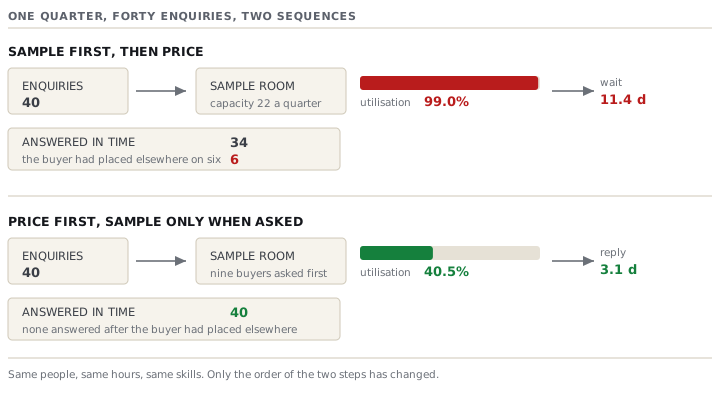
The twenty-two samples the room made used 209 hours of the 211.2 available. That is 99.0% utilisation: the share of the room's available hours that are actually being worked. At that level a request does not wait a little. It waits for everything in front of it. Zaouali's log says a counter sample was requested with 4.2 requests already ahead of it on average, and the room clears 0.37 of them a day. That is 11.4 days of waiting before the sample is even started.
The result showed up where nobody was looking. The desk's median response time on a sampled quotation was 11.4 days. On a price-only reply it was 3.1 days. And six of the forty enquiries were answered after the buyer had already placed the order somewhere else.
Which quotations actually won
Here is where the quarter stops being an accounting exercise.
Of the twenty-two quotations that carried a counter sample, three became orders — 13.6%. Of the twelve that went out as a price with no sample, four became orders — 33.3%.
That result is uncomfortable, and it needs handling honestly. Seven orders is a very small number. Zaouali cannot prove from seven wins that the sample was worthless. The two groups were not the same buyers, and the price-only replies went to the enquiries that happened to arrive when the room was full, which is close to random but is not random. What the factory can say without any statistics at all is this: the sampled route cost 9.5 sample-room hours and more than eight extra days of response time, and the win rate did not reward it.
Resequencing costs nothing
Move the sample behind the price, except for the buyers who ask for it first. The quarter then looks like this.
Nine enquiries get the full treatment: 9 samples, 85.5 sample-room hours, 40.5% utilisation. That is a room with slack in it, so a request waits days rather than weeks. Thirty-one get a price in 3.1 days. All forty are answered, and none is answered too late.
The money: USD 5,267.16 against USD 6,790.88 for the quarter as it actually ran. A saving of USD 1,523.72.
That saving is the small half, and it is worth saying why. The six enquiries that went unanswered were worth USD 33,776.46 of expected contribution at the desk's own average. Contribution is what an order leaves behind after the costs it causes: the quarter's seven orders produced USD 191,400.00 of it across thirty-four quotations, so a quotation issued is worth USD 5,629.41 whether it wins or not. The six answers the resequencing buys are worth 22.17 times the money it saves.
The cost per win, and why it is the wrong headline
For completeness: the quarter cost USD 6,790.88 in quotations and produced seven orders, so each order cost USD 970.13 to win. It is a fine number to know and a poor one to manage by. You can improve it by quoting less, and quoting less is the one move that reliably reduces contribution.
The number to manage by is the one this lesson has been circling: what does an hour of the constrained resource produce? In Zaouali's first quarter the constrained resource was nine and a half hours of sample-room time per enquiry, and it was being spent on thirty-one buyers who had not asked for it.
Check yourselfYour sample room is at 99% utilisation and the response time is eleven days. Would hiring a third machinist fix it?Show the answer
It would, and it is the expensive answer to a sequencing problem. Adding capacity to a queue works: utilisation falls and the wait collapses. But Zaouali's queue existed because thirty-one of forty samples were being made for buyers who had not asked for one. Removing the work costs nothing and returns the same 211.2 hours. Adding a machinist costs a salary every quarter after that. Take the sequencing first, and hire only if the queue is still there when the work is genuinely wanted.
What to do on Monday
- Time one quotation honestly, in hours by department, and add every cash line including the courier.
- Do it twice: once with a sample and once without. The gap between the two is your sequencing decision.
- Find the constrained resource in your quoting process. It is usually the sample room, occasionally the technical desk, almost never the merchandiser.
- Measure its utilisation. Anything above about ninety per cent is buying you a queue, and the queue is paid for in response time.
- Ask your last twenty enquiries which of them actually wanted a sample before a price. Sample those, and quote the rest in days.