Lessons · Lesson 2 of 6
Late is a price, and there were two clauses in that email
Price a late-delivery charge and a freight recovery against the same order's margin, and learn the difference between a clause you can put a number on and one you cannot.
Lesson 2 of 6 · 19 min
Eleven days
The fleece for KF-2145 was dyed by Tanberk Tekstil in Ceyhan. Halstrow's own supplier manual promises lab dips back within five working days. A lab dip is a small swatch dyed to prove the shade before the mill dyes the whole lot. The navy took nineteen days, because the technologist who looks after children's outerwear was on leave and the shade sat in a queue.
So Tanberk held the dye lot. The cloth landed in Irbid twelve days behind plan. Mushatta clawed some of it back with weekend overtime, then lost three days to a bar-tack machine that failed on a Tuesday and was back on the Thursday. A bar-tack is the short dense stitch that reinforces a pocket corner or a hood drawcord.
Ex-factory: 28 July, against a contracted 17 July. Eleven days late.
Nobody in this story did anything obviously wrong. The technologist was on leave and her cover cleared the queue in order. Tanberk will not dye to an unapproved shade, and is right not to. Mushatta paid the overtime out of its own pocket. Machines fail; that is what machines do.
And the order lost money on the day it shipped.
The clause Samar negotiated
Halstrow's terms of purchase charge for lateness at a stated weekly rate on the value of the late goods, for each week or part week, capped at a stated share of the order.
Samar had already improved the rate from 2.0% to 1.5% a week. Here is what that produced.
Eleven days is one week and four days. A part week counts as a whole week, so the clock reads two weeks.
- Two weeks at 1.5% is 3.0% of USD 419,040.00
- Deduction: USD 12,571.20
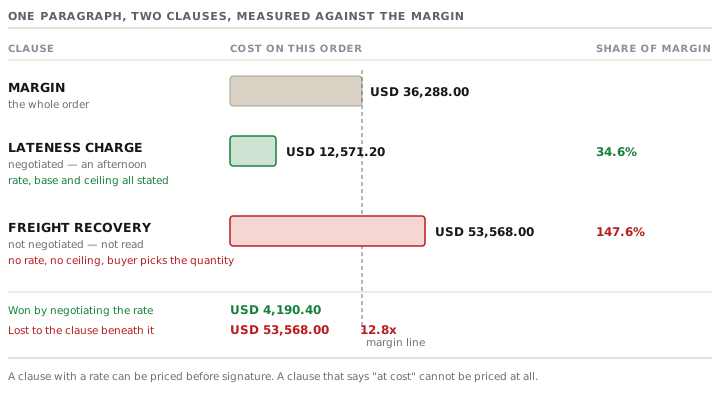
- Against the order's margin of USD 36,288.00, that is 34.6%
A third of the margin for eleven days. Painful — and, this is the point of the lesson, completely foreseeable. Samar could have worked it out on 6 March, because every input was on the page in front of her: a rate, a base and a cap. Her negotiation was worth USD 4,190.40, the difference between two weeks at 2.0% and two weeks at 1.5%. That is real money and she earned it.
The clause in the same email
Four lines further down the same page, in the same block of text, sits a sentence about freight.
In substance: if the supplier misses the ex-factory date, the buyer may choose to have all or part of the goods sent by air, and the difference between the contracted sea freight and the actual air freight, plus any extra handling, is for the supplier's account.
Halstrow's back-to-school launch was 20 August and the buying team had a floor set to fill. On 29 July, Gareth Lomas chose air for 40% of the order.
| Line | Working | Amount |
|---|---|---|
| Pieces sent by air | 40% of 86,400 | 34,560 |
| Packed weight | 34,560 at 0.40 kg | 13,824 kg |
| Air freight charged | 13,824 kg at USD 4.10 | USD 56,678.40 |
| Sea freight the goods would have carried | 34,560 at USD 0.09 | USD 3,110.40 |
| Difference, recovered from the supplier | USD 53,568.00 |
USD 53,568.00. That is 147.6% of the entire margin on the order. It was taken by a sentence nobody read, in the same email as a negotiation everybody was pleased with.
Add the administration charge Halstrow's terms apply to a late delivery, USD 65.00, and the total deducted for eleven days is USD 66,204.20 — 15.80% of the order value and 182.4% of the margin.
The rule underneath: a rate is priceable, a cost is not
Put the two clauses side by side. The difference is structural, not a matter of degree.
| The lateness charge | The freight recovery | |
|---|---|---|
| Who sets the rate | the contract | an airline, on a date you do not control |
| Who sets the quantity | the calendar | the buyer, at its option |
| Is there a stated ceiling | yes | no |
| Could you price it on the day you signed | yes | no |
| What it cost here | USD 12,571.20 | USD 53,568.00 |
So here is the rule, and it goes well beyond freight:
A clause that states a rate can be priced before you sign it. A clause that says "at cost", "at the buyer's option" or "any additional expense" cannot be priced at all — because the number is set later, by somebody else, in a quantity the other side chooses.
That is not an argument for refusing such clauses. You will not win that argument, and there is a real interest behind this one: the buyer genuinely does lose a floor set if the goods are late. It is an argument for knowing which of your clauses are open-ended. Those are the ones that can swallow your margin, and they are the ones worth spending your negotiating capital on.
What to ask for, and what you will actually get
"Delete the freight clause" is not an ask. No buyer with a launch date will agree to it, and pushing hard burns the capital you need for lesson 6.
Three narrower asks are routinely accepted. Each one leaves the buyer's protection intact and only removes the open end.
- The choice must be made in writing, by a stated date. Without this, the buyer can choose air after the goods are already at the port. That turns a recoverable cost into a wasted one.
- The recovery is the difference between the actual air invoice and the contracted sea rate, with both evidenced. Otherwise the "difference" is calculated against a sea rate nobody ever produces.
- All deductions for one late delivery, freight included, share the ceiling that already caps the lateness charge.
The third is the one with the money in it. Halstrow's terms cap the lateness charge at 10% of order value — USD 41,904.00 on HS-90412 — but the cap sits on that clause alone, and freight is outside it. Bring the freight recovery inside the same ceiling and the deduction on this order falls from USD 66,204.20 to USD 41,904.00. That is USD 24,300.20 saved by one sentence, and it does not reduce the buyer's protection by a single day of lateness.
Prompt · Price my buyer's lateness and freight clauses against this order's margin
Before you accept an order, or the moment a delay becomes likely and somebody says the buyer will probably be reasonable about it.
Act as a factory commercial manager who has been on the wrong end of a chargeback schedule. I want the cost of being late on one order, in money, before it happens. Here are the clauses, copied exactly: [PASTE THE LATE DELIVERY CLAUSE, ANY AIR FREIGHT OR EXPEDITED SHIPPING RECOVERY, ANY ADMINISTRATION OR HANDLING CHARGE, ANY SET-OFF CLAUSE, AND ANY CEILING THAT APPLIES TO ANY OF THEM]. My order: quantity [QTY] pieces, price [PRICE] per piece, order value [AMOUNT], margin per piece [AMOUNT], ex-factory [DATE], the buyer's on-shelf or launch date if known [DATE], packed weight per piece [KG], my contracted sea freight rate [RATE], a current air freight rate to that destination [RATE], my working capital rate [RATE] a year. Do the following. First, read the lateness clause precisely and tell me exactly how it counts: whole weeks or part weeks, calendar days or working days, from which date, on the value of the late goods or on the whole order, and what ceiling applies. Second, build a table of days late from one to thirty. Show the charge at each day, the share of my margin it eats, and the day on which the order stops making money. Third, price the freight recovery separately, at several possible buyer choices — a quarter, a half and all of the order — and show it as money and as a share of margin. Fourth, tell me which of these clauses is PRICEABLE and which is OPEN-ENDED, and say plainly that an open-ended one has no maximum I can plan against. Fifth, work out what a single shared ceiling over all deductions for one late delivery would have saved in each of those cases. Sixth, list every alternative I could offer the buyer instead of air freight — part air on the launch quantity only, a markdown allowance, a discount on the next order — and price each one against the freight recovery, so I arrive with a priced choice rather than an apology. Show every calculation.
AI can make mistakes — check anything you act on.
Check yourselfMushatta shipped eleven days late. Halstrow's approval delay cost fourteen days more than its own manual allows. Does the factory owe the eleven days?Show the answer
On the arithmetic, almost certainly not all of them. With a normal shade approval, the only delay left is the three days lost to the machine. Three days late, not eleven — one week under the clause instead of two, and no realistic need for air freight at all. But notice how little that changes on the day. The deduction is taken from the next remittance whatever the cause, and turning "you delayed me" into money requires the factory to start something. What the factory can do is build the record of cause while it is still cheap: a dated email the day the lab dip goes out, a dated email the day it comes back, and one line in the weekly report naming the days lost. Lesson 5 is what that file is worth.
What you should be able to do now
- Price your buyer's lateness charge on your own live order — rate, base, part-week rule, ceiling — before the order is confirmed, not after it ships.
- Find every clause with no number in it and mark it unpriceable. That is a category of risk, not a small one.
- Ask for one ceiling over all deductions for a single failure, rather than trying to delete the clause that produced the largest one.
- Record causes as they happen, in dated writing, because a cause you cannot evidence is worth nothing when the deduction lands.