Lessons · Lesson 1 of 6
Where the terms actually live
Find every document that binds your order, learn which one wins when two disagree, and see how little of the contract was ever negotiated.
Lesson 1 of 6 · 19 min
The order everybody was pleased with
6 March 2026. Mushatta Garment Industries, in Irbid, confirms purchase order HS-90412 with Halstrow Stores plc, a value clothing chain buying out of Leeds.
- 86,400 children's brushed-back fleece hooded sweatshirts, style
KF-2145, four sizes, three colours - FOB Aqaba USD 4.85 (Incoterms 2020). FOB means the factory pays everything up to the goods being loaded on the ship at Aqaba. After that the cost is the buyer's.
- Order value USD 419,040.00
- Ex-factory 17 July 2026, on the shelf for the back-to-school launch on 20 August
- Retail USD 12.99
The price took three weeks. Two fabric quotations. A re-timed sewing operation. A second fit sample. Four telephone calls. All of it to land on USD 4.85 against a cost of USD 4.43. That is a margin of USD 0.42 a piece, or USD 36,288.00 on the order — 8.66% of the selling price.
Samar Odeh runs the account at Mushatta. She won something on the terms too. Halstrow's first draft charged 2.0% of order value for every week the goods were late. She got it down to 1.5%. She sent the acceptance the same evening.
By November this order had lost USD 42,257.00. Not one dollar of that came from the price she spent three weeks on.
The contract is not the document you signed
Ask Samar for "the contract" and she sends you the purchase order. One page. Nine lines. The nine things that were discussed. That page is the smallest part of the agreement.
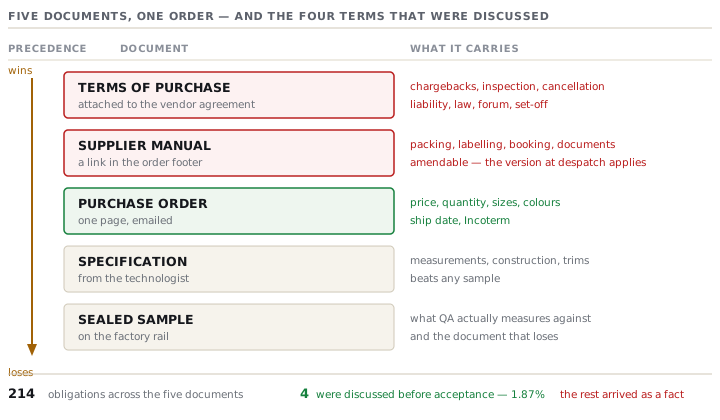
Here is everything that was actually in force on HS-90412.
| Document | How it arrived | What it carries |
|---|---|---|
| The purchase order | emailed, one page | price, quantity, sizes, colours, ship date, Incoterm |
| The vendor agreement | signed once, in 2024 | the relationship, and the hook that pulls in everything below |
| The terms of purchase | attached to the vendor agreement | chargebacks, inspection, cancellation, liability, law and forum |
| The supplier manual | a link in the footer of the order | packing, labelling, booking, documents, lead times |
| The specification and the sealed sample | sent by the technologist | what the garment must be |
Mushatta's own lawyer was asked afterwards to count. He found 214 separate obligations on the factory across those five documents. Four of them were discussed before the order was accepted: price, quantity, ship date, and the weekly rate for lateness.
Four out of two hundred and fourteen. So 1.87% of the obligations were negotiated. The other 98% arrived as a fact. Every one of them is as binding as the price.
That is the argument of this whole course. It is worth putting flatly:
The clauses that decide a dispute are almost never the clauses that were negotiated. Price and delivery get argued over because they are visible and everybody in the room understands them. What actually takes the money is the chargeback mechanism, the inspection right, who owns the cloth when an order is cancelled, whose law and whose court, and a liability cap with a hole in it.
A chargeback is money the buyer deducts from your invoice instead of asking you to pay it. You will meet it properly in lesson 2.
Which document wins
The five documents do not agree with each other. They cannot. Different people wrote them, at different times, for different purposes. So a serious set of buyer's terms carries an order of precedence clause. It says which document wins.
Halstrow's clause works like this. The terms of purchase beat the supplier manual. The manual beats the purchase order. The specification beats any sample. And no term put forward by the supplier has any effect unless Halstrow accepts it in writing.
Read that slowly. Two things in it matter more than they look.
First, the specification beats the sealed sample. The sample is the thing the factory keeps on a rail and measures against. The specification is a document in a folder. When they disagree — and they disagree more often than anybody admits, because a sample gets approved with a comment and the comment never reaches the measurement chart — the folder wins and the rail loses. Lesson 3 is what that cost on this order.
Second, the supplier's own terms are switched off. Mushatta's proforma invoice carries its own conditions of sale on the back, including a limit on its liability. They have no effect. This is ordinary in buyer-drafted terms and it is not a trick. It simply answers the question of whose paperwork governs, decided in advance and in the buyer's favour.
A term you are not able to read yet
There is one more line in Halstrow's terms. It is the one Samar should have stopped at.
The supplier manual, it says, may be changed by Halstrow from time to time, and the version in force on the day you despatch applies.
That sentence does something unusual. It lets one side change the other side's obligations, after the price is fixed, without asking. It is not unreasonable on its face. A retailer genuinely does need to update its packing and labelling rules across hundreds of suppliers, and re-negotiating every order to do it would be absurd. But look at what it means for the person doing the costing. On 6 March, when the price was set, part of the contract had not been written yet.
Here is what it did on this order. Between March and July, Halstrow reissued the manual twice. The second reissue changed the outer-carton label: a new format, with the department code in a different box. Mushatta packed to the March rules, because those were the rules in March.
The order shipped in 2,880 cartons. Halstrow's distribution centre relabelled all of them and charged the work back at USD 1.15 a carton: USD 3,312.00.
That is a small number. It is in this lesson precisely because it is small. Nobody would fight about it. What matters is the mechanism. A cost appeared on the order from a document that did not exist when the order was priced. The factory had no way to see it coming and no argument against it.
Read the terms once, and read them for money
There is a version of this lesson that ends with "read your contracts". That is useless advice. Nobody has time to read 118 pages of supplier manual, and reading it would not help, because a reader with no method just gets to the end.
The method is to read for money. It takes about an hour. Go through the terms of purchase looking only for sentences that can move cash. Write the money next to each one, on your own live order. There are usually fewer than a dozen of them, and they fall into five families:
- Something the buyer can deduct — chargebacks, allowances, handling charges, freight recoveries, fines.
- Something the buyer can refuse — rejection rights, inspection rights, and what "acceptance" does or does not mean.
- Something the buyer can cancel — and what you are left holding when they do.
- Something you have promised to pay for somebody else — indemnities, and whether the cap covers them.
- Something that decides whether you can ever argue — governing law, court, and the right to set off.
The remaining five lessons are those five families, each priced on this one order. By the end you will have a number against every clause that can take money from you. That is a different thing from having read the contract, and a good deal more useful.
Prompt · Rank this buyer's terms by the money each clause can take
When a vendor agreement, terms of purchase or supplier manual has arrived and you have one hour, not one week, to decide what to argue about.
Act as a commercial contracts adviser to a garment factory. You are not writing a legal opinion, and you must say so once at the start. Your job is to turn clauses into money on one specific order, so a merchandiser can decide where to spend limited negotiating capital. Below are the buyer's contract documents. Read all of them together, including anything pulled in by reference. Here they are: [PASTE THE PURCHASE ORDER, THE VENDOR AGREEMENT, THE TERMS OF PURCHASE, ANY SUPPLIER MANUAL SECTIONS AND ANY SPECIFICATION CLAUSES]. My order: buyer [BUYER], order number [NUMBER], style [STYLE], quantity [QTY] pieces, price [PRICE] per piece [INCOTERM AND NAMED PLACE], order value [AMOUNT], ex-factory [DATE], my cost per piece [AMOUNT] of which margin [AMOUNT], the buyer's retail price if I know it [AMOUNT], my product liability insurance limit [AMOUNT]. Do the following. First, list EVERY clause that can move cash in either direction, grouped into five families: what the buyer can deduct, what the buyer can refuse, what the buyer can cancel, what I have promised to pay on somebody else's behalf, and what decides whether I can ever argue. Second, put a number on each one, on my order — the most it can take, using the buyer's own rates where they are stated. Third, mark each clause PRICEABLE or OPEN-ENDED. Priceable means the rate, the base and the ceiling are all in the document. Open-ended means at least one of them is set later, by somebody else. Never give an open-ended clause a single figure as though it were priceable. Say what sets it, and what the worst realistic case is. Fourth, find the order-of-precedence clause and tell me which document my QA team should be measuring against. Fifth, find every carve-out from the liability cap and price the largest one. Sixth, give me a ranked table: clause, money at risk, priceable or open-ended, and the single narrowest amendment that would cap it without removing the buyer's protection. Finally, tell me the three asks worth making and the order to make them in, and draft the exact sentence to send for each one.
AI can make mistakes — check anything you act on.
Check yourselfHalstrow's terms say the specification prevails over any sample. Mushatta's QA measures every production audit against the sealed sample. Nobody has done anything wrong. What is the exposure?Show the answer
Every audit Mushatta runs measures conformity to a document that loses. If the sealed sample and the measurement chart differ anywhere — a sleeve, a body length, a hood depth — then production can pass every internal check and still be non-conforming under the contract. The factory will not find out until the goods are in the buyer's distribution centre, where the buyer chooses the remedy. The fix is not a better inspection. It is a one-hour comparison of the sealed sample against the specification, before the sample is sealed, with any difference resolved in writing. Lesson 3 puts the number on it.
What you should be able to do now
- List the documents in force on your own live order — all of them, including the one that arrived as a link in a footer — and find the order-of-precedence clause.
- Say which document your QA team measures against, and whether that is the document that wins.
- Find any sentence that lets the buyer change the rules after the price is fixed, and know the one sentence to ask for in return.
- Stop treating the purchase order as the contract. It is the page with the negotiated terms on it, which is to say the small part.