Lessons · Lesson 4 of 6
Who owns the cloth when the order is cancelled
Price what you risk when you buy materials against a forecast, and find the one written authorisation that moves that risk back to the party who asked for it.
Lesson 4 of 6 · 18 min
The email that was not an order
12 May. Gareth Lomas writes to Samar Odeh about the winter block:
Winter repeat of
KF-2145in the new marl, indicative 120,000 pieces, ex-factory mid-November. Fabric lead time is our problem here — please secure yarn and cloth now so we protect the date. Purchase orders will follow once the range is signed off.
A marl is a yarn spun from fibres of two or more shades, so the cloth reads as a soft mottled colour rather than a flat one. Every word of that email is normal. It is how a factory is asked to protect a date. It is how the trade has always worked. Any merchandiser who replied "send me a purchase order first" would be starting a fight with their best account over a courtesy.
Samar did what she was asked. She placed the cloth with Tanberk Tekstil, and the nominated trims with the buyer's own trim supplier.
| Commitment | Working | Value |
|---|---|---|
| Brushed fleece | 120,000 at 0.62 kg, at USD 4.15 a kg | USD 308,760.00 |
| Nominated trims | 120,000 sets at USD 0.14 | USD 16,800.00 |
On 30 July the range review cut the winter buy. Halstrow issued a purchase order for 42,000 pieces and said nothing about the rest, because there was nothing to say. No order had ever been placed for the rest.
Everybody was right
This lesson has no villain. That is why it is worth six pages.
- Halstrow never committed to 120,000 pieces, and its terms say plainly that only a purchase order creates an obligation. It cut a range that was not selling, which is its job.
- Samar did exactly what she was asked to do. Had she refused, the November date would have been impossible and the whole block would have moved to another factory.
- Tanberk will not take yarn back from a dyed lot into stock at cost. Nobody will. That rule is why a mill can quote a keen price against a specific shade in the first place.
And the loss is real, and it sits with the only party that never had a choice.
What it cost
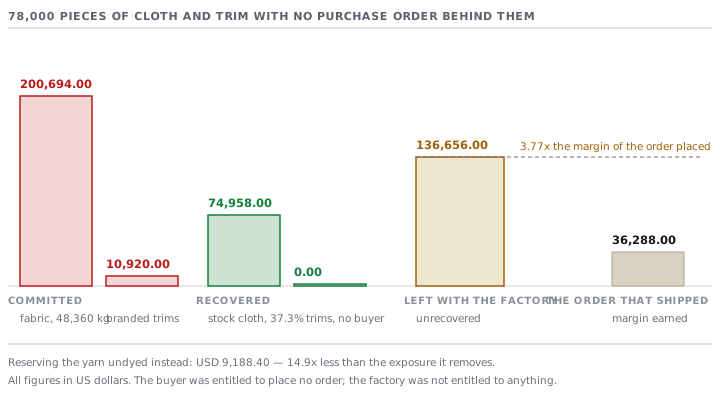
78,000 pieces of cloth and trims have no order behind them.
| Line | Working | Amount |
|---|---|---|
| Fleece for the unordered pieces | 48,360 kg at USD 4.15 | USD 200,694.00 |
| Sold on as stock cloth | 48,360 kg at USD 1.55 | USD 74,958.00 |
| Unrecovered on fabric | USD 125,736.00 | |
| Nominated trims, branded, no second buyer | 78,000 at USD 0.14 | USD 10,920.00 |
| Total unrecovered | USD 136,656.00 |
The cloth sold at 37.3% of what it cost. That is a decent outcome for a dyed lot in a buyer's own marl, and it is the number to expect rather than a disaster. The trims recovered nothing, because a woven label with somebody else's name on it is worth its weight as waste.
USD 136,656.00. The order Mushatta actually shipped for this buyer earned USD 36,288.00. So cancelling an order that was never placed cost 3.77 times the margin of the order that was.
The law gives a seller remedies. It gives them to a seller who has a contract.
This is the part that surprises people. It is worth stating carefully, and then stating the limit.
Where a buyer walks away from a contract for goods, an aggrieved seller is not helpless. Commercial sales law generally lets the seller resell the goods and recover the shortfall from the buyer. And — this is the part worth knowing about — where the goods are unfinished, it lets the seller decide, using reasonable commercial judgement, either to finish making them or to stop and salvage what is there. A seller who makes that call sensibly is protected in having made it.
Now the limit, and it is the whole lesson. Every one of those remedies assumes a contract. Mushatta had a contract for 42,000 pieces and performed it. For the other 78,000 it had a forecast, an email and a relationship. So it had no seller's remedies to use, because in law there was nothing to be aggrieved about. The party that did not order was never obliged to order.
The exposure was not created by the cancellation. It was created on 14 May, by a purchase order Mushatta placed with a mill against an obligation nobody owed it.
The sentence that moves it back
Here is the useful part. Halstrow's terms of purchase already contain a materials clause. Most serious buyers' terms do, and merchandisers rarely know it is there.
In substance it says: where the buyer has authorised the supplier in writing to buy materials ahead of a purchase order, and the buyer then does not place that order, the buyer will reimburse the documented cost of those materials, less anything realised on disposal.
Read Gareth's email again against that clause. It says please secure yarn and cloth now. It does not say this is an authorisation. It names no authorised quantity. It has no expiry date. It is a request, not an authorisation, and the clause does not engage.
When you cannot get the authorisation, buy the option instead
Sometimes the answer really is no, and the date really does need cloth. There is still a middle position, and it is commercial rather than legal: commit the part of the material that is not specific to this buyer, and defer the part that is.
The dyeing is what destroys the value in a lot. Greige yarn — yarn as it comes off the spinning frame, undyed and unfinished — and undyed cloth are ordinary goods another customer will take. So Mushatta asked Tanberk what it costs to reserve undyed yarn against a shade to be named later. Tanberk quoted USD 0.19 a kg to hold it.
On the tail that turned out to be exposed, that reservation would have cost 48,360 kg at USD 0.19 — USD 9,188.40 — and every kilo would have been re-sellable close to its cost, because it would still have been white.
USD 9,188.40 against USD 136,656.00. The option costs 14.9 times less than the exposure it removes, and it needs no clause, no authorisation and nobody's permission.
Prompt · Price the cloth I am about to buy against an order that does not exist
The moment a buyer asks you to secure yarn, fabric or nominated trims before the purchase order is issued, which is usually the moment it sounds least like a decision.
Act as a sourcing and risk manager in an export garment factory. A buyer has asked me to commit materials ahead of a purchase order. I want the exposure priced, and the wording that moves it back, before I place anything. My facts: buyer [BUYER], indicated quantity [QTY] pieces, style [STYLE], indicated ex-factory [DATE], my fabric consumption [AMOUNT] per piece, fabric price [PRICE] per unit, nominated or branded trims [AMOUNT] per set, the mill's minimum order quantity [AMOUNT], the mill's last cancellable step and what it costs to hold at the step before it [DESCRIBE AND PRICE], the realistic salvage price for this cloth undyed [PRICE] and dyed in the buyer's shade [PRICE], and the salvage value of the branded trims [PRICE]. What the buyer has actually sent me, copied exactly: [PASTE THE FORECAST OR EMAIL]. The buyer's terms of purchase, in particular any clause about materials bought ahead of an order: [PASTE IT, OR SAY YOU CANNOT FIND ONE]. Do the following. First, tell me plainly whether what the buyer sent creates any obligation on them, and quote the words that decide it. Second, build the exposure as a table at several cancellation points — no order at all, half the quantity, three quarters. Show committed cost, salvage recovery and unrecovered loss at each, and express the worst case as a multiple of the margin on the orders this buyer has actually placed with me. Third, if the terms contain a materials clause, tell me exactly what wording makes it engage, and draft the paragraph I should send back today, naming the clause, a quantity, an expiry date and a request for a reply. Fourth, if there is no such clause, draft the shortest version I could ask them to accept. Fifth, price the middle position: committing only what is not specific to this buyer and deferring the rest, with the holding cost and what it saves at each cancellation point. Sixth, tell me what to do if they refuse everything, including how much of this exposure I should carry from my own balance sheet and what I should stop doing. Do not reassure me. Show the arithmetic.
AI can make mistakes — check anything you act on.
Check yourselfMushatta's owner asks the obvious question: should the factory simply refuse to buy materials without a purchase order?Show the answer
As a rule, no. It would cost the account. Almost every seasonal programme in this trade depends on somebody committing cloth before the orders exist, and a factory that will not do it is a factory that cannot hold a lead time. The decision is not whether to carry the exposure. It is whether to carry it without knowing. Three things make it a decision rather than a habit: put a number on the commitment before you place it, ask for the written authorisation the buyer's own terms already provide for, and where the answer is no, buy the cheapest version of the option — undyed, unbranded, uncut — and let the buyer's silence decide only the part you can afford.
What you should be able to do now
- Value every open materials commitment you are carrying that has no purchase order behind it, this week, as one number.
- Find the materials clause in your buyer's terms — it is probably there — and know exactly what wording makes it engage.
- Send the authorisation paragraph whenever you are asked to secure cloth early, and treat silence as a no.
- Know the last cancellable step at each of your mills, and what it costs to stop there.