Lessons · Lesson 4 of 6
Onboarding is a project, and it has a critical path
Draw the network between a first handshake and a first shipment, find which activities have float and which have none, and price the only one worth compressing.
Lesson 4 of 6 · 18 min
The chart nobody draws
Every factory has a critical path for an order. The critical path is the chain of steps that decides the finish date: delay any one of them and the whole thing moves. Almost no factory has one for becoming a supplier. That is strange, because it is longer, it is mostly made of other people's calendars, and it decides whether your first order is the one you wanted or the one that was left over.
Serapion's took 31 weeks, from the Monday after the Paris fair to the container going on board. Here is the network, drawn once and then argued with.
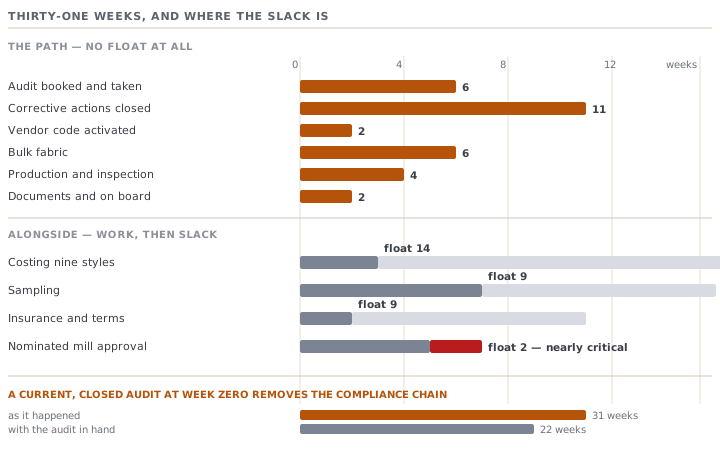
Thirty-one weeks, and where they went
The chain that actually decides the date runs: book the compliance audit and take it, agree and close the corrective actions, get the vendor code activated, buy the bulk fabric, make and inspect the goods, and ship.
| Activity | Weeks | Float |
|---|---|---|
| Booking the compliance audit and taking it | 6 | none |
| Agreeing and closing the corrective actions | 11 | none |
| Vendor code activated by the buyer | 2 | none |
| Bulk fabric | 6 | none |
| Production, finishing and final inspection | 4 | none |
| Booking, documents and on board | 2 | none |
| Costing nine styles, two of them re-quoted | 3 | 14 weeks |
| Sampling: five protos and their fit rounds | 7 | 9 weeks |
| Insurance certificates, bank details, signed terms | 2 | 9 weeks |
| Nominated mill approval and test reports | 5 | 2 weeks |
Float is the spare time an activity has. An activity with float can slip without moving the ship date. An activity with none cannot slip at all. Read the two halves of that table against each other and the whole lesson is there.
Everything Serapion chased has float. The costing pack had 14 weeks of spare time, and it was treated as an emergency. The insurance certificates and the signed terms had 9 weeks, and three people worked a weekend on them. Sampling had 9 weeks. That was real work, and genuinely urgent in the buyer's mind, but it was not the thing holding the date.
Everything on the path was somebody else's diary. The audit body's next free slot was five weeks out. The verification visit came three weeks after the corrective actions were declared closed. The vendor code was activated when Brindlemoor's compliance team got to it. Of the 17 weeks of compliance chain, Serapion controlled the six weeks of corrective-action work and nothing else.
The activity everyone under-books
Booking an audit is not an administrative step. It is a lead time, and it behaves exactly like a fabric lead time. You cannot shorten it by wanting it. It gets longer in the busy months. And it sits at the front of everything.
That is the whole reason the chart is worth drawing. Nobody at Serapion had ever thought of the audit booking as an activity with a duration. It was a form, and forms feel instant.
The same table also names the activity that nearly ended the whole thing, and it is not on the path. Approval of the nominated mill was Brindlemoor's own choice of fabric supplier, with its test reports and a development cut. It had 2 weeks of float, the smallest number in the table that is not zero. An activity with two weeks of spare time is not safe. It is one late courier away from becoming the critical path. Serapion did not know that, because nobody had worked out the float. So it was chased with exactly the same urgency as a costing pack that had fourteen weeks in hand.
Float is the thing worth knowing about an activity, and you cannot see it without the network. Two activities can look identical on a status call. Both open, both waiting on somebody else. One has three months of room, the other has eleven days.
The only item worth compressing, and what it costs
You cannot compress an activity that has float. Shortening the costing pack from three weeks to one moves the ship date by nothing at all. The only compression available is on the path. And on Serapion's path, exactly one item can be moved: the audit, if it is already valid and closed when the buyer asks.
Run the network again with a current, closed audit in hand at week zero. The compliance chain disappears. The vendor code takes two weeks. Sampling becomes the binding constraint, at seven weeks. The order goes on board in 22 weeks instead of 31. That is 9 weeks earlier, or 29.0% of the whole onboarding.
Nine weeks is exactly what lesson 2 cost. It is the difference between the autumn programme and the winter trial.
So price holding a current audit as a standing cost of doing business:
- Audit fee — USD 3,900
- Closure verification — USD 1,850
- The records reconciliation that keeps you closable — USD 1,340
- Two internal audits a year, two days each — USD 1,120
- USD 8,210 a year
A missed autumn placement is worth USD 29,120 of contribution. So a standing audit pays for itself if it saves one placement every 3.5 years. Serapion missed one in its first year of trying.
And note what happens after that compression. The constraint moves to sampling, which lesson 3 measured at 82.1% queue. The second-best week you can buy in this whole course is in your own sample room.
Check yourselfA buyer says they need you approved by June. Which three questions decide whether that is possible?Show the answer
First, when is the audit body's next free slot? That is a lead time, not a form. Second, how long does this buyer's programme take between a declared closure and a verified one? That is their diary, not yours. Third, how long does the buyer's own compliance team take to activate a vendor code once the verification lands? Sampling and costing are not on the list, because they almost always have float. If you cannot answer the three, you cannot answer the buyer. Saying yes without them is how a factory ends up explaining itself in July.
Both sides pay, and neither shows the other its number
Course 27.1 costs this same onboarding from the buying chair: about USD 19,046 and 21 weeks from a first visit to goods on a vessel, for the buyer.
Serapion's own chart, measured from Brindlemoor's first visit rather than from the fair, is 25 weeks. That is four weeks longer than the buyer's own estimate, and every one of those four sits inside the corrective-action window that the buyer's own audit created.
Two useful things follow. First, the buyer is not being unreasonable when they think onboarding takes twenty-one weeks. They are measuring their own chart, and their chart does not contain your corrective actions. Second, a factory that can show a buyer a dated network wins arguments no brochure can win. It is the only document either side has that explains why the date is the date.
What to take away
- Becoming a supplier is a project. Draw its network once, with durations and owners, and keep it.
- The path is mostly other people's calendars. Of Serapion's compliance chain, only the corrective-action work was its own.
- An audit booking is a lead time, not a form, and it is at the front of everything.
- You cannot compress float. Chasing the costing pack and the insurance certificates moves the ship date by nothing.
- A current, closed audit in hand is worth nine weeks, and holding one costs a fraction of a single missed placement.
- Once the audit is off the path, your sample room becomes the constraint — and that one is entirely yours.