Lessons · Lesson 1 of 6
What the buyer is actually scoring
Read your own capability pack against the screen a buyer really runs, and find out how many of your claims are scored at all.
Lesson 1 of 6 · 19 min
Fourteen pages and one question nobody asked
3 March 2026, a menswear trade fair in Paris. Nashwa Hilmy, commercial director of Serapion Apparel in Mit Ghamr, hands Ruth Ellender a fourteen-page capability pack. Ellender buys men's bottoms for Brindlemoor, a British high-street chain with 380 stores and a web shop.
The pack is good. It took a month, a photographer and a designer, and it contains nine claims:
- Twelve sewing lines and 576 sewing operators, 740 people in total
- Founded in 1994, second generation, family owned
- A machine list, 68 types, by count
- Certified to a quality management standard
- Exports to six countries
- Capacity of 190,000 pieces a month
- In-house laundry and embroidery
- Photographs of the canteen, the clinic and the nursery
- Four named brands as customers
Ellender reads it on the train. By the time she reaches Lille she has decided Serapion is worth an assessment visit, and she could not tell you why, because only two of those nine claims touch anything she is going to measure.
The screen on the other side of the table
A buyer never judges a factory on its own. A buyer runs an approved list through a filter, against one order. The filter is a series of vetoes. Course 27.1 teaches that filter from the buyer's chair. This lesson is the mirror: how the filter looks from the seat being filtered.
Brindlemoor's filter runs in five stages against style BM-4260. That is a men's cotton-stretch five-pocket trouser, 14,600 pieces in three colours: Char 6,800, Fennel 5,200, Loam 2,600. The target price is USD 9.85 FOB. FOB means the price with the goods loaded on the ship at your port, so shipping and duty are the buyer's cost from there on.
| Serapion's claim | Which stage it answers |
|---|---|
| Twelve lines, 576 operators, 740 people | none |
| Founded 1994, second generation | none |
| Machine list, 68 types | partly the category stage |
| Certified to a quality management standard | none |
| Exports to six countries | none |
| Capacity 190,000 pieces a month | none |
| In-house laundry and embroidery | none for this product |
| Canteen, clinic and nursery photographs | none |
| Four named brands as customers | the category stage, if the products are named |
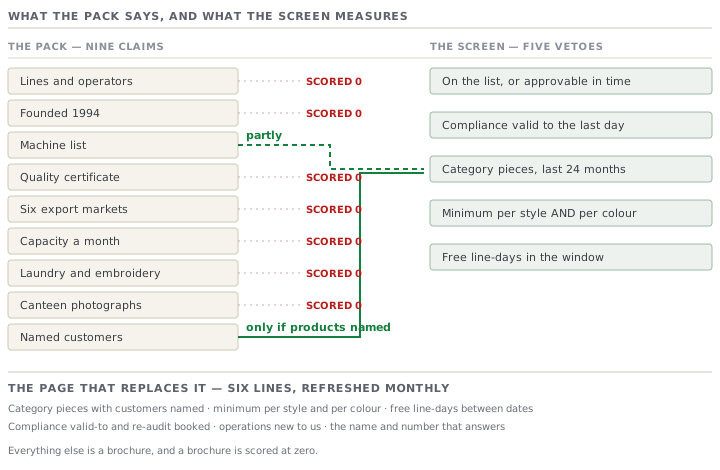
Here are the five stages. Each one is a veto. A veto is not a preference. A factory that fails one is not more expensive. It is unavailable.
On the list, or approvable inside this order's window. Not "could be approved one day". Approvable before the purchase order has to go out.
Compliance valid throughout production, with margin. This means social compliance, not a quality certificate. They are different programmes, checked by different auditors. Mixing them up is one of the commonest and most expensive mistakes a factory makes in front of a buyer.
Category miles. Not the machine. The mileage. How many pieces of this category have you made in the last 24 months, and for whom.
Minimums, per style and per colour. Two numbers, and the buyer checks the second against the smallest colour in the order, which here is 2,600.
Free line-days inside the buyer's window. Not capacity. Uncommitted capacity, between named dates.
Why six claims land nowhere
A machine count is a claim about supply. The buyer is asking about a date: can this order be made by these weeks, without me finding out in July that it cannot. A machine list answers none of that. A factory with 68 machine types and no free weeks is as useful to this order as a factory with no machines at all.
Capacity is the same mistake one level up. 190,000 pieces a month is a number about the building. The buyer needs a number about the diary. Serapion's real answer to stage five in March was 46 free line-days between week 24 and week 38. That one sentence is worth more than the other thirteen pages.
The certificate is the claim that costs real orders. A quality management certificate says something true, and it says it about quality systems. Stage two is about working hours, wages, records, safety and subcontracting. A different body audits it, against a different programme. Answer a social-compliance question with a quality certificate and you have told the buyer you did not understand the question.
The enquiry that was lost with the machines standing idle
In October 2025 Serapion was one of eleven factories asked to quote a 62,000-piece bottoms programme. Its contribution on that product would have been USD 1.15 a piece. That is USD 71,300. It had the machines. It had the weeks. It was dropped at the category stage.
The buyer's question was: how many pieces of five-pocket cotton bottoms have you made in the last 24 months? Serapion's pack said "outerwear and bottoms specialists". That is not an answer to a question about quantity. So the buyer scored it as unknown, and unknown loses to a rival's 96,000.
The count existed. Serapion's own production records held 41,800 pieces of exactly that category, made for Ostlund, a Nordic casualwear brand, inside the window. Nobody had ever added them up. When Hilmy finally ran the query in February it took 40 minutes.
The information was in the building. It was not in the pack. That is the cheapest loss in this course and the most common one in the trade.
Check yourselfYour pack says 'capacity 190,000 pieces a month'. What does a buyer do with that?Show the answer
Almost nothing. It is a claim about your factory, not about their order. They cannot tell whether any of it is free in their weeks. They cannot tell whether any of it is on the machines their product needs. They cannot tell whether the number is a peak month or an average month. Replace it with the two facts they can act on: free line-days between named dates, and pieces of their category made in the last 24 months. Both are queries you can run today.
A date is a capability
Serapion's social-compliance audit was valid to 12 September 2026. Brindlemoor's autumn programme would have been in production until 20 October 2026. The filter is not run on the day you quote. It is run against the last day of production, with margin on top. Valid today and expired during production is a fail, and the factory never hears why.
So the most valuable line in a capability pack is a pair of dates: audit valid to 12 September 2026, re-audit booked for 3 July 2026. It turns a veto into a pass. It costs nothing to write. And almost no factory writes it.
Prompt · Rewrite my capability pack as an answer sheet
The week before a trade fair, or the morning an enquiry arrives from a buyer who has never worked with you.
Act as an experienced sourcing manager at a clothing retailer who screens factories for a living and has no patience for brochures. I am going to give you my factory's capability material and one order I want to be considered for, and I want you to score the material the way you would actually score it. My factory: [NAME, COUNTRY, SEWING LINES, OPERATORS, TOTAL EMPLOYEES, MACHINE TYPES, CERTIFICATES HELD WITH THEIR ISSUING PROGRAMME AND VALID-TO DATES, IN-HOUSE PROCESSES, EXPORT MARKETS, NAMED CUSTOMERS]. My production records for the last 24 months, by product category: [CATEGORY, PIECES, CUSTOMER]. My minimums: [PER STYLE], [PER COLOUR]. My uncommitted line-days, by week: [WEEK RANGE, FREE LINE-DAYS]. The order: [BUYER, STYLE, PRODUCT, TOTAL QUANTITY, SPLIT BY COLOUR, TARGET PRICE, EX-FACTORY DATE, LAST DAY OF PRODUCTION]. Do the following. First, list every claim in my material and say, for each one, which of these five screening stages it answers, writing NONE where it answers none: on the approved list or approvable inside this order's window; social compliance valid through the LAST day of production with margin; pieces of this category made in the last 24 months; minimum per style AND per colour against the smallest colour in this order; free line-days inside the buyer's window. Second, tell me which stages I have left unanswered, and exactly what fact would answer each one. Third, check my compliance validity against the last day of production rather than today, and tell me if I fail. Fourth, tell me which of my minimums the smallest colour in this order breaks. Fifth, write me a one-page answer sheet, six lines maximum, that a buyer could screen without reading anything else. Be blunt. If a claim is a brochure sentence, say so.
AI can make mistakes — check anything you act on.
What to take away
- A buyer filters against one order, in stages, and every stage is a veto. Your pack should be an answer sheet to those stages, in their order.
- A machine count and a monthly capacity are claims about the building. The buyer is asking about a diary and a category. Neither is in the pack.
- A quality certificate does not answer a social-compliance question. Offering it as if it does reads as not understanding the question.
- Publish both minimums. The number you leave out is assumed to be the one that disqualifies you.
- Your compliance validity is a date, and it is checked against the last day of production. Publish the valid-to date and the booked re-audit date together.
- The facts that win filters are usually already in your production records. Losing an order for want of a 40-minute query is the cheapest loss in this course.