Lessons · Lesson 6 of 6
The cost of being considered
Total everything one pursuit cost, split it by what survives a refusal, and compare it with what the first order actually earned.
Lesson 6 of 6 · 18 min
Add it up
From the Paris fair on 3 March 2026 to the container going on board, Serapion spent eleven months getting Brindlemoor to place one order. Nobody had ever added up what that cost, because the spending sat in six different accounts: travel, marketing, third-party services, sample room, laboratory testing and salaries.
Here it is in one place, split three ways. The split matters, because what a dollar of pursuit spending is worth depends entirely on what happens to it if the buyer says no.
| Dies with this buyer | Reusable on the next | Would have been spent anyway | |
|---|---|---|---|
| Trade fair space, stand, sample freight, two people | USD 11,600.00 | ||
| The presentation set, fourteen garments | USD 2,380.00 | ||
| Rebuilding the capability pack | USD 1,460.00 | ||
| Hosting the assessment visit | USD 1,140.00 | ||
| Initial social-compliance audit | USD 3,900.00 | ||
| Corrective actions the programme required | USD 3,120.00 | ||
| Closure verification re-audit | USD 1,850.00 | ||
| Guarding, electrical and fire work, overdue | USD 6,940.00 | ||
| Development: five protos, twelve later rounds | USD 1,074.16 | ||
| Sample couriers, eleven shipments | USD 1,166.00 | ||
| Testing to the buyer's manual | USD 2,690.00 | ||
| Two trips to the buyer's office | USD 4,860.00 | ||
| Merchandising and management time | USD 3,937.60 | ||
| Nominated mill approval and development cut | USD 1,240.00 | ||
| Total | USD 16,107.76 | USD 24,310.00 | USD 6,940.00 |
Why the three columns matter more than the total
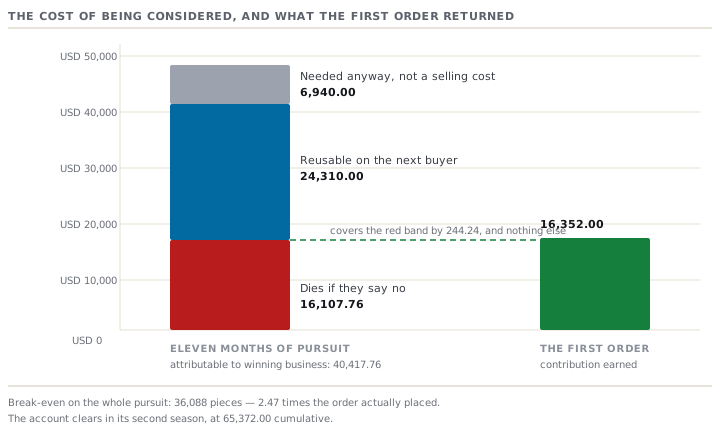
USD 16,107.76 dies if the buyer says no. This is the number to use when you decide whether to chase an enquiry at all. It is the only part genuinely at risk in this pursuit.
USD 24,310.00 survives. The fair produced nine serious conversations, not one. The audit is valid for a year, and two other buyers accept the same programme. The capability pack answers every buyer's filter, not just Brindlemoor's. Charging all of it to one account would make every pursuit look ruinous, and it would be wrong.
USD 6,940.00 was never a sales cost at all. The guarding, electrical and fire work was required by law and overdue. Counting it here would let a factory tell itself that being audited is expensive. What was expensive was not having done the work.
Total cash out over the eleven months: USD 47,357.76. Total attributable to winning business: USD 40,417.76.
What the first order earned
BM-4260 was 14,600 pieces at USD 9.85 FOB. That is an order value of USD 143,810.00. After every cost that varied with the order, the contribution was USD 1.12 a piece, or USD 16,352.00.
Set the two numbers side by side and three findings fall out, each more uncomfortable than the last.
The first order covered the spend that dies with this buyer, and nothing else. USD 16,352.00 against USD 16,107.76 is a surplus of USD 244.24, or 101.5%. It looks like break-even, and it is one, on the narrowest possible definition.
Against everything spent to win business, the first order returned 40.5%. The remaining USD 24,065.76 is carried by the next buyer, or it is not carried at all.
The order that would have broken even on the whole pursuit was 36,088 pieces. That is 2.47 times the one Brindlemoor actually placed. A first order is nearly always a trial, and a trial is nearly always too small to pay for itself. That is not a failure of the trial. It is what a trial is.
The second season is where the account pays
Brindlemoor's autumn programme the following year was 38,000 pieces. The 100% inspection came off, worth USD 0.13. The line was faster on a style it now knew, worth another USD 0.04. So the contribution was USD 1.29 a piece, or USD 49,020.00.
Cumulative contribution after two seasons: USD 65,372.00, against USD 40,417.76 of pursuit. The account clears by USD 24,954.24, in its second season.
That gives the sentence this lesson exists for. An account is paid for by its second order. So a factory that quotes a first order as though it were a normal order has already lost. And a factory that walks away after one order has paid for something it never collected.
What a landed account actually costs
Serapion pursued four buyers seriously that year. Three did not land, at buyer-specific spends of USD 8,420.00, USD 5,260.00 and USD 2,180.00.
- Buyer-specific spending across all four: USD 31,967.76
- Plus the reusable spending they shared: USD 24,310.00
- Total selling spend for one landed account: USD 56,277.76
The first order returned 29.1% of that. And the whole year's selling spend is 0.60% of a turnover of about USD 9.4 million. That is a number Serapion has never seen. It has no budget line, and nobody is accountable for it.
Check yourselfAn enquiry arrives from a buyer who has never worked with you. What do you need before you say yes?Show the answer
First, the buyer-specific cost of pursuing them: samples, testing, travel, and your own hours. That is what is at risk. Second, the size of the order they are actually hinting at, and the contribution per piece it would carry, so you can see whether it can ever repay that spend. Third, whether this is a programme or a one-off. The arithmetic of this lesson says the account pays in its second order. A buyer with no second order is a pursuit you are funding out of somebody else's margin.
Which enquiries to decline
Lesson 1 showed a buyer filtering twenty-two factories down to five. The symmetry is the point of the course: you should be filtering enquiries too, and almost no factory does.
Five questions. The first two are usually enough.
- Is there a second order behind this one, or is it a one-off? An account pays in season two.
- What is the buyer-specific spend to reach a quotation, and can this order's contribution repay it?
- How many of the operations are new to us, and what do they cost to learn?
- Is our compliance valid through their last day of production, with margin?
- Would we be able to say yes to their next enquiry, or does this one consume the capacity that would win it?
A factory that cannot say no to an enquiry is spending its sales budget by accident. And it will spend it on the buyer who asks most often, rather than the buyer worth having.
Prompt · Price one pursuit, from first contact to first order
Before you commit to chasing a new buyer, or after a first order lands and somebody says it was not worth it.
Act as a commercial director at a garment factory who has to justify a selling budget to an owner. Price one pursuit of one buyer end to end, and then tell me whether to do it again. The pursuit: [BUYER, HOW WE MET, DATES OF FIRST CONTACT AND FIRST SHIPMENT]. Everything spent, one line each with the amount: [TRADE FAIR OR TRAVEL TO MEET THEM, PRESENTATION SAMPLES, CAPABILITY MATERIAL, HOSTING THEIR VISITS, AUDITS AND RE-AUDITS, CORRECTIVE ACTIONS SPLIT INTO WHAT THEIR PROGRAMME REQUIRED AND WHAT WAS LEGALLY OVERDUE ANYWAY, DEVELOPMENT SAMPLES, COURIERS, LABORATORY TESTING, TRIPS TO THEIR OFFICE, OUR OWN HOURS AT A LOADED RATE, MILL OR TRIM APPROVAL COSTS]. The first order: [QUANTITY, PRICE, CONTRIBUTION PER PIECE AFTER EVERYTHING THAT VARIED WITH IT, INCLUDING ANY TRIAL DISCOUNT AND ANY EXTRA INSPECTION]. What we expect next season: [QUANTITY, CONTRIBUTION PER PIECE]. Other pursuits this year that did not land: [BUYER, BUYER-SPECIFIC SPEND]. Do the following. First, sort every line into three columns, and total each one. The columns are: dies if this buyer says no; reusable on the next buyer; would have been spent anyway. Second, warn me about any figure I may have double-counted, especially a trial discount or an extra inspection that is already inside my contribution per piece. Third, compare the first order's contribution against each of the three totals. Fourth, compute the order quantity that would have broken even on all pursuit spending, and express it as a multiple of the order I actually got. Fifth, run the account across two seasons and tell me in which one it clears. Sixth, add the pursuits that did not land and give me a total selling spend per landed account, and that figure as a percentage of my turnover. Seventh, write me five questions to screen the next enquiry with, in the order I should ask them.
AI can make mistakes — check anything you act on.
What to take away
- Total your pursuit spending in one place. It sits in six accounts and nobody owns the sum.
- Split it three ways: what dies with the buyer, what serves the next one, and what you needed anyway. Only the first belongs in a go or no-go decision.
- A first order is a trial, and a trial is nearly always too small to repay a pursuit. Work out the quantity that would, so you know how far short you are.
- The account pays in its second season. Price the first order knowing that, and never abandon an account after one order.
- Reusable spending is real, and it should be spread across the pursuits it serves. Do not charge it to the one that happened to land.
- Run your own filter on incoming enquiries. Being filtered is what this course is about. Filtering back is what makes it profitable.