Lessons · Lesson 3 of 11
- 01 · The unit of account is a task, not a tool
- 02 · What to give it: the facts, the format, the forbidden
- 03 · Checkability, and the four classes of output
- 04 · Reading a long document: ask for pointers, never a summary
- 05 · Drafting a message: the saving is on the blank page
- 06 · Reconciling a list: change the output's shape, change the review
- 07 · Setting up a calculation: the task where the arithmetic says no
- 08 · Translation, checked the way it actually fails
- 09 · The review budget, and the rate at which checking stops working
- 10 · The log, and why the task you use most pays least
- 11 · Six weeks, honestly totalled
Checkability, and the four classes of output
Sort the desk's tasks by how expensive the output is to disbelieve, and derive the ratio above which a task cannot pay.
Lesson 3 of 11 · 13 min
Two tasks that look identical and are not
Restating a size breakdown and setting up a consumption calculation look like the same job. Hand over some figures, get a table back. One of them saved Marasem 8.0 minutes a use. The other lost 4.0.
The difference is not difficulty, and it is not the quality of the output. It is how much work it takes to disbelieve the answer.
A restated size grid can be disbelieved cell by cell, against a grid sitting in the same window. A consumption calculation — how much cloth a garment eats — can only be disbelieved by doing the calculation. A wrong number and a right number look exactly the same, and the only way to tell them apart is to produce the right one yourself. The first is a comparison. The second is the job.
The check ratio, and the line it has to stay under
Write the checking and repair time as a fraction of what the task would have taken by hand. Call it the check ratio.
Net saving is positive when checking and repair together cost less than the manual time minus the input and waiting time. Divide through by the manual time and the condition becomes a ratio you can read off a log:
a task pays when its check ratio is below 1 minus (input plus waiting time ÷ manual time)
That is a formal way of saying something blunt: the bigger the job, the more checking it can carry. A forty-six-minute job can absorb a great deal of scrutiny. An eleven-minute job cannot absorb much. A two-minute job cannot absorb any.
| Task | Manual minutes | Check ratio | Had to stay under | Verdict |
|---|---|---|---|---|
| Locate a clause in a buyer manual | 46.0 | 27.2% | 90.2% | keep |
| Compare two lists side by side | 34.0 | 26.5% | 82.4% | keep |
| Translate a work instruction | 26.0 | 32.7% | 86.5% | keep |
| Restate a revised size breakdown | 22.0 | 40.9% | 77.3% | keep |
| Draft a buyer message | 8.5 | 43.5% | 70.6% | keep, small |
| Set up a consumption calculation | 11.0 | 90.9% | 54.5% | retire |
| Odd jobs of about two minutes | 2.1 | 100.0% | −19.0% | retire |
The last row is worth reading twice. The threshold is negative, which means no check ratio at all — not even zero — makes that task pay. That is lesson 1's floor, arrived at from the other direction.
The four classes
Every output the desk produced fell into one of four kinds, and the kind decides the check ratio before you write a word of input.
Class 1 — checkable against a source you hold. The answer's correctness is settled by a comparison with a document. Restating, extracting, locating, rearranging, comparing. Check ratios at Marasem: between 26.5% and 40.9%. This is where nearly all of the desk's saving came from.
Class 2 — checkable only by re-doing it. A calculation, an inference, anything whose answer is not written down anywhere. To check it you must produce the answer independently, and that is the task. The check ratio approaches 100.0%. So the saving approaches nothing, and the risk does not.
Class 3 — checkable only against a judgement you hold. A message to a buyer, a summary for the owner, a rewrite for the floor. No document settles whether the tone is right. The check is you reading it as the person who would have written it. The check ratio is around half. There is a real saving here, but it is on the blank page rather than on the words, and lesson 5 measures exactly how much.
Class 4 — not checkable in the time you have. "What does this buyer usually accept on a shade concession?" "Is this supplier reliable?" There is no source in the room, and no judgement short of the answer itself. Marasem logged 4 of these before the desk stopped. Two came back confident, and carried a named tolerance nobody could trace to anything. They cost 2.7 minutes each and produced nothing that could be acted on: 10.8 minutes. The only reason that number is small is that they stopped quickly.
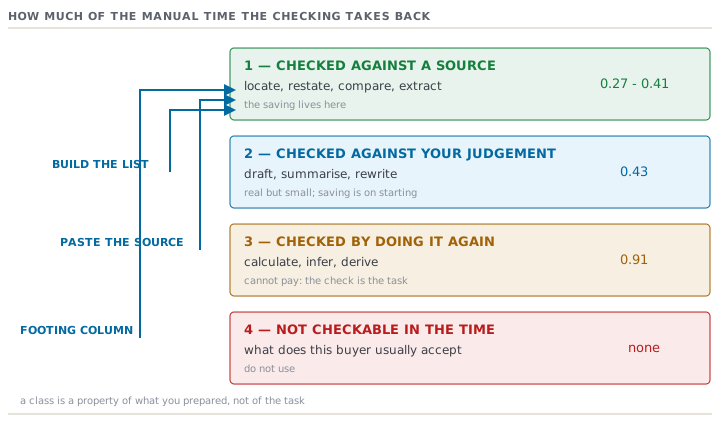
The class is not a property of the task. It is a property of your preparation.
This is the finding the desk did not expect, and it changed how they worked more than any instruction did.
Translating a work instruction looks like class 3. How do you check a translation, except by reading it as a bilingual person? Marasem's answer is that you do not. Lesson 8 shows that reading catching 2 defects out of 11. Then the factory wrote down its own forty-term glossary — a list pairing each English term with the exact Arabic word this factory uses. The same task became class 1: every term in the output is now checkable against a list, mechanically, in ninety seconds. The same check caught 10.
Nothing about the task changed. The thing it is checked against came into existence.
There are three moves and they recur in every remaining lesson:
- Put the source in the window — lesson 2. Turns a claim into a comparison.
- Build the list it is checked against — lesson 8. A glossary, a size chart, a price list, a code table. Written once, and it converts a whole category.
- Ask for an output that carries its own check — lesson 6. A column whose total you already know, so a whole class of omission is excluded by arithmetic rather than by reading.
Each of those is an hour or two of work that you do once. Each moves the check ratio of every future use of that task. That is a better investment than any amount of effort spent on the wording of the request, and the log says so in numbers: the best instruction Ghaly wrote moved a check ratio by 1.0 minute. Pasting the source moved it by 4.0.
Check yourselfWhich class is 'read this inspection report and tell me the three things the owner needs to know'?Show the answer
Class 3. There is no document that settles which three matter — that is a judgement about your owner. It is a legitimate use with a modest saving, and the check is you reading the report anyway. What it is NOT is a substitute for reading the report, and the moment you treat it as one you have moved yourself into class 4 without noticing.