Lessons · Lesson 1 of 11
- 01 · The unit of account is a task, not a tool
- 02 · What to give it: the facts, the format, the forbidden
- 03 · Checkability, and the four classes of output
- 04 · Reading a long document: ask for pointers, never a summary
- 05 · Drafting a message: the saving is on the blank page
- 06 · Reconciling a list: change the output's shape, change the review
- 07 · Setting up a calculation: the task where the arithmetic says no
- 08 · Translation, checked the way it actually fails
- 09 · The review budget, and the rate at which checking stops working
- 10 · The log, and why the task you use most pays least
- 11 · Six weeks, honestly totalled
The unit of account is a task, not a tool
Score one real task five ways instead of asking whether the assistant is any good, and find the task size below which it cannot pay.
Lesson 1 of 11 · 14 min
The wrong question, asked every week
Marasem Apparel makes woven outerwear on six lines in an industrial city east of Cairo. In March its owner asked the merchandising desk a question that sounds reasonable. It cannot be answered: is this thing any good?
Four merchandisers — Zeinab Ghaly, Hosny, Basyouni and one more — spent the next six weeks answering a different question. They kept a log. Every time one of them handed a piece of work to an assistant, they wrote down five numbers. How long the job would have taken by hand. How long it took to prepare the input. How long they waited. How long they spent checking what came back. How long they spent repairing it. Six weeks, 214 logged uses.
The log is the whole course. Every figure in these eleven lessons is Marasem's own measurement, of its own desk, on its own documents. None of it is a claim about any product. Your desk will produce different numbers. The method is what transfers.
The five-term equation
A task is worth handing over when
net saving = manual time − (input time + waiting time + checking time + repair time)
and it is worth nothing at all if you do not measure the last two. That is the whole subject. Most accounts of this stop after the first three terms, because those three are pleasant and the last two are not.
Take the desk's most ordinary job. Ravenscar Workwear is a British workwear brand. It revises the size breakdown on purchase order RO-9142 — style RV-4180, a men's cotton-canvas work jacket, 24,000 pieces at FOB USD 21.40. FOB means the price of the goods loaded on board at the port of shipment. The order is worth USD 513,600. The revision arrives as an email with a grid attached. Somebody has to turn it into a cutting-ready table: size against colour, ratio per bundle, totals that add up.
By hand, Ghaly does it in 22.0 minutes. Handed over, on the day she got the input right:
| Term | Minutes |
|---|---|
| Manual time | 22.0 |
| Input time | 4.0 |
| Waiting time | 1.0 |
| Checking time | 7.0 |
| Repair time | 2.0 |
| Cost with the assistant | 14.0 |
| Net saving | 8.0 |
Eight minutes. Marasem's loaded cost for a merchandiser is USD 9.60 an hour, which is USD 0.16 a minute. That is this factory's payroll figure, not a market rate. So eight minutes is USD 1.28. Every dollar in this course is that rate multiplied by a number of minutes. If your rate differs, every dollar figure here scales with it, and every ratio survives unchanged.
Notice what the table refuses to do. It does not say the output was good. It says checking it took 7.0 minutes and repairing it took 2.0. Those minutes are as real as the twenty-two they replaced. A task that takes twenty minutes to do and five to check has not saved twenty minutes.
The six-week total, before anything is retired
Across all 214 uses:
| Minutes | |
|---|---|
| The same work done by hand | 3,485.5 |
| The same work with the assistant | 2,063.0 |
| Net saved | 1,422.5 |
| New checking and repair created | 1,310.9 |
Read those four numbers together. Separately, each of them lies.
The work fell by 40.8%. That is the number that goes in a presentation.
The saving was 1,422.5 minutes. That is 23.71 hours across four people over six weeks, or USD 227.60.
And 1,310.9 minutes — 21.85 hours — of a kind of work that did not exist before appeared on the same four desks. Of the time still being spent on these tasks, 63.5% is now checking. Of the gross saving in doing, 48.0% went straight back out as reviewing. Nobody had put that in a calendar. Lesson 9 is about what happens when nobody does.
The floor, and the tasks that sit under it
The log's sharpest finding is not about quality at all. It is about size.
Preparing an input, waiting, and reading the result each have a floor. That floor does not fall however small the job is. Marasem measured its own. The leanest input any of the four ever wrote took 1.9 minutes. The median wait was 0.6. The shortest useful check was 1.6. That is 4.1 minutes before a single word of repair.
So a task you can do yourself in under 4.1 minutes cannot be saved on. Not because the output is poor. Because the floor is higher than the job.
60 of the 214 logged uses — 28.0% — were tasks with a manual time of about 2.1 minutes. Rename a column. Turn three bullet points into a sentence. Convert a date. Each of those cost 4.6 minutes to hand over and get back, so each lost 2.5 minutes. Together they lost 150.0 minutes over six weeks: USD 24.00 of a desk's time spent going backwards, cheerfully, by people who thought they were saving time.
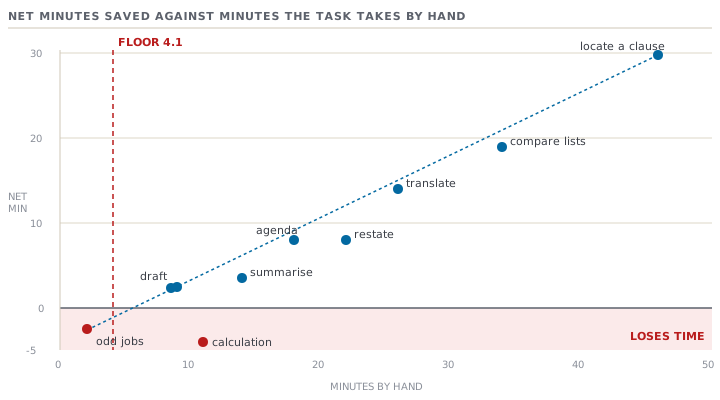
They were the most-used category in the log. Lesson 10 explains why that is structural rather than silly, and what to do about it.
Check yourselfA colleague says the assistant 'saves them about an hour a day'. What is the first question to ask?Show the answer
Not "on what?" but "how long do you spend checking it?" — and then "what would the task have taken you by hand?" Without those two numbers the hour is an estimate of the pleasant half of the equation. At Marasem the pleasant half was 2,733.4 minutes of doing removed. The honest half was 1,310.9 minutes of checking added.
What this course does, and what it deliberately does not
Every lesson from here takes one task the desk actually does — a document read, a message drafted, a list reconciled, a calculation set up, a translation checked — and scores it in the five terms. Two come out negative and get retired. Lesson 7 is the one where the arithmetic says do not use it, and the course means it.
Three things belong to this track's other courses, and they are named where they touch. The honest map of what these systems can and cannot do at all, and the arithmetic of when a nearly-right answer is worth less than no answer, is course 15.1. Anything applied to your own order data at scale — extraction, classification, matching — is 15.3, and course 24.2 already owns the gap between an inferred count and a counted one. A system that takes actions rather than producing text is 15.4. What you owe your buyers and your workers, and how to buy any of this, is 15.5.
Prompt · Score a task before you hand it over again
Before adding a task to the list of things your desk hands over, and again after a month of using it, when you want to know whether it is earning anything.
Act as an operations analyst who is sceptical of tools and interested only in measured time. I want one task scored honestly, not recommended. The task: [DESCRIBE IT IN ONE SENTENCE, AS YOUR DESK ACTUALLY DOES IT]. My own measurements: it takes me [MINUTES] by hand; preparing the input takes [MINUTES]; waiting takes [MINUTES]; checking the output to the standard this task needs takes [MINUTES]; repairing what checking finds takes [MINUTES]. My loaded cost is [AMOUNT] an hour. I ran it [NUMBER] times in [WEEKS] weeks. Do the following. First, compute the net saving a use and over the period, in minutes and in money, and say plainly whether the number is positive. Second, compute the check ratio, which is checking plus repair divided by manual time. Then compute the ratio it had to stay under, which is one minus preparing plus waiting divided by manual time. Say whether it clears it, and by how much. Third, classify the output: checkable against a source I hold, checkable only against my own judgement, checkable only by doing the task again, or not checkable in the time available. Justify the class from what would have to happen for me to disbelieve the answer, not from how hard the task is. Fourth, if the class is the third or fourth, say so and recommend retiring the task, and do not soften it. Fifth, if it is the first or second, name the single change to my input that would most reduce the CHECKING time, and estimate by how many minutes. Sixth, list every error this task could produce that my described check would not catch, and for each one name what it would cost if it left the building. Do not estimate any figure I have not given you: write MISSING instead.
AI can make mistakes — check anything you act on.