Lessons · Lesson 6 of 11
- 01 · The unit of account is a task, not a tool
- 02 · What to give it: the facts, the format, the forbidden
- 03 · Checkability, and the four classes of output
- 04 · Reading a long document: ask for pointers, never a summary
- 05 · Drafting a message: the saving is on the blank page
- 06 · Reconciling a list: change the output's shape, change the review
- 07 · Setting up a calculation: the task where the arithmetic says no
- 08 · Translation, checked the way it actually fails
- 09 · The review budget, and the rate at which checking stops working
- 10 · The log, and why the task you use most pays least
- 11 · Six weeks, honestly totalled
Reconciling a list: change the output's shape, change the review
Compare a packing list against a purchase order two ways, and find the two cheap arithmetic checks that make one of them believable.
Lesson 6 of 11 · 13 min
A task that punishes the obvious request
The packing list for purchase order RO-9142 has 148 lines: size against colour against carton. The order's breakdown has the same 148 lines. Somebody has to prove they agree before the container is sealed.
By hand, line by line, Ghaly does it in 34.0 minutes. It is exactly the kind of work everybody wants to hand over. The obvious way to hand it over makes it worse.
Route one: ask for the answer
Compare this packing list against this breakdown and tell me the discrepancies.
Input 4.0 minutes, wait 2.0, and back comes a tidy list of four discrepancies.
Now check it. The claim is not these four are wrong. You can verify those in a minute. The claim is these four are the only ones wrong, and the only way to verify that is to compare all 148 lines yourself. Total: 40.0 minutes against a manual 34.0.
This is lesson 4's summary trap in a different coat. A short answer about a long input is cheap to produce and expensive to disbelieve, and the check ratio decides everything.
Route two: ask for the working
Produce a table with one row for every line of the purchase order, in the order the purchase order lists them. Columns: size, colour, quantity ordered, quantity packed, and a difference column. Include rows where the two agree. Add a total row for all three numeric columns. Do not omit anything and do not sort.
Input 4.0, wait 2.0, and back comes a table of 148 rows plus a total. Checking it took Ghaly 9.0 minutes, and nothing needed repair. Total 15.0 minutes: 19.0 saved. Over 13 uses in six weeks that is 247.0 minutes and USD 39.52.
The output is not more accurate. It is easier to disprove, and it can be disproved by arithmetic rather than by reading.
The two checks, and they take about five seconds each
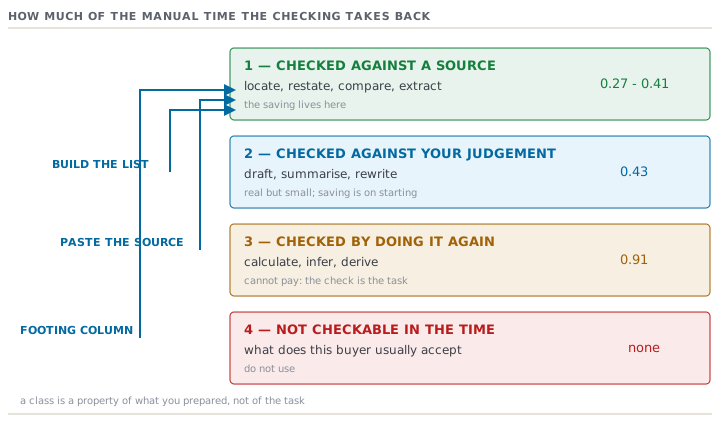
The row count. The order has 148 lines. If the table has 148 rows, no row has been dropped. If it has fewer, you know the answer is incomplete before you have read a word of it. On 2 of the 13 uses it had fewer. Both times a size-and-colour with a zero packed quantity had been quietly left out.
The footing. Footing means adding a column up and seeing whether it comes to the total you already hold. You know two totals here: 24,000 ordered, 23,970 packed. So the difference column must come to −30. It did. And the four named discrepancies — short 42, over 12, short 18, over 18 — also come to −30.
That second check is the one worth stealing for every task you ever hand over.
Why the ordering instruction is not fussiness
Ghaly ran the same list twice on the same afternoon. Asked without an ordering instruction, the table came back grouped by size. That mixed the colours together and put the rows in an order the purchase order never uses. Scanning it took 19.0 minutes. Asked in the purchase order's own row order, the same 148 rows took 9.0.
Two lists in the same order are compared in one pass down the page. Your eye holds one row at a time and never goes back. Two lists in different orders are compared by searching, once per row. The cost stops being a walk and becomes a hunt. It is the difference between reading a page and looking something up 148 times.
So the instruction is: in the order my document already uses. Not because it is neater, but because it is the difference between 9.0 minutes and 19.0.
What was actually wrong with the shipment
The four discrepancies were real. Forty-two navy jackets short in size L, eighteen short in XL, twelve extra olive in M, eighteen extra olive in S. That is one carton of 30 missing overall, plus a colour packed against a bag mark that looked almost identical.
Found nine days before loading, it cost a re-pack of six cartons and an amended packing list. Found by Ravenscar's warehouse, it would have been a short-shipment claim on a 24,000-piece order, and a conversation about the next one.
Check yourselfThe difference column foots correctly, but you have not read a single row. What do you know?Show the answer
That no row with a non-zero difference has been dropped, and that the named discrepancies account for the whole gap between the two totals you already held. You do not know that any individual row is right. Two errors inside one row's ordered and packed figures could cancel each other out and still foot perfectly. The footing narrows what you have to read. It does not replace reading.
Prompt · Compare two lists so the comparison can be footed
A packing list against an order, a proforma against a purchase order, a mill's dispatch note against your own booking. Any time two documents should say the same thing and somebody has to prove it.
Act as a clerk who transcribes and does not judge. I am giving you two lists that should agree. List A: [PASTE IT, WITH ITS HEADINGS]. List B: [PASTE IT, WITH ITS HEADINGS]. The key that joins a row of A to a row of B is [NAME THE COLUMNS, FOR EXAMPLE SIZE AND COLOUR]. Do the following. First, produce one table with one row for every row of list A, in the order list A already uses. Do not sort, do not group and do not rearrange. Second, the columns are: the key, the value from A, the value from B, and a difference column of B minus A. Third, INCLUDE every row where the two agree, showing a difference of zero. Do not omit matching rows and do not collapse them into a note. Fourth, add a total row summing the A column, the B column and the difference column. Fifth, below the table state the number of rows you produced. Sixth, list separately any row that appears in B and not in A, and any row of A you could not read. Do not tell me which differences matter, do not suggest causes, and do not correct anything. If a value is unreadable, write MISSING rather than inferring it.
AI can make mistakes — check anything you act on.