Lessons · Lesson 11 of 11
- 01 · The unit of account is a task, not a tool
- 02 · What to give it: the facts, the format, the forbidden
- 03 · Checkability, and the four classes of output
- 04 · Reading a long document: ask for pointers, never a summary
- 05 · Drafting a message: the saving is on the blank page
- 06 · Reconciling a list: change the output's shape, change the review
- 07 · Setting up a calculation: the task where the arithmetic says no
- 08 · Translation, checked the way it actually fails
- 09 · The review budget, and the rate at which checking stops working
- 10 · The log, and why the task you use most pays least
- 11 · Six weeks, honestly totalled
Six weeks, honestly totalled
Put the time saved, the review created and the three incidents on one page, and name the single mistake all three incidents share.
Lesson 11 of 11 · 12 min
The scoreboard
| Task | Uses | Net minutes | Verdict |
|---|---|---|---|
| Locate a clause in a buyer manual | 26 | 754.0 | keep, never as proof of absence |
| Translate a work instruction | 22 | 308.0 | keep, never for a commitment |
| Compare two lists side by side | 13 | 247.0 | keep |
| Restate a revised size breakdown | 18 | 144.0 | keep |
| Draft a buyer message | 31 | 71.3 | keep, with the figure check |
| Draft a meeting agenda | 8 | 64.0 | keep |
| Simplify a floor instruction | 12 | 30.0 | keep |
| Summarise an inspection report | 6 | 21.0 | keep, never instead of reading it |
| Ask what a buyer usually accepts | 4 | −10.8 | stopped |
| Set up a consumption calculation | 14 | −56.0 | retired |
| Odd jobs of about two minutes | 60 | −150.0 | retired |
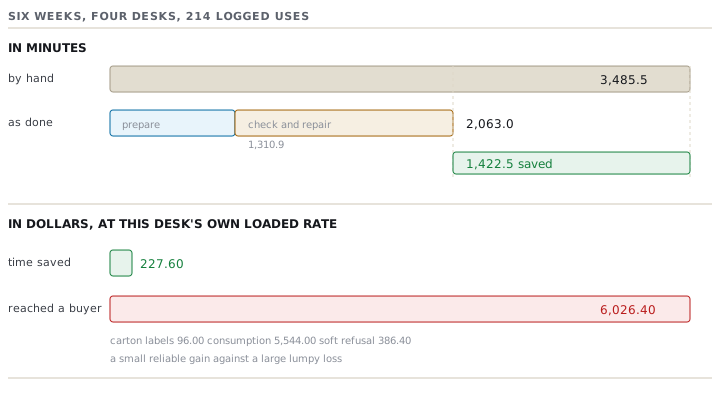
Net across the six weeks: 1,422.5 minutes, 23.71 hours, USD 227.60. Against that, 1,310.9 minutes of checking and repair that had not existed before.
And then the other column
Three defects reached something real.
| Cost | Lesson | |
|---|---|---|
| Carton labels on 640 assortment cartons | 96.00 | 4 |
| A consumption figure built on a supplied wastage allowance | 5,544.00 | 7 |
| A supplier's soft refusal read as a firm date | 386.40 | 8 |
| Realised total | 6,026.40 |
USD 6,026.40 against a time saving of USD 227.60. That is 26.5 times. The six-week position is minus USD 5,798.80.
One more was caught at review, and honestly it belongs in neither column: the buyer message that agreed to a price reduction, worth USD 2,640.00, stopped by a forty-second check. It is not a saving. Nothing was gained by nearly making a mistake. But it is the best evidence in the log that the review time is worth protecting.
Read the sign of that number carefully
Minus USD 5,798.80 is a real figure, and it is a fragile one. Saying so is more useful than the figure itself.
Remove the single consumption error and the position is minus USD 254.80. Remove all three incidents and it is plus USD 227.60. The sign of the six-week answer is decided by one event, and one event in six weeks is not a rate you can estimate from six weeks.
So the honest reading is not "this lost money". It is this:
the time saving is small and reliable; the incident cost is large and lumpy.
That is a risk position rather than a productivity gain. And a risk position is managed by removing the classes of task that generate the lumpy half. That is exactly what retiring two tasks and writing three rules does, and it is why those matter more than any improvement in how the inputs are written.
The one mistake all three incidents share
None of the three was invented. This is the finding that took Marasem six weeks to see, and it is the thing to carry out of this course.
The nine pointers were real, correctly quoted and correctly located. The consumption arithmetic was correct in every line, working from the premise it was given. The Arabic sentence was put into English competently by any standard a dictionary would apply.
In each case a true output was used to support a claim one step wider than the output:
- nine correct pointers became there are nine places in the manual;
- a correct calculation on a stated premise became the consumption is 2.29 metres;
- a correct rendering of a sentence became the supplier has committed to the eleventh.
The widening happens in the reader, silently, and it is invisible precisely because the output is right. Nothing in the answer signals it, no amount of care in the request prevents it, and no check on the output can catch it, because the output is not what is wrong.
What a desk should actually do on Monday
Keep the four-column log for a month. Estimate the manual time before, not after. Twenty seconds a use.
Score every task in the five terms and rank by minutes saved. Retire anything negative. Expect the most-used task to be among them.
Build the three things that make outputs cheap to check: the source pasted in the window, the glossary or code list your factory already carries in its head, and the footing column whose total you already know.
Protect the review time before you spend the saving, and hold a ceiling on checks in an hour. The rate is the thing, not the step.
Never hand over the three that will not be checked: an unanswerable question, a premise you have not supplied, and a sentence whose meaning is how firmly it is said.
Check yourselfYour desk's six-week log shows a net saving and no incidents. What is the honest conclusion?Show the answer
That no incident has surfaced yet. Marasem's largest cost came from a single use in fourteen, on a task that had been quietly losing four minutes a time for six weeks without anybody noticing. Six weeks is enough to measure a time saving. It is nowhere near enough to measure an incident rate. Treating the absence of one as evidence is the same widening the three incidents were made of.