Lessons · Lesson 1 of 3
From a cost price to what the business keeps
Follow one coat from a factory's quotation to the money a retailer actually keeps, and read the two margins a buyer is judged on.
Lesson 1 of 3 · 38 min
The situation
Ask most people what a shop makes on a coat. They take the factory price off the price on the ticket. Nearly every step of that sum is wrong. Freight, duty and sales tax all sit between those two numbers. And the shop measures what is left against what it sold for, not against what it paid. This lesson follows one coat through the whole sum. A garment that has to be discounted to shift it earns far less than its ticket ever promised.
12 January, the buying office at Marchbank in Hexham. Marchbank is a British womenswear retailer. It has 148 stores and a website, a customer who buys a winter coat every second or third year, and a buying team of nine.
Imogen Thackray buys outerwear. In front of her is the autumn season review, one page a line. The line she is about to be asked about is MK-8120. It is a belted wrap coat in wool-blend melton, shade Ironstone, made by Denizkent Konfeksiyon in Silivri. It was ordered on PO MRB-4022, ticketed at GBP 89.00, and bought 14,000 units deep.
The coat sold. It sold a great deal. It is also why outerwear finished the season GBP 216,532 below the margin it was signed off to make. And nothing Imogen decided in February was wrong.
This lesson is the anatomy of that. Where a garment's money goes between a factory's quotation and a retailer's profit and loss account. And why the margin a buyer quotes on the day of the buy is not the margin the business gets.
One word, settled before it causes trouble
In UK and European retail a merchandiser is the numbers role. They own the budget, the phasing, the weekly stock and sales, and the markdown. The buyer chooses the product and agrees the price. Callum Ordish is Marchbank's outerwear merchandiser. Imogen is its buyer. They share the season and are judged on different halves of it.
On the supply side the same word means something else. There, a merchandiser is the person inside or beside a factory who runs the order. That is track 27's meaning, and if you have come from a factory it is the one you already know. This track means the retail sense throughout.
Three things this course deliberately does not teach. They belong to courses that do not exist yet, and re-teaching them here would create two lessons that contradict each other.
- How a buying budget is built, phased and traded through the season, and how a markdown is planned. That is Retail Planning, track 17. Here, budgets and markdowns arrive as given data.
- How stock is allocated to stores, replenished and returned. That is Allocation and Inventory, track 18.
- How space is laid out and how a product is presented. That is Visual and Digital Merchandising, track 19.
And one that does exist. How a factory arrives at the FOB price is course 8.1. From this chair the FOB is given data. It is a number on a quotation. A buyer can argue about it and cannot see inside it.
The chain begins with a number you cannot see inside
Denizkent quoted FOB USD 24.90 a coat at 14,000 units. FOB means the price with the goods loaded at the port of departure. Everything after that is Marchbank's cost and Marchbank's problem.
Marchbank sells in pounds and buys in dollars. So the first thing that happens to the quotation is that finance converts it. It uses a rate fixed in January for the whole autumn buy: USD 1.25 to GBP 1.00. Every autumn cost sheet uses that rate whatever the market does afterwards. That way six buyers are not each guessing at a different future.
| Line | GBP a coat | Where it comes from |
|---|---|---|
| FOB, converted | 19.92 | USD 24.90 at the season rate |
| Sea freight, insurance, inland to the distribution centre | 0.86 | the freight forwarder's rate card |
| Duty and clearance | 2.39 | an illustrative rate on the converted value |
| Landed cost | 23.17 | what one coat costs on Marchbank's own shelf |
Two notes on that table before it is used for anything.
The duty line is illustrative. It is shown at 12% of the converted FOB value, against an unnamed importing market. Real duty depends on two things: the tariff heading a garment classifies to, and whatever trade agreement exists between the two countries. Rates are published, they are checkable, and they change. Course 8.5 is where that is taught. All that matters here is the shape of it. Duty is part of landed cost, it is charged on value, and so it moves with the FOB price.
Landed cost, not cost price. A factory-side reader hears "cost" and thinks of the FOB. A retailer's cost is the FOB plus everything needed to get the garment onto its own shelf. That is the landed cost. On this coat the extra is GBP 3.25 a unit, or 16.3% on top of the FOB, and it is not optional.
The ticket price is not the retailer's money
Ticket price: GBP 89.00. That is what the customer pays. It is not what Marchbank books.
Clothing in Marchbank's market carries sales tax at 20%. The shop collects it at the till and passes it on. So of GBP 89.00, GBP 14.83 is tax and GBP 74.17 is net sales. Net sales is the number that appears in the accounts. It is also the number every margin in retail is calculated on.
Margin is not markup, and this is where factory and retail stop understanding each other
Marchbank pays GBP 23.17 and asks GBP 74.17 net. A factory reader looks at that and says: they sell it for 3.20 times what they pay us. True. That is the markup.
The retailer says: our margin on that coat is 68.8%. Also true, and the same fact.
| Net selling price | GBP 74.17 |
| Landed cost | GBP 23.17 |
| Cash margin a coat | GBP 51.00 |
| Markup, cost to selling price | 3.20 times |
| Margin, as a share of the selling price | 68.8% |
Markup divides by cost. Margin divides by net selling price. Retail runs on margin. Every other cost in the business is planned as a percentage of sales: store payroll, rent, distribution, marketing. So percentage of sales is the only useful language. A supplier who negotiates in markup and a buyer who negotiates in margin will agree on words and disagree on money.
The number in that table that a buyer signs off in February is 68.8%. It has a name: the intake margin. It is the margin the goods came in at, at full price, before a single one was sold.
Then the season happens
The intake margin assumes every coat sells at GBP 89.00. Not one autumn in retail history has done that. Here is what MK-8120 actually did across 26 weeks.
| Sold at | Ticket | Net a coat | Units | Net sales |
|---|---|---|---|---|
| Full price | 89.00 | 74.17 | 5,150 | 381,958 |
| Twenty per cent off | 71.20 | 59.33 | 1,850 | 109,767 |
| Forty per cent off | 53.40 | 44.50 | 2,300 | 102,350 |
| Sixty per cent off | 35.60 | 29.67 | 2,800 | 83,067 |
| Cleared to a jobber | — | 4.00 | 1,900 | 7,600 |
| Total | 14,000 | 684,742 |
A jobber is a clearance trader. They buy unsold stock in bulk, for cash, and sell it through markets and discount channels. They pay very little and they take it away. At the end of a season, taking it away is worth something on its own.
Now the arithmetic that matters.
- Net sales: GBP 684,742
- Cost of goods, 14,000 at GBP 23.17: GBP 324,380
- Gross margin: GBP 360,362
- Achieved margin: 52.6%
The coat came in at 68.8% and went out at 52.6%. Averaged across the season it sold for GBP 48.91 net. That is 2.11 times its landed cost, not 3.20 times.
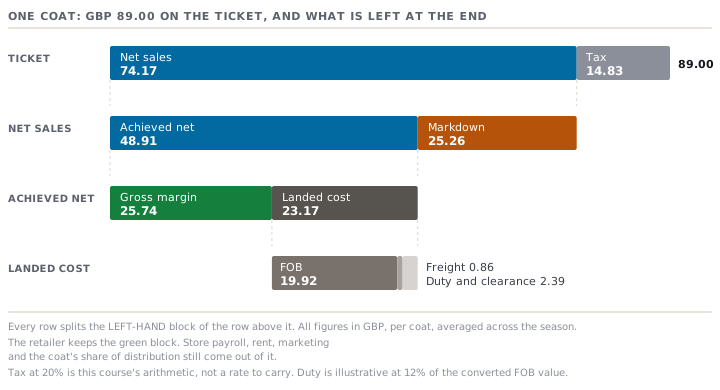
If all 14,000 had sold at full price, net sales would have been GBP 1,038,333. They were GBP 684,742. The difference is GBP 353,592, or 34.0% of the full-price value of the buy. That is what the season gave away in price. It is not a mistake yet. Some of it was always going to happen. Lesson 2 is about which part was not.
Three margins, and only one of them is news
Marchbank's outerwear season is judged on three numbers. A factory reader has probably only ever heard the first of them.
| Margin | What it is | |
|---|---|---|
| Intake | 68.8% | what the buy was signed off at, at full price |
| Planned achieved | 64.0% | intake, less the markdown the plan allowed for |
| Realised | 52.6% | what the season actually delivered |
The middle one is the one outsiders miss. Marchbank did not plan to sell every coat at GBP 89.00. The February plan assumed 8,680 coats at full price, 2,520 at twenty per cent off, 1,680 at forty and 1,120 at sixty. That is net sales of GBP 901,273 and a gross margin of GBP 576,893. Actual gross margin: GBP 360,362. So GBP 216,532 short, on a line whose intake margin was better than the range's target.
That gap is the whole of this course. Lesson 2 is where it went. Lesson 3 is the three lenses that would have shown it in February.
The same trick at range level: everybody on target, the range under
One line is easy to argue about. The season is not judged on one line. Here is a shape you will meet constantly.
Marchbank's autumn outerwear range is six lines with a blended intake target of 66.0%. The range Imogen plotted in November hit it. The range she actually bought in February did not. And not one line missed its own number.
| Line | Ticket | Landed | Intake | November plot | February buy |
|---|---|---|---|---|---|
| MK-8104 entry padded jacket | 39.00 | 17.88 | 45.0% | 4,000 | 11,000 |
| MK-8120 wrap coat | 89.00 | 23.17 | 68.8% | 9,000 | 14,000 |
| MK-8132 padded jacket | 69.00 | 18.90 | 67.1% | 7,500 | 6,800 |
| MK-8148 wool-mix shacket | 49.00 | 13.10 | 67.9% | 6,000 | 6,400 |
| MK-8160 longline puffer | 119.00 | 33.60 | 66.1% | 5,000 | 1,800 |
| MK-8176 trench | 99.00 | 27.20 | 67.0% | 3,500 | 1,800 |
| Blended intake margin | 66.2% | 64.5% |
Every line delivered exactly the intake margin it was signed off at. The MK-8104 entry jacket is supposed to be thin. It is the opening price point, priced to sit under a competitor's ticket, and 45.0% is its target, not its failure. What moved was the mix. A competitor cut its own entry jacket in January, so Imogen deepened hers from 4,000 to 11,000. That was a correct, defensible reaction. She paid for it by cutting the puffer and the trench, which are the two highest tickets in the range.
Here is the result. The February buy is worth GBP 2,375,167 at full retail. A blended intake margin of 64.5% against a 66.0% target is GBP 35,303 of margin gone before a single coat was sold. And there is no line to blame it on.
What a factory reader should take from this
Four things. They are the reason a retailer's decisions look strange from a cutting floor.
- A retailer's cost is not your FOB. It is your FOB, converted, plus freight, duty and clearance. On this coat that is 16.3% more than the number on the quotation. Everything the retailer says about margin is said on the larger figure.
- A retailer's price is not the ticket. Sales tax comes off first. The GBP 89.00 coat is a GBP 74.17 coat in every conversation that matters.
- A retailer's margin is a percentage of the selling price, not of your cost. Your 3.20 times markup and their 68.8% margin are the same event.
- The margin a buyer quotes is the beginning of a season, not the end of one. Intake is a promise. Realised is the result. On MK-8120 the distance between them was 16.2 percentage points and GBP 216,532. The buyer's own quotation was the least interesting number in the story.
Check yourselfA supplier offers a price cut worth GBP 1.00 a coat on the FOB. How much does the retailer's landed cost fall?Show the answer
More than GBP 1.00. The FOB converts at the season rate, so GBP 1.00 off the landed FOB is GBP 1.00. But duty is charged on value, so at the illustrative 12% used here the duty line falls by another GBP 0.12. The landed cost falls by about GBP 1.12. The same works in reverse: a price rise costs the retailer more than the rise. This is why a buyer chases FOB rather than freight, even when the freight number looks bigger.
Check yourselfA buyer tells you the intake margin on your style is 62%. What is your FOB as a share of the retail ticket, roughly?Show the answer
You cannot say, and that is the point. 62% is 62% of the net selling price after sales tax, and it is calculated on the landed cost, not on your FOB. Work backwards instead. Net selling price times 0.38 is the landed cost, and your FOB is that minus freight, duty and clearance. On a ticket of GBP 89.00 in a market taxing at 20%, an intake margin of 62% means a landed cost of GBP 28.18 and an FOB well under it. Any answer that starts from the ticket price is out by the tax and the landed lines together.
Prompt · Take one garment from FOB to what the business keeps
When you have a quotation and a retail price, and you want the whole chain in front of you with the two margins separated.
Act as a retail buyer's merchandiser building a margin sheet on one line. Facts: garment [DESCRIPTION], supplier [NAME], quoted [INCOTERM] at [CURRENCY AND PRICE] a unit at a quantity of [UNITS]. My season's currency rate is [RATE]. Freight, insurance and inland to my distribution centre: [AMOUNT] a unit, or tell me you have assumed it. Duty and clearance: [RATE OR AMOUNT]. Treat any rate I give as given data and do not invent one. Intended ticket price [AMOUNT], sales tax in my market [RATE], and any zero-rating that applies. Do the following. First, build the landed cost per unit line by line, and state which lines are assumptions. Second, convert the ticket price to a net selling price and show the tax that came off. Third, give me the intake margin as a percentage of net selling price AND the markup as a multiple of landed cost, and say in one sentence why a supplier and I will quote different numbers for the same fact. Fourth, ask me for my expected sell-through at full price and at each markdown step. If I do not have one, ask for last year's equivalent line instead of assuming. Fifth, with that ladder, calculate net sales, cost of goods, gross margin and the achieved margin percentage, and show the gap between intake and achieved in both points and money. Sixth, tell me the sell-through at full price this line needs to hit its intake margin less the markdown my plan allows, and state that number plainly. Do not give me a range where a number is possible. List every assumption at the end.
AI can make mistakes — check anything you act on.
Where this goes next
You now have the chain: FOB, landed cost, net selling price, intake margin, achieved margin. You have also seen that the two ends of it can be a long way apart, on a line that did nothing wrong.
Lesson 2 takes the GBP 216,532 apart. There are three ways a planned margin leaves a retailer. The largest one on this coat was set in a meeting in February, by a decision that any buyer in the country would have made.