Lessons · Lesson 2 of 3
The three ways the planned margin leaves
Take one season's margin shortfall apart into markdown, terminal stock and the cost of being wrong about quantity, and price a correct decision that produced a bad result.
Lesson 2 of 3 · 37 min
What has to be explained
A shop plans one profit on a garment and ends up with another. Money leaves in three places: price given away to shift stock, stock left over at the end, and the wrong number bought. The last one is the one worth staying awake for. Buy too many and you are left with objects everybody can count. Buy too few and there is nothing to count, so the garment looks like a triumph.
MK-8120 was signed off at an intake margin of 68.8% and a planned achieved margin of 64.0%. It delivered 52.6%. In money, gross margin was GBP 216,532 below the plan.
There are only three doors a retailer's planned margin can leave by. All three are open on this coat.
- Markdown. Price given away to move stock that would not move at full price.
- Terminal stock. Units still there when the selling window shuts.
- Being wrong about the quantity. In either direction. Only one of the two directions leaves evidence.
Take them in order. The third one is the whole story.
Door one: markdown, and why every unplanned pound of it is a pound of margin
If all 14,000 coats had sold at GBP 89.00, net sales would have been GBP 1,038,333. They were GBP 684,742. So GBP 353,592 of price was given away.
The plan already expected to give some away. Marchbank's February plan assumed net sales of GBP 901,273. That is GBP 137,060 of markdown built in from the start. Subtract:
- Markdown the plan allowed for: GBP 137,060
- Markdown the plan did not: GBP 216,532
That second figure is exactly the margin shortfall, and it is not a coincidence. The buy quantity did not change between plan and outcome, so the cost of goods did not change either. It is 14,000 coats at GBP 23.17 in both cases. When the cost side is fixed, every pound of unplanned markdown is a pound of lost gross margin, one for one. There is nothing else it can be.
There is a second cost inside a markdown that is easy to miss. Some of the customers who bought at twenty per cent off were going to buy anyway.
Marchbank read the promotion in week 14 against the two weeks either side of it. About 600 of the 1,850 coats sold at GBP 71.20 would have sold at GBP 89.00. Each of those cost GBP 14.83 in price already earned. That is GBP 8,898 handed to customers who had already decided. The other 1,250 are the coats the markdown actually bought.
That is not an argument against the markdown. It is an argument for knowing the number. The difference is between "the promotion sold 1,850 coats" and "the promotion sold 1,250 coats and cost GBP 8,898 in cannibalised full-price sales". Only one of those two sentences is a decision you can repeat.
Door two: terminal stock, and the fact that it is worth almost nothing
At the end of February, 1,900 coats were still in the business. That is terminal stock: units still on hand when the season's selling window has shut.
They cost GBP 23.17 each to land. They went to a jobber at GBP 4.00. Against cost that is GBP 19.17 a coat, and across 1,900 coats it is GBP 36,423 below what was paid for them.
Imogen had three exits and priced all of them.
| Option | Cash it produces | When | What can still go wrong |
|---|---|---|---|
| Clear to a jobber now | 7,600 | this month | the coat appears on a market stall beside a GBP 89.00 ticket in a Marchbank window |
| Carry to next autumn | 33,480 | in twelve months | assumes 700 of them sell at forty per cent off next season |
| Carry, on the pessimistic read | 13,230 | in twelve months | if only 200 sell at forty per cent off, and the rest still go to a jobber |
| Donate and write off | 0 | this month | none, and the write-off is already taken |
The carry numbers are after GBP 2,470 of storage and handling, at GBP 1.30 a coat over the twelve months.
Read that table the way a buyer has to. Carrying looks better than clearing on both reads, and Marchbank cleared anyway. The reason is not on the table. 1,900 carried coats are 1,900 units of next autumn's budget and next autumn's rail space. And next autumn has a new coat in it, with an intake margin of 68.8% and a full season to sell in. What the carried stock costs is not storage. It is whatever that space and that money would otherwise have earned. Lesson 3 is how to put a number on it.
Door three: the quantity, and the decision that any buyer would have made
Now the meeting that produced all of this. It was in February, it lasted about ten minutes, and everything said in it was true.
Denizkent had quoted FOB USD 26.50 at 9,000 coats. That was the quantity Marchbank's own history said the coat would sell. Then the mill came back with a fabric minimum. A dyed-to-order melton in one shade has a minimum of 30,000 metres, and at 2.20 metres a coat that is 13,636 coats. Nobody buys 13,636 of anything.
So Denizkent re-quoted at 14,000: FOB USD 24.90. That is USD 1.60 a coat, 6.0% off, and it was not a sales tactic. Above the fabric minimum the mill charges its list price rather than a short-lot surcharge, and the sewing line runs a fortnight without a changeover. The factory's costing was honest. Course 8.1 is where that costing is built. The offer was genuinely generous.
Look at what it does to the buyer's own numbers on the day.
| Buy 9,000 | Buy 14,000 | |
|---|---|---|
| FOB | USD 26.50 | USD 24.90 |
| Landed cost | GBP 24.60 | GBP 23.17 |
| Net selling price | GBP 74.17 | GBP 74.17 |
| Intake margin | 66.8% | 68.8% |
| Against a range target of 66.0% | just over | comfortably over |
Every buying director in the trade signs the 14,000 column. It is a better cost price, a better intake margin, a supplier being straight with you, and a range target you were struggling to hit.
Imogen signed it. Here is what the season did with it.
| Buy 9,000 | Buy 14,000 | |
|---|---|---|
| Sold at full price | 5,000 | 5,150 |
| Sold at twenty per cent off | 1,750 | 1,850 |
| Sold at forty per cent off | 1,400 | 2,300 |
| Sold at sixty per cent off | 800 | 2,800 |
| Cleared to a jobber | 50 | 1,900 |
| Net sales | GBP 560,900 | GBP 684,742 |
| Cost of goods | GBP 221,400 | GBP 324,380 |
| Gross margin | GBP 339,500 | GBP 360,362 |
| Achieved margin | 60.5% | 52.6% |
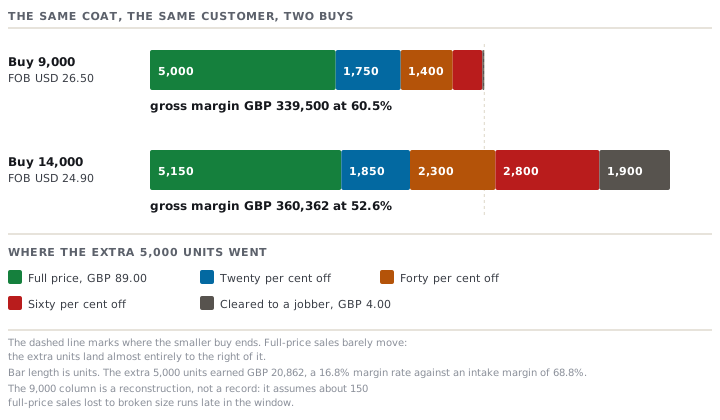
Read the bottom two rows against each other. They disagree, and the disagreement is the point of this whole course.
The bigger buy made more money: GBP 360,362 of gross margin against GBP 339,500. It also made it at 52.6% instead of 60.5%. A buyer who is judged on cash says the big buy won. A buyer who is judged on margin rate says it lost. Both are reading the same table correctly.
So look at the part that is genuinely new: the extra 5,000 coats on their own.
| Extra net sales | GBP 123,842 |
| Extra cost of goods | GBP 102,980 |
| Extra gross margin | GBP 20,862 |
| Margin rate on those units | 16.8% |
| Less distribution and handling, at GBP 1.15 a unit | GBP 5,750 |
| Less markdown handling, on 3,000 extra units re-ticketed at GBP 0.34 | GBP 1,020 |
| Less clearance baling and collection, at GBP 0.20 a unit | GBP 370 |
| Contribution from the extra 5,000 coats | GBP 13,722 |
The extra 5,000 coats were bought at an intake margin of 68.8% and delivered 16.8%. After the costs that follow a unit around a business, they returned GBP 13,722 on GBP 102,980 of the company's money, tied up for most of a season.
Nothing in that sentence is a criticism of Denizkent's price. The price was excellent. The units were the problem, and the units came attached to the price.
The other direction, and why nobody ever sees it
The 14,000 coats were paid for out of a budget that was already full. Imogen found the money by cutting the longline puffer from 5,000 units to 1,800, and the trench from 3,500 to 1,800.
The puffer sold out in week 14 of a 26-week season, at full price. It had averaged about 128 units a week across the chain. Suppose it would have sold at only half that rate for another six weeks. That is 386 coats at a margin of GBP 65.57 each, or GBP 25,310 of gross margin the department did not make.
That figure is a lower bound and an estimate, and it is deliberately a cautious one. It will never be as convincing as the 1,900 coats in a warehouse. That is the asymmetry this door hides:
- Buying too many leaves objects. They are counted weekly, they take up space, they have a value in a system, and everybody in the building can see them.
- Buying too few leaves nothing at all. An empty peg is not a record. The customer who came in for a puffer in week 18 and left without one appears in no report, and the line looks like a triumph: sold out, full price, no markdown.
A department that only ever measures the visible failure will drift, year on year, towards buying too much of everything. That drift is not a personal failing. It is what happens when one of two errors is countable and the other is not.
Check yourselfA supplier offers 8% off for double the quantity. What is the first thing you check?Show the answer
Not the margin. Check the sell-through: at your normal rate of sale, how many weeks does double the quantity take to clear, and does that fit inside the selling window? Eight per cent off improves the intake margin by roughly two and a half points on a typical structure. One extra week of clearance at forty per cent off destroys many times that. The offer is about quantity; the answer is about time. Only after that do you look at what the extra units cost in cash and space, which is lesson 3.
Check yourselfYour buyer took a bigger quantity, made more gross margin in cash, and is unhappy. Why?Show the answer
Because gross margin in cash is not the only thing being measured. The margin rate fell from 60.5% to 52.6%. Every other cost in a retailer is planned as a percentage of sales at a planned margin rate: payroll, rent, distribution, marketing. So a rate miss lands everywhere at once. And the cash that bought the extra units was not free. It came out of a fixed budget, and it came out of other lines. The gross margin says the buy was worth doing. It does not say it was the best thing that money could have done, and that is a different question with a different answer.
Prompt · Test a price break before you take it
The hour a supplier offers a better price for a bigger quantity and the intake margin improves on the spot.
Act as a sceptical retail merchandiser stress-testing a quantity offer. My supplier has offered [PRICE] a unit at [HIGHER QUANTITY] instead of [PRICE] at [LOWER QUANTITY]. My landed-cost adders are [FREIGHT] a unit, and duty and clearance at [RATE OR AMOUNT]. Ticket price [AMOUNT], sales tax [RATE]. My own history for this line or its nearest equivalent: [UNITS SOLD LAST TIME, SPLIT BY FULL PRICE AND EACH MARKDOWN STEP], selling window [WEEKS], and the week the line sold out or was cleared. Do the following. First, work out the landed cost and intake margin at both quantities, and show the improvement in points. Second, and this is the part I actually want: build a disposal ladder for BOTH quantities using my history, holding full-price demand roughly constant, because more stock does not create more customers. Say explicitly what you assumed about full-price sales at the higher quantity. Third, give me net sales, cost of goods, gross margin and achieved margin for both. Fourth, isolate the EXTRA units on their own: their revenue, their cost, their gross margin and their margin rate. Then subtract the costs that follow a unit around a business — distribution, markdown handling, clearance handling — at rates I give you or that you name as assumptions. Fifth, tell me the average stock at cost each option holds across the season, and the gross margin return on inventory investment for each. Sixth, state in one sentence whether the extra units beat my department's target return. If not, say what the money would have to earn elsewhere for the offer to be worth refusing. Never conclude from the intake margin alone.
AI can make mistakes — check anything you act on.
What lesson 2 leaves you with
Three doors, and one of them dominates. On MK-8120 the markdown was the visible loss and the quantity was the cause of it: an excellent price attached to 5,000 coats the customer had not asked for.
But the case is not yet closed, and it would be dishonest to close it here. On the only number examined so far, gross margin in cash, the big buy still won. Lesson 3 is the three lenses that settle it, and the reason a retailer refuses an order that a cost sheet says is a good one.