Lessons · Lesson 3 of 3
What the last dresses are worth
Value a pile of terminal stock by what each part of it can actually be sold for, price what holding it costs a week, and rebuild the season's margin variance once it is gone.
Lesson 3 of 3 · 38 min
3,060 dresses, and a question nobody enjoys
A pile of unsold garments at the end of a season looks like one thing. It is usually three or four. There are the good garments there were simply too many of. There are the ones left only in the smallest and largest sizes, and the colour nobody wanted. Each is got rid of in a different place at a very different price. This lesson sorts the pile before it prices it.
The season closed at the end of week 26 with 3,060 units of CF-3140 still owned. They cost GBP 14.75 each to land, so there is GBP 45,135 at cost standing in a warehouse in a dress that will not be in next spring's range.
This is terminal stock: units still on hand when the selling window has shut. Almost everything written about it is written as a lament. It is a valuation problem, and it has an answer.
Two things this lesson does not do. It does not explain why there is terminal stock — the split between having bought too many and having sold too few is course 17.1, and on this line it is mostly the five weeks in lesson 1. And it does not decide the buy; by week 26 that argument is fourteen months old. This lesson takes the pile as given and asks the only two questions left: what will these dresses actually fetch, and what does it cost to keep them while somebody decides?
The mistake that comes first: treating the pile as one thing
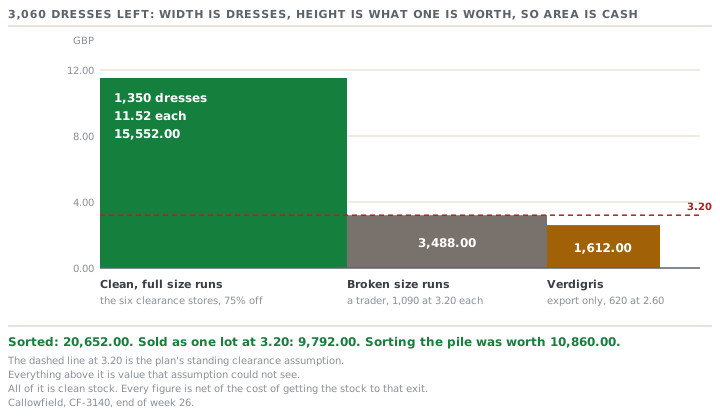
Callowfield's plan valued terminal stock at a standing assumption of GBP 3.20 a unit net — what its clearance trader, Oakhanger Trading, pays for mixed end-of-season womenswear, after the cost of baling and loading it. Every plan in the department uses that figure, and it is a reasonable figure for a pile you have not looked at.
Thea looked at it. The 3,060 dresses are three completely different assets.
| Dresses | Why they are here | |
|---|---|---|
| Clean stock, full size runs, the three colourways that sold | 1,350 | there were simply too many; nothing is wrong with them |
| Broken size runs | 1,090 | sizes 8 and 18 only, spread thin across 96 stores |
| Verdigris, the colourway that failed | 620 | full size runs, in a shade the customer refused from week 2 |
Those three need three different exits, and the difference between sorting them and selling them as one lot is the largest single number in this lesson.
Clean full-run stock can be sold at retail, because it is still a dress somebody wants at a price. Callowfield has six clearance stores and has moved dress stock through them at 75% off in each of the last three springs.
Broken size runs cannot. A clearance store cannot merchandise a rail of size 8 and size 18, and it will not take them; the units are real and the sellable units are not. This is the point at which a stock number and a saleable stock number stop being the same number.
The failed colourway is a full size run and still cannot go to a clearance store, because it failed on colour and a lower price does not fix a colour. It also carries a risk the other two do not: 620 dresses in one distinctive shade are recognisable, and Callowfield does not want them on a market stall two miles from a store still selling the same dress in Inkwell.
The four exits, priced
| Dresses | Gross a dress | Costs to get there | Net a dress | Cash | |
|---|---|---|---|---|---|
| Clean, to the six clearance stores at 75% off | 1,350 | 12.29 | 0.46 transfer and re-ticketing, 0.31 outlet handling | 11.52 | 15,552.00 |
| Broken runs, to Oakhanger | 1,090 | 3.38 | 0.18 baling and loading | 3.20 | 3,488.00 |
| Verdigris, to Oakhanger on an export-only condition | 620 | 2.78 | 0.18 baling and loading | 2.60 | 1,612.00 |
| Total | 3,060 | 20,652.00 | |||
| The same 3,060 sold as one lot at the standing assumption | 3,060 | 3.38 | 0.18 | 3.20 | 9,792.00 |
Sorting the pile is worth GBP 10,860.00, and almost all of it is the 1,350 clean dresses, which are worth three and a half times what the standing assumption says.
Two things in that table are decisions rather than arithmetic, and both should be said out loud.
The clearance price is below the last in-season price on purpose. The dress finished the season at 70% off. Offering it at 75% off in a clearance store is a step down, not a step up, and a clearance channel that asks more than the main estate was asking last month does not sell anything. The general rule is worth carrying: an exit price has to be lower than the last price the customer saw, whatever the arithmetic would prefer.
The export-only condition costs GBP 0.60 a dress, which on 620 dresses is GBP 372.00. That is what Callowfield paid to keep the failed colourway out of the domestic market. It is a brand decision, and the right way to have it is with the price on it: GBP 372.00 is cheap, and knowing it is GBP 372.00 is what makes it possible to say so.
What holding costs, per dress per week
The other half of the question is time. A better exit that takes twelve weeks to arrange is only better if it beats the exit you have by more than twelve weeks of holding. So put a number on a week.
| GBP a dress a week | Where it comes from | |
|---|---|---|
| Warehouse storage | 0.02 | the distribution centre charges GBP 0.09 a unit a month |
| The cost of the money | 0.02 | 8.0% a year on the GBP 11.52 not yet collected |
| Shrinkage, handling and re-counting | 0.01 | Callowfield's own measured rate on held stock |
| Total | 0.05 |
Read the middle line carefully, because it is the one people get wrong. The money tied up in terminal stock is not what you paid for it. It is what you have turned down. The GBP 14.75 is spent and gone; the choice in front of you is between GBP 11.52 today and something else later, so the capital at stake is GBP 11.52. Costing held stock at its original cost overstates the cost of waiting and pushes a department into bad clearances.
At GBP 0.05 a dress a week, waiting eight weeks for space in a clearance store costs GBP 0.40 a dress against a gain of GBP 8.32 over the trader's price. The wait is obviously right, and it is worth noticing that the cash cost of holding is small. It is not the reason to move quickly.
The reason to move quickly, priced
The reason is not storage. It is that the asset itself decays.
Callowfield's own experience with carried dress stock is that a spring dress held to the following spring realises about 65% of what it would have realised as clearance stock this year. The shape has moved on, the shade is a season old, and it is competing for a clearance rail with newer, better stock.
| Now | Carried twelve months | |
|---|---|---|
| Net a dress | 11.52 | 7.49 |
| Less 52 weeks of holding, at GBP 0.05 | — | 2.60 |
| Net a dress | 11.52 | 4.89 |
| Cash on 1,350 dresses | 15,552.00 | 6,601.50 |
| When | this month | in twelve months |
Carrying loses GBP 8,950.50 on the clean stock, and it takes a year to do it. That is before the rail space and the clearance-store slot it will occupy next spring, which the table does not try to price. The general test is one line, and it works on any pile:
Hold only if the value you expect later, less the holding cost over the wait, is worth more than the value you can get today.
On this pile it is not close in either direction: wait eight weeks for a clearance-store slot, yes; wait a year, no.
The season, reconciled
Now put the whole thing back together. Three columns: the plan the range meeting signed off, what the season actually did, and what the plan's own dates would have produced against the season's real behaviour. Every column is 18,000 dresses and a cost of goods of GBP 265,500. Every column also values terminal stock at the standing GBP 3.20. That is how a variance is reported, because it is the number the plan used.
| Sold at | Plan | The plan's dates, re-run | What happened |
|---|---|---|---|
| Full price, 49.17 | 5,400 | 5,260 | 6,890 |
| 20% off, 39.33 | 3,300 | 3,380 | 0 |
| 25% off in the event, 36.88 | 0 | 0 | 520 |
| 30% off, 34.42 | 2,900 | 2,850 | 2,850 |
| 50% off, 24.58 | 2,400 | 2,370 | 2,370 |
| 70% off, 14.75 | 2,200 | 2,310 | 2,310 |
| Cleared, 3.20 | 1,800 | 1,830 | 3,060 |
| Net sales | 592,327.00 | 587,849.70 | 558,175.00 |
| Gross margin | 326,827.00 | 322,349.70 | 292,675.00 |
| Achieved margin | 55.2% | 54.8% | 52.4% |
| Full-price sell-through at week 13 | 30.0% | 29.2% | 38.3% |
| Sell-through before clearance, week 26 | 90.0% | 89.8% | 83.0% |
The season sold 1,490 more dresses at full price than the plan asked for and finished GBP 34,152.00 below the plan's gross margin. Full-price sell-through beat the plan by more than eight points. Everything a buyer is congratulated on went right.
Here is where the money went, band by band. When the buy is fixed, the cost of goods is identical in every column. So the entire margin variance is units migrating between price bands and nothing else. It reconciles exactly, and you can put a name on every pound.
| Band | Units against plan | Net a dress | Effect on gross margin |
|---|---|---|---|
| Full price | +1,490 | 49.17 | +73,263.30 |
| 20% off | −3,300 | 39.33 | −129,789.00 |
| 25% off | +520 | 36.88 | +19,177.60 |
| 30% off | −50 | 34.42 | −1,721.00 |
| 50% off | −30 | 24.58 | −737.40 |
| 70% off | +110 | 14.75 | +1,622.50 |
| Cleared | +1,260 | 3.20 | +4,032.00 |
| Total | −34,152.00 |
One row is the whole story. The 20% band never happened, and 3,300 dresses that the plan had selling at GBP 39.33 sold somewhere else — mostly at full price, which paid GBP 49.17, and mostly, later, at clearance, which paid GBP 3.20.
Split that variance into the part that was a decision and the part that was the market, by running the middle column against each end.
| Gross margin | Against the plan | |
|---|---|---|
| Plan | 326,827.00 | — |
| The plan's dates, re-run on the season's real behaviour | 322,349.70 | −4,477.30, the market |
| What happened | 292,675.00 | −29,674.70, the decision |
| Total | −34,152.00 |
GBP 4,477.30 of the miss was the season and GBP 29,674.70 was the five weeks. That is a ratio worth remembering when a department explains a margin miss by talking about the weather.
And then the terminal stock was actually sold
The bridge above values all three columns' clearance at GBP 3.20, because that is the plan's own assumption and a variance has to be reported against something. Then Thea sorted the pile and got GBP 20,652.00 instead of GBP 9,792.00 — and the numbers change, in the direction nobody expects.
The plan's 1,800 terminal dresses and the re-run column's 1,830 contain the same 1,090 broken runs and the same 620 Verdigris. The sizes that do not sell do not sell at any price, and the colourway failed in week 2. What the five weeks added to the pile was clean stock — dresses worth GBP 11.52, not GBP 3.20.
| Clean dresses left | Terminal cash | Gross margin | Achieved margin | |
|---|---|---|---|---|
| Plan | 90 | 6,136.80 | 327,203.80 | 55.2% |
| The plan's dates, re-run | 120 | 6,482.40 | 322,976.10 | 54.9% |
| What happened | 1,350 | 20,652.00 | 303,535.00 | 53.3% |
The miss against plan is GBP 23,668.80, of which GBP 19,441.10 is the decision and GBP 4,227.70 is the market.
So the true cost of the five weeks was not GBP 29,674.70. It was GBP 19,441.10 — a third less — because a good exit recovered part of it. That is not a technicality, it is the most practically useful thing in this lesson:
The cost of a markdown decision is not known until the units it stranded have been sold. A variance reported in week 27 on a standing clearance assumption overstates the damage. The overstatement is whatever the terminal exit is going to recover. A department that reports it that way will over-correct next season — buying too shallow, marking down too early, and giving away margin to avoid a number that was never that big.
What you can do now
- Set an exit curve at the buy, with terminal stock and its clearance value written into the plan, and read cover against that curve rather than against a full-price rate.
- Price a markdown as a trade, not as a loss: what you give away on the units that would have sold anyway, against what you collect on the units that would otherwise have ended at clearance.
- Find the response multiple at which a step breaks even, and state the assumption it rests on — where a deferred unit would otherwise have landed — before you state the answer.
- Tell a promotion from a markdown in money: cost per unit actually removed, the effect on forward cover, and whether the stock is revalued.
- Sort terminal stock before you sell it. Clean stock, broken runs and a failed colourway are three assets with three exits, and the difference on this line was GBP 10,860.00.
- Cost a week of holding, on the value you have turned down rather than on what you paid, and hold only when the later value less the wait beats the value today.
- Bridge the season band by band, split the variance into the decision and the market, and restate it once the last units have really gone.
And one thing that is not a calculation. Every markdown on CF-3140 was signed off correctly, individually justified, and taken by people who could each defend their reasoning in the room on the day. The season still finished below plan, because a markdown decision is not judged on the week it is taken — it is judged eighteen weeks later, by what the stock it left behind turned out to be worth.
Check yourselfYou have 4,000 units of terminal stock. A trader offers GBP 2.80 a unit now; an outlet slot in fourteen weeks would net GBP 9.10. Holding costs GBP 0.06 a unit a week. Which?Show the answer
The outlet, and not narrowly. Fourteen weeks of holding is GBP 0.84 a unit against a gain of GBP 6.30, so waiting is worth GBP 5.46 a unit, or GBP 21,840 across the pile. The two things that would change the answer are neither of them on this arithmetic. The first is whether the outlet will really take all 4,000, because a broken size run will not go. The second is whether the stock is decaying faster than the holding cost, which on a seasonal garment crossing into a new season it usually is. Check what the outlet will accept before you calculate anything, because the units it refuses are worth GBP 2.80 whatever the sum says.
Check yourselfYour line beat its full-price sell-through plan and missed its achieved margin. How is that possible?Show the answer
Because full-price sell-through counts units and achieved margin counts money, and the units that did not sell at full price have to go somewhere. On CF-3140 the line sold 1,490 more dresses at full price than the plan, and 3,300 dresses that were planned to sell at 20% off ended up at clearance at GBP 3.20 instead. A full-price sell-through figure on its own tells you nothing about the season, because it says what happened to the good end of the ladder and nothing at all about the bad end. Always read it beside the sell-through before clearance, which on this line was 83.0% against a plan of 90.0% — and it is that second number the margin follows.
Prompt · Value what is left, and cost a week of keeping it
The week after a season closes, with a pile in a warehouse and four people with opinions about it.
Act as a retail planner valuing terminal stock, not lamenting it. I have [UNITS] of [CODE AND DESCRIPTION] left at the end of a [WEEKS]-week season. Ticket was [AMOUNT], sales tax [RATE], landed cost [AMOUNT] a unit, and the last in-season price was [DEPTH] off. Do the following. First, before any valuation, ask me to split the pile into clean full-size-run stock, broken size runs, and any colour or print that failed — and tell me why the three cannot share an exit. Second, for each part, list the exits genuinely available to me and ask me for the price each one pays: a clearance trader, my own outlet or clearance stores, an online clearance event, an export-only sale, a staff sale, donation. Do not invent a price for any of them. Third, subtract the cost of getting the stock to each exit — transfer freight, re-ticketing, baling and loading, handling — at rates I give you or that you name as assumptions, and give me net per unit and total cash for each part. Fourth, check one thing explicitly and tell me if it fails: no exit price may be higher than the last price my own customer saw. Fifth, build the cost of holding one unit for one week from storage, the cost of money, and shrinkage and handling — and calculate the cost of money on the value I am turning down, not on what I paid, and say in one line why. Sixth, for any exit that needs me to wait, tell me the break-even wait in weeks. Seventh, if carrying to the same season next year is on the table, ask me what my own carried stock has historically realised as a percentage of this year's clearance value, and refuse to model it if I do not know. Finally, give me the total the sorted pile is worth against the total it would fetch sold as one lot, and name the difference in money.
AI can make mistakes — check anything you act on.