Lessons · Lesson 1 of 3
Five weeks of holding the ticket
Price a markdown taken early and shallow against the same markdown taken late and deep, on the same dresses, and find the response rate at which the cut pays for itself.
Lesson 1 of 3 · 42 min
The situation
Cutting the price of something that has not sold sounds like an admission of failure. In a clothes shop it is nothing of the kind. On most fashion ranges the cuts are planned before the first garment goes on sale. This lesson treats a price cut as a trade rather than a defeat. You give money away on the people who were going to buy anyway. You collect it back from the people who buy only because it got cheaper.
Week 8 of a 26-week spring season, the dresses office at Callowfield in Kendal. Callowfield is a British womenswear retailer: 96 stores, a website, six clearance stores, and a customer who buys two or three dresses a year and expects to be able to wear them to a wedding.
Thea Quennell plans dresses. Rafe Onslow buys them. In front of them both is CF-3140, a viscose midi dress in four colourways, made by Mekhala Apparel in Erode on purchase order CLF-7311, ticketed at GBP 59.00 and bought 18,000 units deep across the chain.
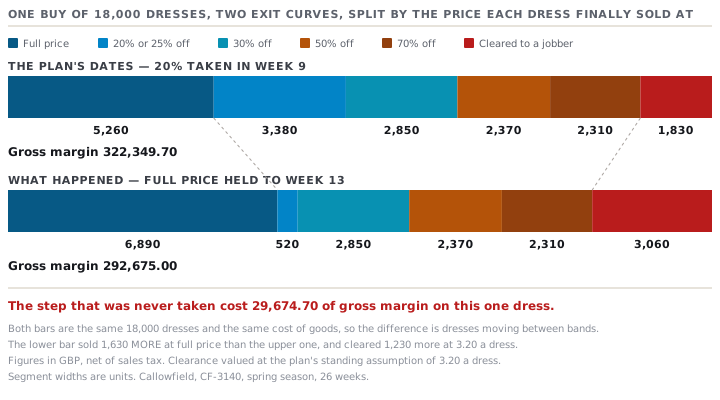
The plan said the price comes down in week 9. It did not come down in week 9. It came down in week 14, and every one of the reasons for waiting was a good one.
At the end of the season the dress had sold 1,490 more units at full price than the plan asked for and finished GBP 34,152 below the plan's gross margin. That sentence is the whole course, and this lesson is where it starts.
The basis, and one thing this course does not teach
Every figure here is at retail and net of sales tax, unless it says "at cost". The ticket is GBP 59.00. Sales tax at 20% takes GBP 9.83, so the dress is a GBP 49.17 dress in every calculation below. It lands at GBP 14.75 at cost. That is an intake margin of 70.0%, meaning the margin the opening price was set to earn before any discount. It is a markup of 3.33 times.
Here is the one thing this course does not teach. How a landed cost is built up from a factory's FOB price (free on board: the price with the goods loaded at the port of export, before freight, insurance and duty), and why intake margin and achieved margin — what the season actually earned in the end — are two different numbers, is course 16.1. Here both arrive as given data.
What is not given, and what this course is about, is everything that happens to that GBP 49.17 between week 1 and the day the last dress leaves the building.
| Off the ticket | Ticket | Net a dress | Margin a dress |
|---|---|---|---|
| Full price | 59.00 | 49.17 | 34.42 |
| 20% | 47.20 | 39.33 | 24.58 |
| 25% | 44.25 | 36.88 | 22.13 |
| 30% | 41.30 | 34.42 | 19.67 |
| 50% | 29.50 | 24.58 | 9.83 |
| 70% | 17.70 | 14.75 | 0.00 |
| Cleared to a jobber | — | 3.20 | −11.55 |
Read the last two rows before anything else, because they are the two facts the rest of the course argues about.
At 70% off this dress makes exactly nothing. GBP 59.00 less seventy per cent is GBP 17.70; take the sales tax off and it is GBP 14.75, which is what the dress cost to land. Every unit sold at 70% off returns its own cost and not one penny of margin. That is not a rule of thumb. It is arithmetic that falls out of a 70.0% intake margin and a 20% tax rate. It is worth working out for every line you plan, because it tells you the depth at which selling stops being trading and becomes disposal.
Below that, a sale costs money. A dress cleared to a jobber at GBP 3.20 destroys GBP 11.55 of the company's money that a dress sold at 70% off would merely have failed to earn.
The instrument: an exit curve, set before the season starts
A markdown is not a failure that happens to a plan. On a fashion line it is the mechanism that makes the plan arithmetically possible, and a planner writes it down at the same meeting the quantity is signed off. Callowfield calls it the exit curve: the depths, and the weeks they come in.
| Weeks | Off the ticket | Planned units | Planned net sales |
|---|---|---|---|
| 1 to 8 | full price | 5,400 | 265,518 |
| 9 to 13 | 20% | 3,300 | 129,789 |
| 14 to 18 | 30% | 2,900 | 99,818 |
| 19 to 22 | 50% | 2,400 | 58,992 |
| 23 to 26 | 70% | 2,200 | 32,450 |
| End of season | cleared | 1,800 | 5,760 |
| Total | 18,000 | 592,327 |
Against a cost of goods of 18,000 at GBP 14.75, or GBP 265,500, that plan is a gross margin of GBP 326,827 and an achieved margin of 55.2%. That is fifteen points below the intake margin, and the fifteen points are the exit curve. Nobody at Callowfield thought that was a bad plan. It has 1,800 dresses in a clearance line, at GBP 3.20 each, written down before the season had started, because the planner did the cover arithmetic and knew they would be there.
Week 8: three ways to read the same stock
The trading sheet in front of Thea in week 8 said the dress had sold 5,260 units and had 12,740 left.
The number that turns stock into a decision is cover: how many weeks the stock you hold will last, at the rate you expect to sell it. You get it by dividing the stock you hold by the units you expect to sell in a week. Everything then depends on which rate you use. Here is that same stock, read three ways, all three correct.
| Reading | Rate used | Cover | Against |
|---|---|---|---|
| On the last four weeks' rate | 2,210 in four weeks, 552.5 a week | 23.1 weeks | 18 weeks left |
| On the full-price forecast for the weeks ahead | 4,135 over 18 weeks, 230 a week | 55.4 weeks | 18 weeks left |
| On the exit curve, at the planned depths | 10,910 over 18 weeks, 606 a week | 21.0 weeks | 18 weeks left |
Three numbers, three arguments, and the meeting turns on which one you quote.
The first reading flatters, and it is the one most often quoted, because it uses the rate the line has just achieved. But the rate has been falling every week since week 2, so measuring cover against it assumes the decline stops today. Cover is a forward number by definition — closing stock divided by the sales you expect in the weeks ahead — and a trailing rate is not a forecast, it is a memory.
The second reading is the honest full-price answer, and it is brutal. At the price on the ticket, this stock is fifty-five weeks of trade and there are eighteen weeks of season. That is not a line that needs watching. It is a line that has already decided how it ends.
The third reading is the plan's own answer, and it is the useful one. At the planned depths the dress clears 10,910 more units in eighteen weeks, which is 21.0 weeks of cover against 18 weeks left. So the plan already knew it would finish with about 1,800 dresses and had priced them. The exit curve is what turns a fifty-five-week stock position into a season that ends.
The week 9 meeting, and the five weeks
Thea put the 20% step to the buying meeting in week 9. It was not taken, and the minutes record three reasons.
- The dress was ahead of its comparison. CF-3140 was running 6% ahead of last spring's equivalent midi on units. Marking down a line that is beating its comparison feels, correctly, like an odd thing to do.
- A dresses event was already booked for week 10. Suki Nandra's marketing plan had a four-day chain-wide dress promotion in the diary. Marking the ticket down the week before an event both wastes the event and confuses the customer.
- Week 11 had a bank holiday and a forecast of warm weather. Dresses trade on weather. Everybody in the room had seen a fortnight of sun rescue a spring dress.
All three were true. The event ran, the weather came, and week 11 was the best week the dress had had since week 3. The decision to hold looked right. By week 13 the 30% step was one week away, so taking 20% for a single week and 30% the next was rejected as an expensive way to confuse a customer: two rounds of re-ticketing across 96 stores, for seven days of trade.
Nobody made a mistake. The ticket held for five weeks, and here is the bill.
What the five weeks cost
Callowfield knows what a price cut does to its own dresses, because it measured. Last spring it took fourteen dress lines through a full exit curve and recorded, for each depth, the multiple of the full-price rate of sale that the first four weeks after the cut produced.
| Off the ticket | Rate of sale, as a multiple of the full-price rate |
|---|---|
| 20% | 1.7 |
| 30% | 2.3 |
| 50% | 4.2 |
| 70% | 6.8 |
This is Callowfield's number, on Callowfield's dresses, in Callowfield's stores. It is not an industry benchmark and it will not be yours. Measuring it is a week's work with last season's data, and it is the single most useful table a dress planner can own. Without it, every markdown argument is two people asserting things at each other.
Weeks 9 to 13 sold 1,990 dresses at full price. At 20% off, the same five weeks would have sold 3,380 — the same base demand, multiplied by 1.7. Now price the difference.
| Dresses that would have sold at full price anyway | 1,990 |
| Given away on each of them, GBP 49.17 less GBP 39.33 | 9.84 |
| Cost of the cut | 19,581.60 |
| Extra dresses the cut would have moved | 1,390 |
| What each of those actually fetched instead, at the end of the season | 3.20 |
| Gained on each of them, GBP 39.33 less GBP 3.20 | 36.13 |
| Value of the cut | 50,220.70 |
| Re-ticketing 12,740 dresses across 96 stores, at GBP 0.21 | 2,675.40 |
| Net value of taking the step on time | 27,963.70 |
Five weeks of holding the ticket cost GBP 27,963.70 on one dress.
Why the arithmetic is counter-intuitive, in one line
Look at what the cut is trading. It gives away GBP 9.84 on a dress that was going to sell anyway, and it collects GBP 36.13 on a dress that was otherwise going to a jobber. It is trading ten pounds for thirty-six. It can afford to subsidise a lot of customers who had already decided.
That ratio is where the break-even lives, and it is worth stating as a rule rather than as a result. The cut pays for itself when
- extra units × (new net price − what the unit would otherwise have fetched) is greater than
- substituted units × (old net price − new net price)
Rearranged, the week 9 cut needed 542 extra dresses to break even, on top of the 1,990 it was always going to sell — a rate-of-sale multiple of 1.27. Callowfield's own table said the cut would deliver 1.7.
The number the whole thing turns on, and nobody writes it down
"What the unit would otherwise have fetched" is doing all the work in that formula, and it is the one input nobody has. Here is the same break-even calculated four ways, changing nothing except the assumption about where a deferred dress eventually lands.
| If a dress not sold in weeks 9 to 13 eventually goes at | It is worth | Extra dresses needed to break even | Required multiple |
|---|---|---|---|
| A jobber, GBP 3.20 | 3.20 | 542 | 1.27 |
| 70% off | 14.75 | 797 | 1.40 |
| 50% off | 24.58 | 1,328 | 1.67 |
| 30% off | 34.42 | 3,988 | 3.00 |
Read the bottom row. If the dresses you defer would all have sold at 30% off later in the season, the week 9 cut needs to treble the rate of sale to be worth taking, and no markdown of 20% has ever trebled anything. If they end at a jobber, it needs 27%.
So the argument about when to mark down is not really an argument about the markdown at all. It is an argument about how much stock the season will strand. Whoever in the meeting has the better answer to that question is right about the price. On CF-3140 the answer was on the cover table in week 8 and nobody read the third line of it.
What lesson 1 leaves you with
The week 9 step was worth GBP 27,963.70 and was not taken, for three reasons that were each individually correct. One of those three reasons was that a promotion was already booked for the following week — and a promotion, everybody in the room assumed, would do the same job.
It did not, and lesson 2 is the arithmetic of why. A promotion and a markdown both give price away. Only one of them changes the stock position, and the difference is not a matter of vocabulary.
Check yourselfYour line is at 45.0% intake margin on a ticket of GBP 40.00 in a market taxing clothing at 20%. At what discount does a sale stop earning anything?Show the answer
Net selling price is GBP 40.00 divided by 1.2, which is GBP 33.33, and at a 45.0% intake margin the landed cost is 55% of that, or GBP 18.33. The sale earns nothing when the net price falls to GBP 18.33, which is a ticket of GBP 22.00 — a discount of 45%. Notice that the depth at which a sale stops earning is exactly the intake margin percentage. That is not a coincidence, it is the same identity read backwards, and it means a thin opening-price-point line runs out of margin at a depth where a 70%-margin line is still trading. Work it out once per line and write it on the exit curve.
Check yourselfA buyer says the line cannot be marked down because it is ahead of last year. What do you ask for?Show the answer
The cover, on the forward forecast, against the weeks left. Being ahead of last year is a statement about the rate of sale and says nothing about the stock. The two are only the same question if the quantity bought was the same as last year's — which on a line that was deepened it never is. A line can be 6% ahead of its comparison and hold 55 weeks of cover in an 18-week window at the same time, which is precisely the position CF-3140 was in when the room agreed it was trading well.
Prompt · Price four more weeks of holding the ticket
The meeting where a markdown step is due and somebody wants to wait, and nobody in the room has a number.
Act as a retail planner costing a deferral, not arguing about one. My line: [CODE AND DESCRIPTION], ticket [AMOUNT], sales tax in my market [RATE], landed cost [AMOUNT] a unit, bought [UNITS], season [WEEKS] long, currently week [NUMBER]. Sold to date [UNITS], split by price step. My planned exit curve is [DEPTHS AND THE WEEKS THEY COME IN]. My own measured rate-of-sale multiple at each depth is [TABLE], or tell me plainly that without it every number below is a guess and ask me for last season's equivalent line instead of inventing one. The proposal on the table is to defer the [DEPTH] step by [WEEKS]. Do the following. First, convert the ticket to a net selling price and give me the margin per unit at every depth on my curve, and state the depth at which a sale earns nothing at all. Second, give me forward cover three ways — on the trailing four-week rate, on the full-price forecast for the weeks left, and on the exit curve at my planned depths — and say which one answers the question 'will this clear'. Third, price the deferral: units that would have sold at full price anyway multiplied by the price given away, against extra units multiplied by what those units will otherwise eventually fetch. Ask me what a deferred unit ends up fetching and do not assume it. Fourth, add the re-ticketing labour at [AMOUNT] a unit across [STORES] doors, on the correct unit count. Fifth, give me the rate-of-sale multiple at which the step exactly breaks even, and repeat that break-even for four different assumptions about where a deferred unit lands: clearance, the deepest planned step, the middle step and the shallowest. Sixth, write me two sentences I can say in the meeting: one naming the number, one naming the assumption it rests on. Never present a single break-even figure without the assumption attached to it.
AI can make mistakes — check anything you act on.