Lessons · Lesson 2 of 3
A metre is worth what walks past it
Split the frontage between categories using margin, rate of sale and the traffic each zone really gets, and test a neighbour pairing against basket data instead of instinct.
Lesson 2 of 3 · 35 min
Seven categories, one hundred and forty-eight metres
Shelf space in a shop is fixed. To give one kind of garment more of it you have to take it from another. There is no version of that decision in which everybody gains. Here the trade is made for a whole shop, across seven kinds of goods. It uses what each one earns, how fast it sells, and how many people walk past it.
Lesson 1 measured the shop. This lesson spends it.
Here is Sallowgate as it stands: seven categories, the frontage each holds, the zone it stands in, and what it returned over the last 52 weeks. Gross margin is what is left of the selling price after the cost of the goods.
| Category | Metres | Zone | Sales GBP | Gross margin % | Gross margin GBP | Units |
|---|---|---|---|---|---|---|
| Shirts | 30.0 | B | 286,000 | 58% | 165,880 | 8,670 |
| Tailoring | 26.0 | C | 242,000 | 54% | 130,680 | 1,560 |
| Knitwear | 22.0 | B | 178,000 | 56% | 99,680 | 3,865 |
| Casual tops | 24.0 | A | 151,000 | 55% | 83,050 | 7,950 |
| Denim | 18.0 | A | 132,000 | 49% | 64,680 | 2,930 |
| Outerwear | 14.0 | A | 164,000 | 52% | 85,280 | 1,520 |
| Accessories | 14.0 | C | 96,000 | 64% | 61,440 | 8,715 |
| Total | 148.0 | 1,249,000 | 55.3% | 690,690 | 33,210 |
Now read the same seven lines three ways. A metre-week is one metre of frontage held for one week: fourteen metres held for a year is 728 metre-weeks.
| Category | Gross margin a metre-week GBP | Units a metre-week | Gross margin a metre-week per thousand passing GBP |
|---|---|---|---|
| Shirts | 106.33 | 5.56 | 42.88 |
| Tailoring | 96.66 | 1.15 | 71.07 |
| Knitwear | 87.13 | 3.38 | 35.13 |
| Casual tops | 66.55 | 6.37 | 16.64 |
| Denim | 69.10 | 3.13 | 17.28 |
| Outerwear | 117.14 | 2.09 | 29.29 |
| Accessories | 84.40 | 11.97 | 62.06 |
Check one row before trusting the rest. Accessories earned GBP 61,440 of margin on 14.0 metres over 52 weeks. That is 61,440 divided by 728 metre-weeks, or GBP 84.40. It stands in zone C, where 1,360 shoppers pass in a week, so per thousand of them the rate is 84.40 divided by 1.36, or GBP 62.06.
The three columns say three different things, and a planner who reads only one of them will draw a wrong plan.
- Margin a metre-week puts outerwear first and casual tops last. This is the column course 18.6 works in detail on a single fixture, and everything it says about the denominator you have run out of applies here unchanged. It answers: what is this metre returning.
- Units a metre-week puts accessories first by a distance — nearly twelve units off every metre every week, against tailoring's one and a bit. Rate of sale is not a money column and is not meant to be one. It is the column about refilling the fixture and holding sizes. A category selling twelve units a metre a week cannot hold a week of stock on the fixture, and if the stockroom trip is long it will be out of size by Saturday whatever the margin says.
- Margin a metre-week per thousand passing shoppers puts tailoring first and accessories second, and pushes all three front-zone categories to the bottom. It answers the only question a layout can act on: what is this category doing with the traffic it is given.
The front third of Sallowgate holds 56 of the 148 metres, receives every shopper who walks in, and converts them at the three lowest rates in the shop. The back third holds 40 metres, receives a third of the traffic, and converts it at the two highest.
The proposal that looked brilliant
Coldstrand's commercial director read that table and made the obvious proposal. Accessories is the second-hardest-converting category in the shop and it is hidden at the back. Put it at the front, where every shopper passes it. Move casual tops — the lowest earner on every money column — to the back to make room.
Do the arithmetic the proposal implies. Suppose accessories held its traffic-adjusted rate of GBP 62.06 while standing in front of 4,000 shoppers a week instead of 1,360. Then 14 metres would return 14 times 62.06 times 4.0 times 52, which is GBP 180,700 a year of gross margin against today's GBP 61,440. A gain of roughly GBP 119,000 for the price of moving some fixtures. On that number you would do it this weekend.
It is not true, and Coldstrand can show it is not true from data it already has.
What the baskets say
Sallowgate rings 41,600 transactions a year. Ruth pulls twelve months of basket data, line by line, and asks one question of it: when an accessory sells, what else is in the basket?
| Accessory units sold in a basket that… | Units | Share | Gross margin GBP |
|---|---|---|---|
| …also contains a shirt, suit, jacket, knit or coat | 5,316 | 61.0% | 37,478 |
| …contains accessories only | 3,399 | 39.0% | 23,963 |
| Total | 8,715 | 61,440 |
Sixty-one per cent of accessory units at Sallowgate are attachment. Attachment is a sale that only happens because of the sale next to it: a tie chosen after the shirt, a belt after the trousers, socks added on the way to the till. The purchase is made at the moment the main garment is decided, and it is made wherever the shopper is standing at that moment.
That is what the front-of-shop proposal breaks. Accessories at the door sits before the decision it attaches to. The garments cannot follow it. Shirts, tailoring, knitwear and outerwear are 96 of the 148 metres and will not fit in the front zone. So the attachment sale would need the shopper to choose a suit at the back and then walk the length of the shop for a tie.
They do not. In the eight-day fitting-room observation, 56 of 60 shoppers who came out of a fitting room went to the till; four went back onto the floor.
So price the proposal properly. It puts GBP 37,478 of attachment margin at risk to win a share of the standalone GBP 23,963. To break even before a single pound of gain, the standalone accessory business would have to add 5,316 units a year, or 102 a week. And the genuinely new audience it is being placed in front of is the 1,520 shoppers a week who enter and leave without passing gate 1. That is a required conversion of 6.7% on the least engaged sixth of the traffic, against a whole-shop conversion of 20.0% measured on shoppers who actually go into the shop.
The proposal was dropped in the meeting it was made in. Nobody at Coldstrand made this mistake. It is in this course because the arithmetic that made it look brilliant is the arithmetic most space planning is done with.
Two adjacencies that survive the same test
The basket data kills one idea and pays for two others.
The till run and the fitting-room lobby. Zone D takes 1,160 shoppers a week past gate 3, holds the six fitting rooms and the counter, and contains no merchandise at all. The median wait before service is 74 seconds. Every one of those shoppers has already decided to buy something. This is exactly the population the attachment 61% describes, standing still, and Coldstrand is showing them a seasonal graphic.
Tailoring against the fitting rooms. Today the suit wall is at the back left and the fitting rooms are at the back right, a measured 14-metre walk apart with a jacket over the arm. The eight-day observation counted 60 tailoring fittings. In 22 of them the shopper went in without the matching trouser or a second size, and in 17 of those a member of staff made a second trip. That is not a lost sale in every case, but it is a category whose fitting-room adjacency has never been designed.
The plan
| Category | Before | Zone | After | Zone | Change |
|---|---|---|---|---|---|
| Shirts | 30.0 | B | 32.0 | B | +2.0 |
| Tailoring | 26.0 | C | 30.0 | C | +4.0 |
| Knitwear | 22.0 | B | 24.0 | B | +2.0 |
| Casual tops | 24.0 | A | 20.0 | A | -4.0 |
| Denim | 18.0 | A | 16.0 | A | -2.0 |
| Outerwear | 14.0 | A | 14.0 | A | 0.0 |
| Accessories | 14.0 | C | 12.0 | B and D | -2.0 |
| Total | 148.0 | 148.0 | 0.0 |
Accessories' 12 metres are split three ways: 7.5 metres along the till run, 1.5 metres on the fitting-room lobby wall, and 3.0 metres as a tie, cufflink and pocket-square unit standing against the formal shirt bays in zone B. That is attachment at the point of the shirt decision as well as at the point of payment.
Tailoring takes the four metres accessories leaves at the rear and moves to the fitting-room side of the back wall.
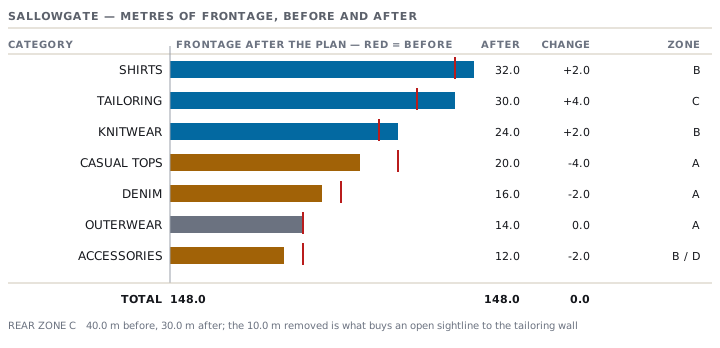
Three things about that table are worth saying out loud, because none of them is visible in it.
First: the shop gains no metres. Every one of the 148 is still there. This is a reallocation, and the changes add up to zero because they must.
Second: the rear loses ten metres of frontage, and that is the point. Zone C goes from 40 metres to 30. The three accessory gondola ends — 8.4 metres of the 14 — are the fixtures standing across the sightline from gate 1 to the suit wall. Taking them out buys a clear view of tailoring from the middle of the shop, and that view is the only mechanism in the plan for raising rear penetration. Open floor is bought with frontage. It is not free, it does not appear on any range plan, and it is the thing a plan drawn to maximise metres will never do.
Third: accessories must work harder just to stand still. Twelve metres have to produce the GBP 61,440 that fourteen produced, which means the rate has to rise from GBP 84.40 to GBP 98.46 a metre-week — up 16.7% — before the plan earns anything at all.
Check yourselfKnitwear gains two metres. What are you entitled to assume it will earn on them, and why is that different from the loss you charged casual tops?Show the answer
You are entitled to assume nothing. Course 18.6 makes the general point on a bedlinen fixture and it holds here. An added facing sells less than the one before it, because most of what it adds is availability rather than visibility. And there is no rate in any of these tables that tells you how much less. The asymmetry is deliberate. Coldstrand charges the full identified loss on the metres removed and claims zero on the metres added, so the appraisal cannot flatter itself with an assumption. What the added metres are actually for is size availability and rate of sale. Knitwear runs at 3.38 units a metre-week, and the two extra metres are there so the mid-sizes are on the fixture on a Saturday afternoon. That is a real benefit; it is just not one you may put a number on in a payback.
Prompt · Stress-test my frontage allocation
When you have a before-and-after plan and you want the holes in it found before the meeting finds them.
Here is a frontage allocation for one store, before and after: [paste the category table with metres, zone, sales, gross margin percentage and units for each category, plus your zone traffic counts].

Review it as a sceptical space planner:
1. Rebuild my three denominators and check my arithmetic: gross margin a metre-week, units a metre-week, and gross margin a metre-week per thousand shoppers passing that zone.
2. Tell me which categories change rank between those columns, and what each ranking is actually good for.
3. Find any place where I have applied a zone's rate to a different zone's traffic. That is the commonest error in this exercise, and I want it named explicitly if I have made it.
4. For every category I have MOVED, ask me what share of its sales is attachment — bought in a basket with a neighbouring category — and what share is standalone. Then tell me what the split implies for where it should sit.
5. Check that the metres add up to the same total before and after. If they do not, tell me what capital spend the difference implies.
6. Charge me the full identified loss on every metre I removed, and claim nothing on any metre I added. Show me the plan's net position under that rule.

Be blunt about anything I have assumed rather than measured.
AI can make mistakes — check anything you act on.