Lessons · Lesson 2 of 3
The sort order is an allocation
Price a change of default sort order the way you would price a range decision. What does the ranking rule actually weigh, what did it move, and what are you entitled to conclude from a change made live?
Lesson 2 of 3 · 44 min
What "Newest first" had done by week four
Every online shop has to show its goods in some order. Most shops inherited that order from whoever built the site, rather than choosing it. Changing it is not a design tweak. It decides which garments get the good places and which get the poor ones. It is taken for a whole catalogue at once, by a line of arithmetic that nobody signs. This lesson follows one such change, from the rule to what happened to the garments.
Marchbourne's Dresses page had always defaulted to Newest first. Nobody chose it. It came with the platform, and for years it was defensible: a new arrival is the thing a returning customer has not seen.
By the end of week 4 of the phase it had become something else. Piers's 48 extra styles had landed across weeks 3, 4 and 5, and a sort by landing date sent them straight to the top. Of the top 24 positions on 3 October 2027, 21 were styles that had been live for fewer than fifteen days. The dresses that were actually selling had been pushed down the grid by nothing but the calendar.
Nerys changed the default in week 5. She was right to. The rest of this lesson is about what the change cost and earned, not about whether she should have made it.
A weighted rank is an allocation, and nobody signs it off
The replacement was a trading score. One number per style, recomputed every night from a rolling fourteen-day window, with the page sorted by that number, highest first.
score = 0.2 × units index + 0.5 × conversion index + 0.3 × urgency index
Each component is indexed against the best dress in the department over the same window. So 100 is the department's best, and everything else is a percentage of it. In the fourteen days to 3 October 2027 those departmental maxima were 88 units a week, a conversion of 9.10%, and a lowest weeks-of-cover of 4.8. Weeks of cover is how many weeks the stock on hand would last at the current rate of sale. Urgency is cover turned upside down: a style with 4.8 weeks of cover scores 100, and one with twice that cover scores half.
Stop and look at what those three weights are.
They are a buy. The page has 148 positions, and later 196. The first twelve are worth 44.0% of the clicks. This one line of arithmetic decides which styles stand in them for the rest of the phase. It reallocates more gross margin in a week than most single range decisions do in a season. And unlike a range decision, it went through no range meeting, no sign-off and no minute. Two people set it at a desk, and they chose the weights because they felt about right.
The six styles, and what the score made of them
| Style | Rank, week 4 | Clicks a week | Units a week | Conversion | Weeks of cover | Units index | Conversion index | Urgency index | Score |
|---|---|---|---|---|---|---|---|---|---|
| MBN-227 Ferrensby | 4 | 1,920 | 58 | 3.02% | 9.6 | 65.91 | 33.19 | 50.00 | 44.78 |
| MBN-372 Pentlow | 9 | 1,920 | 52 | 2.71% | 14.0 | 59.09 | 29.78 | 34.29 | 37.00 |
| MBN-289 Ombersley | 15 | 830 | 25 | 3.01% | 12.0 | 28.41 | 33.08 | 40.00 | 34.22 |
| MBN-214 Quenington | 22 | 830 | 38 | 4.58% | 5.5 | 43.18 | 50.33 | 87.27 | 59.98 |
| MBN-360 Glaisdale | 63 | 142 | 12 | 8.45% | 7.0 | 13.64 | 92.86 | 68.57 | 69.73 |
| MBN-431 Bickerstaffe | 88 | 142 | 6 | 4.23% | 22.0 | 6.82 | 46.48 | 21.82 | 31.15 |
Work one line, so the rest are checkable. Glaisdale sold 12 a week out of 142 clicks a week. Its conversion is 12 ÷ 142 = 8.45%. Against a departmental best of 9.10%, that indexes at 92.86. Its units index is 12 ÷ 88 = 13.64, and its urgency is 4.8 ÷ 7.0 = 68.57. Score = 0.2 × 13.64 + 0.5 × 92.86 + 0.3 × 68.57 = 69.73. That is the highest of the six, and it belonged to the style with the fewest units and the least attention.
The ranks the score produced, applied on the night of Sunday 10 October 2027:
- Glaisdale, 63 to 3.
- Quenington, 22 to 11.
- Ferrensby, 4 to 31.
- Pentlow, 9 to 58.
- Ombersley, 15 to 79.
- Bickerstaffe, 88 to 104.
What actually happened
Week 6 was the first full week on the new sort. It was read against week 4, the last full week on the old one. The department did not stand still in between, so the reading needs a control.
A control set is a group of styles that were left alone, used to show what would have happened anyway. Marchbourne used the 71 dress styles whose rank moved fewer than five places. Their combined units went from 486 a week to 501 a week, which is 3.1% up. That index, 1.031, is what any style would have done without moving.
| Style | Rank | Clicks a week | Conversion | Units, week 4 | Expected, week 6 | Actual, week 6 | Position effect | GM a unit | GM a week |
|---|---|---|---|---|---|---|---|---|---|
| MBN-360 Glaisdale | 63 to 3 | 142 to 1,920 | 8.45% to 2.24% | 12 | 12.4 | 43 | plus 30.6 | GBP 36.58 | plus GBP 1,119.35 |
| MBN-214 Quenington | 22 to 11 | 830 to 1,920 | 4.58% to 5.00% | 38 | 39.2 | 96 | plus 56.8 | GBP 36.54 | plus GBP 2,075.47 |
| MBN-227 Ferrensby | 4 to 31 | 1,920 to 382 | 3.02% to 7.07% | 58 | 59.8 | 27 | minus 32.8 | GBP 47.40 | minus GBP 1,554.72 |
| MBN-372 Pentlow | 9 to 58 | 1,920 to 142 | 2.71% to 7.75% | 52 | 53.6 | 11 | minus 42.6 | GBP 27.00 | minus GBP 1,150.20 |
| MBN-289 Ombersley | 15 to 79 | 830 to 142 | 3.01% to 5.63% | 25 | 25.8 | 8 | minus 17.8 | GBP 29.89 | minus GBP 532.04 |
| MBN-431 Bickerstaffe | 88 to 104 | 142 to 65 | 4.23% to 4.62% | 6 | 6.2 | 3 | minus 3.2 | GBP 58.80 | minus GBP 188.16 |
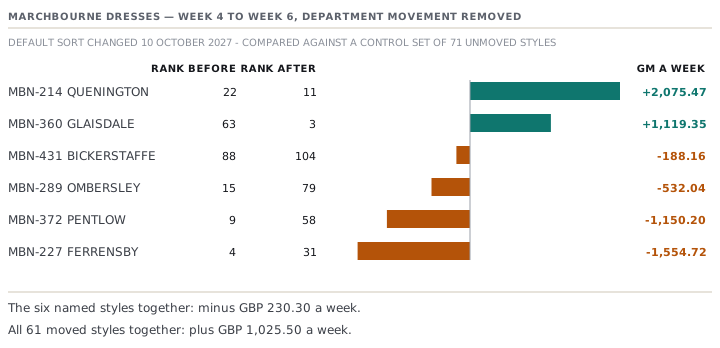
Three findings. The third is the one to take away.
Conversion is not a property of a style. Glaisdale went from 8.45% to 2.24% the moment it reached position 3. Ferrensby went from 3.02% to 7.07% on the way down to position 31. Nothing about either garment changed. Conversion is a property of the style and the position together, because position decides who is looking. At position 3 the click comes from everybody. At position 63 it comes from somebody who scrolled past sixty-two dresses to get there. So Nerys's argument — that conversion is free of position, and therefore a fair basis for ranking — is wrong in exactly the way that matters. A rule that ranks on conversion promotes styles whose conversion will fall once they are promoted.
The named six lost money. Add the last column: minus GBP 230.30 a week. Those are the six styles a human would have pulled up on a screen to check the change, and their sign is the opposite of the truth.
The whole moved set made money. Run the identical arithmetic over all 61 styles that moved five places or more. The net is plus 31.7 units a week, at a blended GBP 32.35 a unit, so plus GBP 1,025.50 a week. Held for the remaining 8 weeks of the phase, that is GBP 8,204.00.
Why this is weaker evidence than a shop's rotation test
Course 19.1 measures what a selling position is worth by rotating lines through positions on a schedule, so that every line sits in every position exactly once. Nothing here is that clean. It is worth being precise about why, because the temptation is to present the table above as though it were.
The treatment was assigned on the outcome. Rank was not allocated by a schedule. It was computed from units and conversion, which are the very things then measured. Styles that rose, rose because they were already selling well per click, and some of what they did next was that, not the move.
There is one reading per style, in one week. A rotation test gets a style into several positions and averages out the week. Here every style has one before and one after, so a style that simply had a good week reads as a position effect.
Position and score cannot be separated. Every promoted style was promoted because the score liked it. You cannot separate "this style was moved up" from "this style is the kind of style the score likes", because in this design they are the same set.
And you could not run 19.1's test even if you wanted to. In a shop the merchandiser assigns position directly: a rail goes where she puts it. On a page, position is generated by the rule, and the rule is the thing under test. To rotate styles through positions you would have to suspend the sort order for the duration, and that is itself a trading decision, on the real page, in the real season.
What you can do is the middle course Marchbourne took later in the phase, and it is the honest answer for a site: hold a slice of traffic on the old sort. Ten per cent of sessions keep the previous order, everybody else gets the new one, and the two are compared over the same weeks. It costs a little margin on the held-back slice. In return it removes both the week effect and the merit problem at a stroke. It is the only version of this measurement you should quote to a board.
The rule writes the evidence that the buyer reads
There is one more effect, and it is slow, so it goes unnoticed.
Ferrensby fell to position 31, and its units fell with it. Six weeks later, in the weekly trade meeting, Ferrensby appeared on the slow-sellers list, and it was marked down. Nobody in that meeting was wrong. On the report in front of them, the style had gone from 58 a week to under 30 and stayed there.
But the number they acted on was manufactured by the sort rule. The rule demoted the style. The demotion reduced the units. The units triggered the markdown. And the markdown will be recorded in next year's history as evidence about the style. A measure that is used to control a thing stops being a measure of that thing.
The protection is procedural, not clever. Any style whose rank has moved more than a stated distance is exempt from the slow-seller report until it has had a stated number of weeks in its new position. And the trade pack shows rank alongside units, so nobody reads one without the other. Marchbourne added both in week 11, after the Ferrensby markdown had already been taken.
Check yourselfA style has 6 clicks a week and sells 1 unit, giving a conversion of 16.67% — the highest in the department. Under Marchbourne's score, what happens, and what would you change?Show the answer
It indexes at 100 on the component carrying half the weight, so it is promoted into the top band on the strength of a single order. The fix is a minimum denominator. No style is eligible to be ranked on its own conversion until it has collected a stated number of clicks. Below that threshold it is ranked on the department average instead of its own rate. Marchbourne set the threshold at 400 clicks in the window. The level of the threshold is a judgement. Having one is not.
Check yourselfYour before-and-after shows a promoted style up 40% in units. The department as a whole was up 6% over the same two weeks. What is the position effect, and what have you still not controlled for?Show the answer
The expected units are the style's own before-figure times 1.06. So the position effect is the 40% less the 6% the style would have done anyway, roughly 34% of the before-figure. State it in units and gross margin rather than as a percentage. You have not controlled for merit. The style was promoted because the rule liked its recent trading, so part of the remaining rise is the trend that got it promoted in the first place. Only a held-back traffic slice removes that.
Prompt · Tell me what my sort change actually moved
After a default sort order or a ranking rule has changed, and before anybody claims the result.
My site changed the default sort order on a listing page. Help me read what it did, honestly.

For each style I will give you: its rank before and after, its clicks and units in the last full week on the old sort, and its clicks and units in the first full week on the new one. I will also give you a control set — styles whose rank barely moved — with their combined units before and after.

First compute the control index from that set, and state it. Then, for every style that moved, show expected units after (units before times the index), actual units, the difference in units, gross margin a unit, and gross margin a week. Total the moved set. Also show the conversion before and after for each style.

Then tell me four things plainly. One: whether conversion rose on demoted styles and fell on promoted ones, and what that implies about ranking on conversion. Two: whether the handful of styles I would have looked at by eye has the same sign as the whole moved set. Three: that the total number of clicks is fixed, so the gain is limited to moving the same clicks to better-converting styles, and what that ceiling is as a percentage. Four: which problems remain — assignment on the outcome, one reading per style, and position that cannot be separated from whatever the rule likes.

Do not present this as an experiment. If I want a defensible number, tell me to hold a slice of traffic on the old sort, and say why.
AI can make mistakes — check anything you act on.