Lessons · Lesson 2 of 3
Consumption from the marker, and the width that moved
Build a woven consumption from marker length, cuttable width and six named allowances. Then price what happens when a mill ships a different width from the one you costed.
Lesson 2 of 3 · 48 min
The situation
How much cloth a garment eats is not a guess. It is measured off a plan, and this lesson shows where that plan begins. The plan gives the honest minimum. Additions on top of it cover cloth that is destroyed on the way. The second half of the lesson is a warning about the field most likely to differ from your costing: the width. Narrower cloth weighs the same per square metre. So a mill can invoice honestly and still leave you short.
14 April, 07:15, the cutting floor at Nile Apparel. Style HB-4402, the Halberg shirt order from lesson 1: 24,000 pieces, FOB USD 7.90, fabric placed with Ravi Mills at USD 9.10 per kilo, 60 inch. The first eleven rolls are on the spreading table. The lay is planned at 60 plies — 60 layers of cloth spread on top of each other, cut in one pass. The cutting master has stopped at ply 41, because the marker will not fit on the cloth.
He measures the roll. It is 58 inch.
The invoice is correct. The packing list says 58 inch. The shipping advice said 58 inch. Nobody read any of the three, because the price per kilo did not change — and the fabric department checks prices. For eight weeks, everything that could have caught this said the truth in a unit nobody was watching.
By the end of today this order will have lost USD 11,790 — 56.5 percent of its margin. All of it comes out of two numbers you can compute before the fabric is ordered.
What a marker actually is
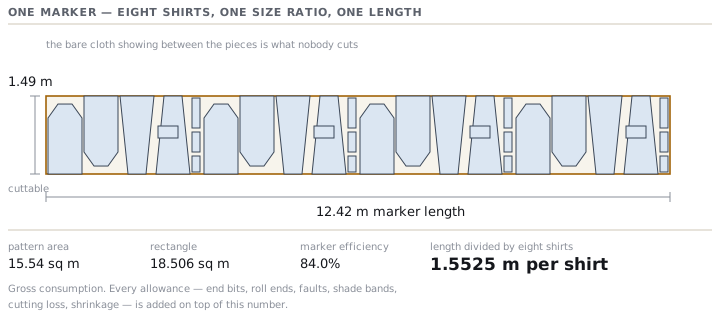
A marker is a scale plan of every pattern piece of one or more garments, laid inside a rectangle. The rectangle's width is the cuttable width of the fabric. The plan is printed full-size, laid on top of the spread, and cut through. The rectangle's length is the marker length. It is the only measurement that turns pattern pieces into metres of cloth.
The marker for HB-4402 was made for Ravi's 60 inch cloth, so at 1.49 m cuttable. It contains 8 shirts, in the size ratio one S, two M, two L, two XL, one XXL. Its length came out at 12.42 m.
gross consumption per garment = marker length ÷ garments in the marker
12.42 ÷ 8 = 1.5525 m per shirt
That is the whole calculation. Everything else in this lesson is an adjustment to it.
Efficiency tells you whether the marker is any good
Give two marker makers the same patterns and the same width, and they will not produce the same length. The number that says who did better is marker efficiency: the area actually covered by pattern pieces, as a fraction of the rectangle.
marker efficiency = total pattern area ÷ (marker length × cuttable width)HB-4402's pattern set is 15.54 m² for the eight shirts. The rectangle is 12.42 × 1.49 = 18.506 m². So efficiency is 15.54 ÷ 18.506 = 0.840, which is 84.0 percent. Sixteen percent of the cloth is cut away as the gaps between pieces. That is normal. A shirt marker lands between 82 and 87 percent. A trouser marker lands higher. A heavily curved or one-way-print garment lands lower.
Efficiency matters commercially because it is the only lever on this page that is free. One point of efficiency on this order is 1.5525 ÷ 0.84 × 0.01 = 0.0185 m per shirt. On 24,000 shirts at USD 1.664 per metre, that is USD 739. Two marker makers, three hours, no capital.
The six allowances, named
The marker gives you the cloth a perfect cut would use on a perfect roll. Neither exists. Most cost sheets deal with this by adding a blanket "5 percent". That is why most cost sheets are wrong in one direction on some orders and the other direction on others. The allowance is not one thing. It is six things, each with a different cause and a different owner.
| Loss | What it physically is | Owner | This order |
|---|---|---|---|
| End bits | 2 cm of cloth beyond the marker at each end of every ply, so the cutter has something to hold | Cutting | 0.3% |
| Roll ends | the last few metres of a roll, too short to make a full ply, left over | Fabric store | 1.2% |
| Fabric faults | holes, slubs, oil marks and shade bars cut around or spliced out | Mill | 1.0% |
| Shade-band segregation | rolls sorted into shade groups, so lays get shorter and each group leaves its own remnant | Dyehouse | 0.8% |
| Cutting loss | mis-cuts, damaged plies, panels re-cut for the sewing floor | Cutting | 0.5% |
| Shrinkage allowance | residual shrinkage after relaxation, added to the pattern or to the lay | Mill and finishing | 1.5% |
| Total | 5.3% |
Three of these are worth arguing about with somebody.
Fabric faults are measured, not guessed. Under the 4-point system, a fault up to 3 inches long scores 1 point, up to 6 inches scores 2, up to 9 inches scores 3, and anything longer — or any hole — scores 4. No single linear yard may score more than 4. Most buyers accept a roll at 20 points per 100 square yards and reject above 28. Ravi's inspection reports on this quality run at 17 to 19 points. That is where the 1.0 percent comes from. A mill running at 26 points is still inside the acceptance limit, and it will cost you nearer 2 percent. That difference belongs in the price you agree with them — not in a surprise at the end of the order.
Shade-band segregation is the one people forget. A dye house does not produce one colour. It produces a batch of rolls that a light box sorts into two, three or four shade groups. Each group must be cut as its own lay, because a shirt with a front panel from group A and a sleeve from group B is a major defect. Three shade groups means three sets of roll ends instead of one.
Shrinkage is an allowance only for what remains after finishing. If the mill pre-shrinks the cloth to a residual 1 percent, and the tech pack tolerates 3 percent, the allowance can come down. If the fabric is not pre-shrunk at all, this line can be 4 percent on its own — and then it belongs in the pattern, not in the booking.
booked consumption = gross consumption × (1 + total allowance)
1.5525 × 1.053 = 1.635 m per shirt
Check yourselfYour marker gives 2.31 m per garment and your six allowances total 6.4 percent. What do you book, and what is the total for 9,000 pieces?Show the answer
Booked consumption is 2.31 × 1.064 = 2.458 m per garment. So the booking is 2.458 × 9,000 = 22,122 m. The one thing you must not do is book 2.31 and tell the fabric store to manage. The allowance is not a safety cushion. It is cloth that will physically be destroyed. A store told to make 2.31 work will start splicing across shade groups.
The booking, and the cost per garment
fabric booking = booked consumption × order quantity
1.635 × 24,000 = 39,240 m
At Ravi's USD 1.664 per metre — lesson 1's conversion of USD 9.10 per kilo at 60 inch — the fabric line on the cost sheet is:
fabric cost per garment = booked consumption × price per metre
1.635 × 1.664 = 2.72 USD per shirt
Going the other way is the same equation rearranged. You will need it every time a buyer asks you to hold a price and a mill raises theirs. 2.72 ÷ 1.635 = 1.664 USD per metre is the highest fabric price this cost sheet can carry. Divide again by the kilograms per metre and you have the ceiling in the mill's own unit: 1.664 ÷ 0.1829 = 9.10 USD per kilo. Now you can negotiate in the unit they think in.
Prompt · Audit a woven consumption before it becomes a booking
The day a consumption sheet arrives from the marker room and before the fabric purchase order is cut, when the number looks plausible and nobody can say what is inside it.
Act as a senior garment merchandiser auditing a fabric consumption before a purchase order is placed. Style [STYLE], buyer [BUYER], order quantity [QTY] pieces, FOB [PRICE], size ratio [PASTE THE RATIO]. The marker room has given me: marker length [LENGTH] m, garments in the marker [NUMBER], cuttable width [WIDTH] m, total pattern area [AREA] square metres if known. The fabric is [WEIGHT] GSM, nominal width [WIDTH], quoted at [PRICE AND UNIT]. The proposed allowance is [PERCENT OR THE LINE ITEMS]. Do this. First, compute gross consumption per garment from the marker and the marker's efficiency, and tell me whether that efficiency is normal for this garment type and this fabric — say explicitly whether the marker is one-way or two-way and whether a check or stripe repeat is being matched. Second, break the allowance into the six named losses — end bits, roll ends, fabric faults, shade-band segregation, cutting loss and shrinkage allowance — give me a defensible number for each on THIS order with the reason, and say which ones I should be negotiating with the mill rather than absorbing. Third, give the booked consumption, the total booking in metres, the fabric cost per garment and the fabric cost as a percentage of FOB. Fourth, work out the highest price per metre and per kilo this cost sheet can carry without breaking the margin. Fifth, list what is NOT in this number and should be: sample and size-set yardage, replacement cutting, and any shade-band or colour minimum. Flag anything you had to assume rather than read from what I gave you.
AI can make mistakes — check anything you act on.
The width that moved
Ravi shipped 58 inch. The marker was made for 1.49 m cuttable. The cloth gives 1.44 m.
Consumption moves almost exactly inversely with cuttable width. The pattern area does not change, and the achievable efficiency does not change. The marker maker simply re-lays the same pieces into a narrower rectangle, and the rectangle has to get longer.
new consumption = old consumption × (old cuttable width ÷ new cuttable width)
1.635 × (1.49 ÷ 1.44) = 1.635 × 1.035 = 1.692 m per shirt| Nominal width | Cuttable | Consumption index | HB-4402 per shirt |
|---|---|---|---|
| 44 inch | 1.09 | 1.367 | 2.235 m |
| 58 inch | 1.44 | 1.035 | 1.692 m |
| 60 inch | 1.49 | 1.000 | 1.635 m |
| 63 inch | 1.57 | 0.949 | 1.552 m |
That index is an estimate, good to about half a point. It fails completely across a width band that changes how many garments fit side by side. On a wide-panel garment, going from 1.44 m to 1.49 m may fit nothing extra, while 1.57 m fits a whole extra front panel and saves far more than 0.949 suggests. Use the index to answer today. Re-mark before you book.
Now the part that explains why nobody caught this.
fabric cost per shirt at 60 inch: 1.635 × 1.664 = 2.72 USD
fabric cost per shirt at 58 inch: 1.692 × 1.609 = 2.72 USD
The price per metre at 58 inch is 9.10 × 0.1768 = 1.609 USD — lower than at 60 inch, because there is less cloth in a metre. The cost per shirt did not change. When you buy by weight, width has almost no effect on price, because a garment consumes an area and an area has a fixed weight. Every commercial check in the building — the invoice, the price per kilo, the cost sheet's fabric line — looked exactly right.
What changed is the number of metres. And the purchase order was written in metres.
metres required at 58 inch: 1.692 × 24,000 = 40,608 m
metres purchased:                             39,240 m
shortfall:                                      1,368 m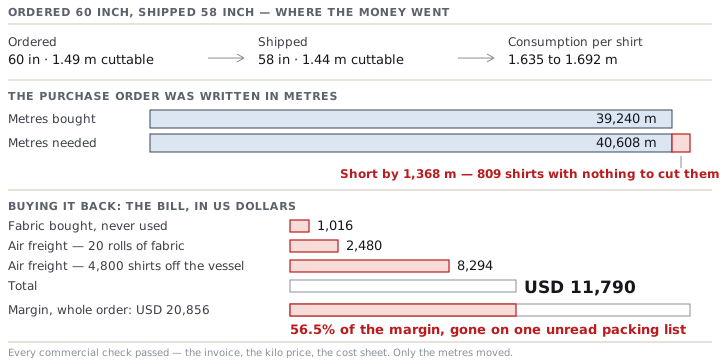
What it cost
The shortfall is 3.5 percent, and 3.5 percent of a fabric booking is not a rounding error. It is 809 shirts with nothing to cut them from.
Ravi's reorder minimum on this quality is 2,000 m. Their sea lead time is 24 days, against a 3 June vessel. The order went by air.
| Line | Working | USD |
|---|---|---|
| Fabric bought and never used, 632 m | 632 × 0.1768 = 111.7 kg at USD 9.10 | 1,016 |
| Air freight, Izmir to Cairo, 20 rolls | chargeable 800 kg at USD 3.10 | 2,480 |
| Air freight, 4,800 shirts that missed the vessel | 120 cartons, 1,536 kg at USD 5.40 | 8,294 |
| Total | 11,790 |
The fabric air freight is the line people get wrong. Twenty rolls of 100 m weigh 100 × 0.1768 = 17.7 kg each, so 354 kg in total. That is not what you pay for. Each roll ships in a box of 150 by 40 by 40 centimetres, which is 240,000 cubic centimetres. Airlines charge by volumetric weight: the box volume divided by 6000. So 240,000 ÷ 6000 = 40 kg per roll, and twenty rolls is 800 kg chargeable against 354 kg actual. Fabric on a roll is mostly air, and it is charged as if it were not. The shirt cartons behave the same way: 40 shirts weighing 10 kg are charged at 12.8 kg.
Against a margin of 189,600 × 0.11 = 20,856 USD, the total is 56.5 percent of everything this order was going to earn — 49 US cents on a shirt whose entire margin is 87 cents.
Prompt · Price a width or construction substitution before you accept it
The hour a mill tells you the width, the construction or the finish has changed, and you have to answer today without waiting for a new marker.
Act as a senior fabric sourcing manager. A mill has offered or already shipped a substitution and I must decide today. What was ordered: [WEIGHT] GSM, nominal width [WIDTH], cuttable [WIDTH], price [PRICE AND UNIT], quantity on the purchase order [QTY AND UNIT]. What is being offered or delivered: [PASTE THE MILL MESSAGE VERBATIM]. The order is [STYLE], [QTY] pieces, ship date [DATE], and the costed consumption is [CONSUMPTION] per garment. Cutting starts [DATE]. Do the following. First, restate the substitution in the units I did NOT order in, so I can see whether the price per kilo, per metre and per cuttable square metre each rise, fall or stay flat — and say plainly which of my documents would have caught this and which would not. Second, estimate the new consumption using the cuttable width ratio, state the estimate's error band, and say explicitly that a re-made marker is required before booking. Third, compute the shortfall or surplus against the quantity already on the purchase order, in the unit the order is written in, and convert it into garments that cannot be cut. Fourth, price the recovery: the balance fabric at the mill's minimum reorder quantity, the sea and air lead times against my ship date, air freight on the fabric using VOLUMETRIC weight not actual, and air freight on any finished garments that will miss the vessel. Give me the total in dollars and as a percentage of the order's margin. Fifth, draft the four-line reply I should send the mill today, stating what I accept, what I do not, and what I expect them to carry.
AI can make mistakes — check anything you act on.
Check yourselfA mill offers 63 inch instead of the 58 inch you costed, at the same price per kilo. Are you better off?Show the answer
Yes, but not where you think. Consumption falls from 1.692 to about 1.552 m per shirt, so you need roughly 8 percent fewer metres. Cost per shirt barely changes, because you pay by weight and the area a shirt consumes has not moved. The gain is in everything that scales with metres: fewer rolls to inspect, fewer roll ends, shorter lays. Check one thing first — that your spreading table takes 1.57 m of cloth. A width your equipment cannot handle is not a saving.