Lessons · Lesson 3 of 3
Knits are bought by weight
Calculate a knit consumption from the dozen weight, correct it for the size ratio that will actually ship, and turn an order quantity into a fabric booking quantity.
Lesson 3 of 3 · 42 min
The situation
Knitted cloth is ordered in kilograms, so its consumption must end in a weight. This lesson builds that figure from the garment's own measurements, then adds the losses. Its real subject is the error hiding inside any single consumption figure. The sum is done on one size. An order has several sizes, and a bigger garment takes more cloth. A sheet with no column for the size mix is quietly short — and always in the same direction.
22 September, 08:30, a knitting and dyeing unit at 10th of Ramadan City. Style FL-220 for the American brand Fairlane: 18,000 men's short-sleeve tees, single jersey, 100 percent combed cotton, FOB USD 4.15, order value USD 74,700. The fabric was booked eleven weeks ago: 4,134 kg of 180 GSM jersey at USD 6.85 per kilo.
The dyeing supervisor has just told the merchandiser that the last colour is short. Not short by a roll — short by 421.5 kg, which is 10 percent of the whole booking. And nothing about the fabric, the machine or the dyeing is wrong. The booking was calculated correctly, from the wrong garment.
The wrong garment was a size M.
Why the knit trade buys weight and the woven trade buys length
A woven fabric's width is set by the reed and the stenter, and it holds to a centimetre or two. So a metre of it is a reliable quantity. A knitted fabric's width follows the machine diameter, the stitch length, how the fabric relaxed and how the finishing range pulled it. And it moves. The same quality can arrive at 1.78 m on one batch and 1.84 m on the next, at the same GSM. Buy jersey by the metre, and you have bought a quantity the finishing range can change after you agreed it.
What does not move is the weight of yarn in the cloth. So the knit trade quotes, books, invoices and claims in kilograms. Every knit consumption calculation ends in kilograms, even when the garment is costed in dollars per piece.
The dozen weight
Knit consumption is calculated per dozen — per twelve pieces — not per piece. The reason is practical, not traditional: the numbers get large enough to read. A tee that consumes 0.2137 kg is a number people mistype. The same tee at 2.564 kg per dozen is not.
The standard method takes the garment's own measurements and treats it as two flat rectangles — a front and a back — big enough to contain it.
kg per dozen = (body length + sleeve length + allowance)
             × (half chest + allowance)
             × 2 × 12 × GSM ÷ 10,000,000
The 2 is the two panels. The 12 is the dozen. The divisor converts square centimetres and grams into square metres and kilograms. The two allowances are where the judgement lives. The length allowance covers the hem, the shoulder seam, the neck drop and the shrinkage the mill has left in. It runs 8 to 14 cm on a tee. The width allowance covers the side seams and the armhole shaping. It runs 3 to 6 cm.
FL-220's size M measures: body length 72 cm, sleeve length 22 cm, half chest 52 cm. The technician uses 12 cm on length and 4 cm on width.
(72 + 22 + 12) × (52 + 4) × 2 × 12 × 180 ÷ 10,000,000
= 106 × 56 × 2 × 12 × 180 ÷ 10,000,000
= 2.564 kg per dozen
Per piece that is 2.564 ÷ 12 = 0.2137 kg — 214 grams of fabric in and around one tee.
Check it against the area, always. At 180 GSM, 0.2137 kg is 0.2137 ÷ 0.180 = 1.187 square metres of cloth per tee. At an open width of 1.80 m, that is 1.187 ÷ 1.80 = 0.660 linear metres. If those three numbers do not agree with each other, one of your allowances is wrong. Finding that out here costs nothing.
Check yourselfA 220 GSM interlock polo: body length 74 cm, sleeve 24 cm, half chest 56 cm, allowances 13 cm and 5 cm. What is the dozen weight?Show the answer
(74 + 24 + 13) × (56 + 5) × 2 × 12 × 220 ÷ 10,000,000, which is 111 × 61 × 2 × 12 × 220 ÷ 10,000,000 = 3.575 kg per dozen, or 0.298 kg per polo. Check it makes sense: 0.298 ÷ 0.220 = 1.355 square metres. That is more cloth than the tee — as it should be, for a heavier, longer, wider garment with a collar. A dozen weight that comes out lighter than the tee would mean an arithmetic error, not a lighter polo.
The process allowance
The dozen weight is the cloth in and immediately around the garment. Getting it from a roll into a finished tee costs more. As in lesson 2, the honest way to carry that cost is line by line.
| Loss | What it is | This order |
|---|---|---|
| Cutting loss | the gaps between pattern pieces, end bits, mis-cuts | 3.0% |
| Fabric faults and rejected rolls | needle lines, holes, barré, oil marks | 2.0% |
| End bits and roll ends | short lengths left when a roll runs out mid-lay | 1.5% |
| Shade-band segregation | rolls split into groups, so each group leaves a remnant | 1.0% |
| Total | 7.5% |
Cutting loss is larger here than the 5.3 percent total in lesson 2. That is because the dozen-weight method already assumes a perfectly efficient rectangle, so the marker's own gaps land in this line instead. Two methods, the same physical cloth, the allowance sitting in a different place. This is exactly why an allowance copied from a woven cost sheet onto a knit one is meaningless.
booked dozen weight = 2.564 × 1.075 = 2.756 kg
fabric booking      = 2.756 × 1,500 dozen = 4,134 kg
fabric per piece    = 2.756 × 6.85 ÷ 12 = 1.573 USD
That is the booking on the desk on 22 September. Every step of it is arithmetically correct.
The size ratio, which is where it went wrong
The dozen weight was calculated on a size M. Fairlane's order is not made of size M.
Run the same formula at each size — the tee grades 2 cm on body length and 2.5 cm on half chest per size — and the weights spread a long way.
| Size | Body length | Half chest | kg per dozen |
|---|---|---|---|
| S | 70 | 49.5 | 2.404 |
| M | 72 | 52 | 2.564 |
| L | 74 | 54.5 | 2.729 |
| XL | 76 | 57 | 2.899 |
| XXL | 78 | 59.5 | 3.072 |
From S to XXL the weight rises by 28 percent. That is not a rounding band you can average away by picking the middle size. Picking the middle is not even neutral, because the formula multiplies two graded dimensions together — so the weight grows faster than the sizes do.
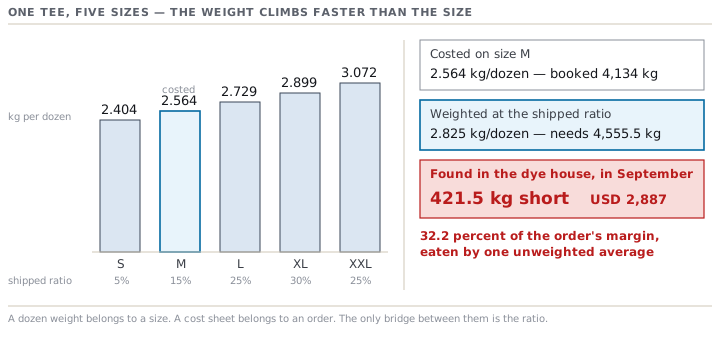
weighted dozen weight = sum of (size ratio at each size × dozen weight at that size)A perfectly symmetric ratio — 10 percent S, 25 M, 30 L, 25 XL, 10 XXL — comes out at 2.732 kg per dozen. That is already 6.6 percent above the size-M figure. And Fairlane's ratio is not symmetric. It is a US order:
5% S, 15% M, 25% L, 30% XL, 25% XXL
= 0.05×2.404 + 0.15×2.564 + 0.25×2.729 + 0.30×2.899 + 0.25×3.072
= 2.825 kg per dozen
2.825 ÷ 2.564 = 1.102. The cost sheet is 10.2 percent light on fabric, on an order where fabric is nearly half the FOB price.
| Costed on size M | At the shipped ratio | |
|---|---|---|
| Net dozen weight | 2.564 kg | 2.825 kg |
| Plus 7.5% process allowance | 2.756 kg | 3.037 kg |
| Fabric for 1,500 dozen | 4,134 kg | 4,555.5 kg |
| Fabric cost per piece | USD 1.573 | USD 1.734 |
The shortfall is 4,555.5 - 4,134 = 421.5 kg, worth 421.5 × 6.85 = 2,887 USD. Against an order margin of 74,700 × 0.12 = 8,964 USD, one unweighted average has eaten 32.2 percent of the margin — 16 US cents a tee.
From order quantity to booking quantity
The last step is the one people skip. It is where a booking stops being a simple multiplication. The booking quantity is what you put on the purchase order, and it is bigger than the consumption for reasons that have nothing to do with the garment.
The biggest reason is the shade lot. A dye house cannot economically run less than a machine load. This dyer's minimum is 500 kg per colour per lot. FL-220 runs six colours.
| Colour | Pieces | Fabric required | Booked |
|---|---|---|---|
| White | 5,400 | 1,366.6 kg | 1,366.6 kg |
| Navy | 4,200 | 1,063.0 kg | 1,063.0 kg |
| Heather grey | 3,300 | 835.2 kg | 835.2 kg |
| Olive | 2,400 | 607.4 kg | 607.4 kg |
| Rust | 1,500 | 379.6 kg | 500.0 kg |
| Sand | 1,200 | 303.7 kg | 500.0 kg |
| Total | 18,000 | 4,555.5 kg | 4,872.2 kg |
The two small colours drag 316.7 kg of unwanted fabric onto the booking, worth USD 2,169. That is not waste, and it is not an error. It is the price of running six colours on an 18,000-piece order — and it is a fact the merchandiser should have carried into the costing meeting. Every commercial answer is available at that meeting, and none of them is available in September. Drop a colour. Move the two smallest colours to a shared base fabric. Raise their minimum quantities in the offer. Or price the surplus into those two colours.
So the booking is 4,872.2 kg for 18,000 tees. That is 4,872.2 ÷ 18,000 = 0.2707 kg a piece, against a net garment content of 0.2137 kg. The booking is 26.7 percent heavier than the garments. Fabric spend is 4,872.2 × 6.85 = 33,375 USD — 44.7 percent of the order's FOB value.
Check yourselfYour consumption sheet says 2.9 kg per dozen and your fabric store reports actual usage of 3.3 kg per dozen at the end of the order. Where do you look first?Show the answer
At the size ratio, before anything else. It is the only one of the usual causes that is fully knowable in advance — and therefore the only one that is entirely your own fault. 3.3 ÷ 2.9 = 1.138 — a 13.8 percent overrun is too big for cutting loss alone, and it is about the size a large-skewed ratio produces on its own. Then look at the two things you can measure: the actual GSM of the delivered fabric against the specified GSM, and the delivered width against the width the marker assumed. A fabric delivered at 190 GSM against a 180 GSM spec is 5.6 percent heavier, and every kilo of it is on your booking.
Prompt · Build a knit fabric booking from the ratio, not from the sample size
Before a knit fabric purchase order is placed, when the consumption came from one dozen weight calculated on the size the sample was made in.
Act as a senior knit merchandiser building a fabric booking. Style [STYLE], buyer [BUYER], [QTY] pieces, FOB [PRICE], fabric [WEIGHT] GSM [CONSTRUCTION] at [PRICE] per kilo, open width [WIDTH] m. Size measurements from the tech pack, every size, not just the sample size: [PASTE BODY LENGTH, SLEEVE LENGTH AND HALF CHEST FOR EACH SIZE]. Size ratio as ordered: [PASTE]. Colour split in pieces: [PASTE]. The dye house minimum shade lot is [KG] kg and the process allowance we normally use is [PERCENT]. Do this. First, compute the dozen weight for EVERY size using the standard formula, showing the length and width allowances you used and justifying them for this garment. Second, compute the ratio-weighted dozen weight and tell me by how many percent it differs from the sample size's dozen weight — this is the number I am here for. Third, cross-check the per-piece weight against the area at this GSM and against linear metres at this open width, and tell me if the three disagree. Fourth, apply the process allowance as named line items rather than one percentage. Fifth, build the booking colour by colour, apply the shade lot minimum, and show me the surplus kilos and what they cost. Sixth, if the buyer nominates yarn, convert the fabric booking into a yarn booking using a stated process loss and say what loss you assumed. Finish with one line: booking in kilos, fabric cost per piece, fabric as a percentage of FOB, and the single biggest risk in the number.
AI can make mistakes — check anything you act on.