Lessons · Lesson 1 of 3
Two units, one fabric
Convert between GSM and ounces, and between price per metre and price per kilo. Then reduce two mill quotes written in different units to one number you can compare.
Lesson 1 of 3 · 45 min
The situation
Two mills quote the same cloth, and the two offers look nothing alike. One states grams and a price by the metre. The other states ounces and a price by the kilo. The usual answer is to ask both mills to quote again in matching units. That costs days, and it is not needed. This lesson does the conversions instead. It ends on the one figure that says which offer is really cheaper.
11 February, 09:40, a merchandising office in Cairo. Nile Apparel is costing style HB-4402 for the German retailer Halberg: 24,000 men's long-sleeve poplin shirts, FOB USD 7.90, order value USD 189,600, on board 3 June. The meeting has been running an hour. It is stuck on one line of the cost sheet — the line that is 35 percent of the garment. Fabric.
Two mills have quoted. Here is exactly what they wrote.
- Denizli Tekstil, Turkey — 120 GSM carded cotton poplin, 58 inch, USD 1.65 per metre.
- Ravi Mills, Faisalabad — 3.54 oz poplin, 60 inch, USD 9.10 per kilo.
The merchandiser's first thought is that these cannot be compared. So somebody suggests asking both mills to requote in the same unit. That request costs four days, and it is not needed. The two quotes are for the same fabric. By the end of this lesson you can say which one is cheaper, by how much, and what that is worth on 24,000 shirts.
Every fabric number in the trade is one of four things: a weight per unit area, a width, a weight per unit length, or a price. Simple arithmetic connects all four. You can do it on a phone. The merchandiser who does it in the meeting is the one who negotiates.
Where 33.906 comes from
A fabric's weight is quoted per unit of area, because area is what a garment uses up. The metric world says grams per square metre — GSM. The American and denim world says ounces per square yard — oz/yd².
The bridge is one constant.
GSM = oz/yd² × 33.906
oz/yd² = GSM ÷ 33.906
The constant is not magic. Derive it once and you will never mistype it. One ounce is 28.3495 grams. One yard is 0.9144 metres, so one square yard is 0.9144 × 0.9144 = 0.836127 square metres. So one ounce per square yard is 28.3495 ÷ 0.836127 = 33.906 grams per square metre.
| oz/yd² | GSM | Where you see it |
|---|---|---|
| 3.5 | 119 | fine cotton poplin shirting |
| 4.5 | 153 | heavier shirting, light twill |
| 5.5 | 186 | single jersey tee |
| 7.0 | 237 | interlock, heavy jersey |
| 12.0 | 407 | mid-weight denim |
| 14.5 | 492 | rigid denim |
So Ravi Mills' 3.54 oz is 3.54 × 33.906 = 120.0 GSM. The two mills have quoted the same fabric weight. That is the first thing the meeting did not know.
Going the other way uses the same constant. A 180 GSM single jersey is 180 ÷ 33.906 = 5.31 oz/yd². When an American buyer's tech pack asks for a 5.3 oz jersey and your knitter works in GSM, that is the sentence you send.
Width: the number that is not the number
A mill quotes a nominal width. It is almost never the width you can cut on. Along each selvedge — the woven edge of the cloth — runs a strip of denser, sometimes distorted fabric, with the pin marks of the stenter frame in it. No garment piece may be laid on that strip. What the marker maker can use is the cuttable width: the nominal width minus the selvedge loss. On a woven that loss is typically 2 to 4 centimetres in total. Take the number from a real roll, not from a quotation.
| Nominal | Centimetres | Metres | Cuttable |
|---|---|---|---|
| 44 inch | 111.76 | 1.1176 | 1.09 |
| 58 inch | 147.32 | 1.4732 | 1.44 |
| 60 inch | 152.4 | 1.524 | 1.49 |
| 63 inch | 160.02 | 1.6002 | 1.57 |
An inch is 2.54 centimetres. So 58 inch is 58 × 2.54 = 147.32 cm, and 60 inch is 152.4 cm. That difference — five centimetres of nominal width, and the same five centimetres of cuttable width — is the whole subject of lesson 2. It is where this order goes wrong.
Two traps live in this table. First: you pay for nominal width and you cut on cuttable width. The mill weighs and invoices the whole cloth, selvedge included. Second: knitted fabric is often quoted at a tubular width, which is the flattened tube. A 90 cm tubular is 180 cm open. Read a tubular width as an open width and your consumption is wrong by a factor of two. That mistake reaches a cutting floor about once a year somewhere.
From area to length: kilograms per linear metre
A fabric's weight is per square metre. A roll is sold by the linear metre or by the kilo. The bridge between the two is the width.
kg per linear metre = GSM × nominal width in metres ÷ 1000For Denizli's 58 inch cloth: 120 × 1.4732 ÷ 1000 = 0.1768 kg per metre. For Ravi's 60 inch cloth: 120 × 1.524 ÷ 1000 = 0.1829 kg per metre.
Note the width in that formula. It is the nominal width, not the cuttable one. You are converting between two things the mill sells — weight and length — and the mill sells the selvedge too.
Now the price converts in one step each way.
price per metre = price per kilo × kg per linear metre
price per kilo  = price per metre ÷ kg per linear metre
Denizli, quoted at USD 1.65 per metre, is 1.65 ÷ 0.1768 = 9.33 USD per kilo. Ravi, quoted at USD 9.10 per kilo, is 9.10 × 0.1829 = 1.664 USD per metre.
Check yourselfA knitter quotes 200 GSM interlock at USD 7.20 per kilo, open width 1.68 m. What is that per metre?Show the answer
Kilograms per linear metre is 200 × 1.68 ÷ 1000 = 0.336. Price per metre is 7.20 × 0.336 = 2.42 USD. Then do it the other way to check: 2.42 ÷ 0.336 = 7.20. If your two directions do not agree, you have used the cuttable width in one of them.
The two prices are the same price, until you look at what you cut
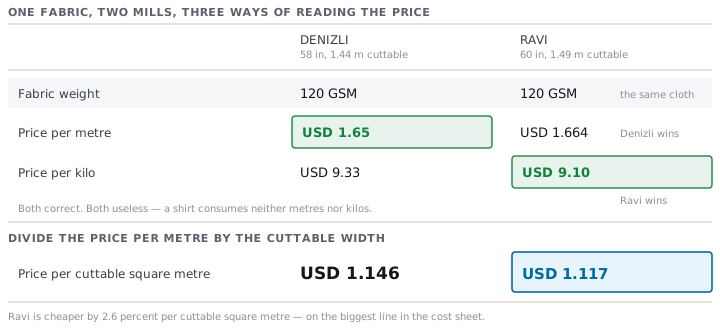
Put the two quotes side by side in both units. Something uncomfortable appears.
| Denizli, 58 inch | Ravi, 60 inch | |
|---|---|---|
| Weight | 120 GSM | 120 GSM |
| Nominal width | 1.4732 m | 1.524 m |
| Kg per linear metre | 0.1768 | 0.1829 |
| Price per metre | USD 1.65 | USD 1.664 |
| Price per kilo | USD 9.33 | USD 9.10 |
| Cuttable width | 1.44 m | 1.49 m |
| Price per cuttable square metre | USD 1.146 | USD 1.117 |
Read the two price rows against each other. Per metre, Denizli looks cheaper. Per kilo, Ravi looks cheaper. Both readings are correct arithmetic. Both are useless, because a shirt consumes neither metres nor kilos.
What a shirt consumes is cuttable area. So divide the price per metre by the cuttable width:
price per cuttable square metre = price per metre ÷ cuttable width in metresDenizli: 1.65 ÷ 1.44 = 1.146 USD. Ravi: 1.664 ÷ 1.49 = 1.117 USD.
Ravi is cheaper by 1.146 ÷ 1.117 = 1.026 — that is 2.6 percent, on the biggest line in the cost sheet. That is the answer the meeting needed. It took two divisions.
What it is worth on this order
The marker department will come back in lesson 2 with the consumption: 1.635 metres per shirt at 1.49 m cuttable, and 1.692 metres per shirt at 1.44 m cuttable. Wider cloth, shorter marker, fewer metres per garment.
Fabric cost per shirt at Denizli: 1.692 × 1.65 = 2.79 USD. Fabric cost per shirt at Ravi: 1.635 × 1.664 = 2.72 USD.
Seven cents. On 24,000 shirts that is 0.07 × 24,000 = 1,680 USD. The whole margin on this order, at 11 percent, is USD 20,856. So the fabric decision — made on a comparison nobody in the room could do at 09:40 — is worth 8 percent of the margin.
Nile Apparel placed the fabric with Ravi Mills at 60 inch. Hold that sentence. Lesson 2 is about what happened to it.
Check yourselfA mill offers 130 GSM poplin at USD 10.20 per kilo, 63 inch nominal, 3 cm selvedge loss. Is it cheaper than Denizli at USD 1.65 per metre, 58 inch, 120 GSM?Show the answer
Kilograms per metre is 130 × 1.6002 ÷ 1000 = 0.208. Price per metre is 10.20 × 0.208 = 2.122 USD. Cuttable width is 1.57 m, so cost per cuttable square metre is 2.122 ÷ 1.57 = 1.352 USD, against Denizli's 1.146. It is 18 percent dearer per square metre. But it is also a heavier cloth — 130 GSM against 120 — so the comparison is only fair if the buyer will accept either. Two fabrics of different weight are two different products. Compare their cost per square metre only after the tech pack says both are acceptable.
Prompt · Reduce every fabric quote to one comparable number
When quotes come in for the same fabric in different units — one per metre, one per kilo, one in ounces, all at different widths — and somebody has to say in the meeting which is cheapest.
Act as a senior fabric sourcing manager in a garment factory. I have several quotations for what is meant to be the same fabric and they are written in different units. Here they are exactly as the mills sent them: [PASTE EVERY QUOTE, ONE PER LINE, WITH MILL NAME, WEIGHT, WIDTH, PRICE AND UNIT]. The garment is [STYLE] and the buyer's fabric specification is: [PASTE THE SPEC FROM THE TECH PACK, INCLUDING WEIGHT AND ITS TOLERANCE]. The selvedge loss we measure on this construction is [CM] cm. Do the following, showing every step. First, restate every quoted weight in BOTH GSM and oz/yd², using 33.906 and saying so. Second, for each quote give the kilograms per linear metre, using the NOMINAL width, and the price in both USD per metre and USD per kilo. Third, give the cuttable width and the cost per cuttable square metre for each, and rank them on that number alone. Fourth, tell me which quotes are outside the buyer's weight tolerance and therefore not comparable at all. Fifth, name the single cheapest quote and say what it is worth against the second cheapest on an order of [QTY] pieces at a consumption of [CONSUMPTION] metres per garment. Do not average anything, do not round the conversion constant, and where a mill has quoted a tubular width say so explicitly and convert it to open width before using it.
AI can make mistakes — check anything you act on.